

The Wealth Building Secret through Mutual fund SIP
Today, many Indian families are planning for financial freedom. However, rising expenses, inflation, and lifestyle changes make saving difficult. This is where Mutual Fund SIP help common investors build wealth in long run and steadily.
A SIP, or Systematic Investment Plan, allows you to invest a fixed amount regularly in mutual funds. Even ₹500 per month can become meaningful wealth over time. Therefore, SIPs are becoming popular for all type of categories like salaried employees, business owners, and young professionals.
In Addition to, traditional saving methods, mutual fund SIP investing gives your money a chance to grow through market-linked returns. At the same time, it helps reduce emotional investing decisions during market ups and downs.
What is a Mutual Fund SIP ?
A Mutual Fund SIP is a simple investment tool where a particular fixed amount is automatically invested every month into a mutual fund scheme.
SIP helps us to invest fixed amounts regularly rather than making a large upfront investment at a time. As a result, investors can gradually build wealth without having pressure on their monthly budget.
For example, a salaried professional in Hyderabad may invest ₹3,000 every month through SIP. Over the years, this disciplined habit can help achieve goals like buying a home, child education, or retirement planning.
How It Works – The Mechanics of a Mutual fund SIP
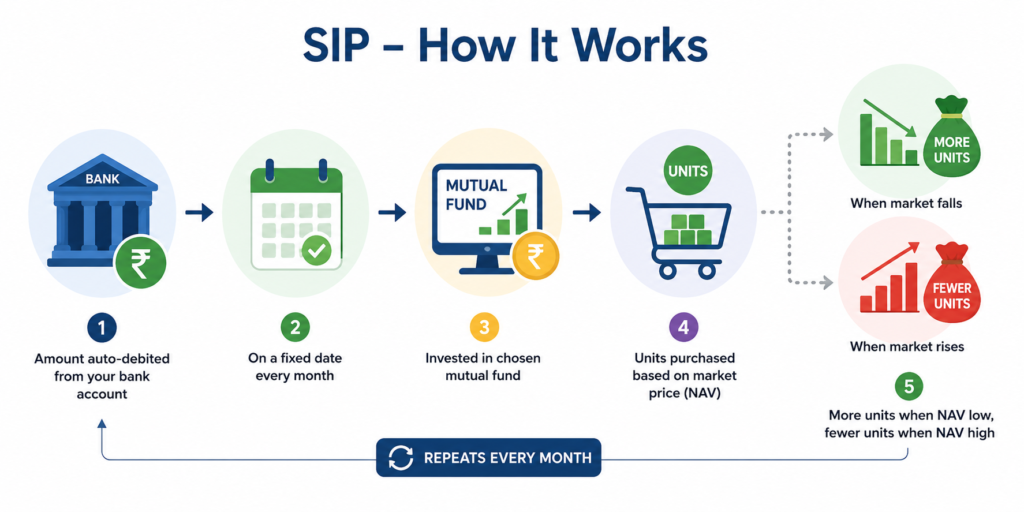
When you start a SIP through a mandate, the selected amount gets auto-debited from your bank account on a fixed date every month.
The invested amount buys mutual fund units based on the market price. When markets fall, you receive more units. When markets rise, you receive fewer units. Altogether, this balances out your average cost per share.
This systematic process makes investing easier for beginners who don’t understand market timing.
What is Rupee Cost Averaging?
Rupee Cost Averaging is one of the greatest advantages of mutual fund SIP investing.
Markets never move in one direction continuously. Sometimes markets rise sharply, while other times they fall due to economic events or global news.
With Mutual fund SIP investing, investors buy more units during market corrections and fewer units during expensive market phases. Therefore, the average investment cost becomes balanced over time.
This strategy reduces the stress of guessing the “right time” to invest.
The Magic of Compounding
In simple words, compounding means earning returns not only on your original investment but also on the returns already generated.
Compounding is often called the eighth wonder of wealth creation.
Suppose a 25-year-old investor starts a SIP of ₹5,000 per month and continues investing for 25 years with an average annual return of 12%. The accumulated wealth can become significantly large due to long-term compounding.
Investment Details
- Monthly SIP Amount: ₹5,000
- Investment Duration: 25 Years
- Expected Return: 12% annually
Wealth Creation After 25 Years
- Total Amount Invested: ₹15 Lakhs
- Estimated Wealth Created: ₹94–95 Lakhs
- Approximate Returns Earned: ₹79–80 Lakhs
This shows how a relatively small monthly investment can become nearly ₹1 Crore through the power of long-term compounding.
Therefore, starting early is important rather than investing huge amounts later.
Benefits of Mutual Fund SIP Investing
Pocket-Friendly Investing
Many people think investing requires lakhs of rupees. However, SIPs can start from just ₹500 monthly.
This makes mutual fund SIP investing affordable for students, salaried employees, freelancers, and small business owners across India.
Even small monthly savings can create meaningful wealth over the long term.
Financial Discipline
Regular Mutual fund SIP investing creates healthy financial habits.
Since the investment amount gets auto-debited, people gradually learn disciplined money management. Over time, this consistency becomes the foundation for financial security.
Moreover, disciplined investing helps avoid unnecessary spending habits.
Eliminating Market Timing
Most new investors wait endlessly for the “perfect market time.” Unfortunately, nobody can consistently predict markets accurately.
SIPs reduce this pressure because investments continue during both rising and falling markets. Therefore, investors stay focused on long-term goals instead of short-term market noise
Flexibility and Liquidity
SIPs are flexible and convenient.
Investors can increase, decrease, pause, or stop SIPs depending on their financial situation.
Most open-ended mutual funds also provide liquidity whenever funds are required. This flexibility makes SIPs suitable for different life stages and financial goals
SIP vs. Lumpsum Investing
When to Choose SIP
SIP investing works best for salaried individuals and beginners who receive monthly income.
It is also suitable during volatile market conditions because investments happen gradually over time.
For first-time investors, Mutual fund SIP reduces emotional decision-making and creates investing discipline.
When to Choose Lumpsum
Lumpsum investing may work better when investors receive a large amount through bonuses, property sales, inheritance, or business profits.
It can also be beneficial during major market corrections when valuations are attractive.
However, lumpsum investments require higher risk tolerance and market understanding.
| Feature | SIP (Systematic Investment Plan) | Lumpsum Investment |
| Investment Style | Invested monthly in small amounts | Invested all at once |
| Market Timing Risk | Lower risk due to staggered investing | Higher risk due to single entry point |
| Investment Cost | Average cost gets balanced over time | Entire amount invested at one market price |
| Market Volatility Impact | Less affected by short-term volatility | More affected by sudden market falls |
| Suitable For | Beginners and salaried investors | Experienced investors with surplus funds |
| Discipline | Encourages regular investing habit | Depends on one-time investment decision |
| Flexibility | Easy to start, pause, or increase | Requires large capital initially |
| Wealth Creation | Ideal for long-term wealth building | Can perform well during market corrections |
| Emotional Stress | Lower stress during market fluctuations | Higher stress due to market timing pressure |
| Advisor Recommendation | Recommended for beginners and long-term goals | Suitable for investors with higher risk appetite |
Importance of SIPs in Real Indian Life
In many Indian households, monthly expenses consume most of the income. Still, people dream about buying homes, funding education, and enjoying peaceful retirement.
A small SIP can slowly turn these dreams into achievable financial goals.
For instance, a middle-class family in Vijayawada may start SIPs for child education. Similarly, a young IT employee in Bengaluru may use SIPs for wealth creation and early retirement planning.
These practical situations show how SIP investing fits naturally into Indian financial lifestyles.
How to Start Your SIP Journey
Define Your Financial Goals
Before starting SIPs, identify your financial goals clearly.
Short-term goals may include vacations or emergency funds. Long-term goals may include retirement, wealth creation, or child education planning.
Clear goals help select the right investment strategy.
Know Your Risk Appetite
Every investor has different risk tolerance.
Young investors with stable income may choose equity mutual funds for higher growth potential. Meanwhile, conservative investors may prefer debt or hybrid funds.
Understanding risk helps avoid panic during market fluctuations.
Select the Right Fund Category
Choosing suitable mutual funds is extremely important.
Large-cap funds may provide stability. Mid-cap and small-cap funds may offer higher growth potential with increased risk. Hybrid funds contains both equity and debt exposure. Therefore, proper guidance helps investors choose funds matching their goals.

Complete the KYC Process
KYC, or Know Your Customer, is mandatory before investing in mutual funds in India.
The process usually requires PAN card, Aadhaar card, address proof, and bank details. Nowadays, many platforms provide fully online KYC facilities.
Set Up the Auto-Debit
After selecting the mutual fund scheme, investors can activate auto-debit instructions from their bank account.
This automation ensures disciplined investing without missing monthly contributions.
Advanced SIP Strategies
| Advanced SIP Strategy | Meaning | Key Benefit | Best Suitable For |
| Step-Up SIP | SIP amount increases periodically, usually yearly | Helps increase investments with rising income | Salaried employees and young investors |
| Example of Step-Up SIP | ₹5,000 SIP increased by 10% every year | Accelerates wealth creation through higher contributions | Long-term financial goal planning |
| Multi-Asset SIP | Investments spread across equity, debt, and gold | Reduces overall portfolio risk through diversification | Conservative and balanced investors |
| Equity Allocation | Portion invested in equity mutual funds | Higher growth potential over long term | Wealth creation goals |
| Debt Allocation | Portion invested in debt instruments | Provides stability during volatile markets | Risk management |
| Gold Allocation | Portion invested in gold assets | Acts as hedge during uncertain economic conditions | Portfolio protection |
| Perpetual SIP | Continues until investor manually stops it | Supports uninterrupted long-term investing | Retirement and long-term wealth creation |
| Fixed Tenure SIP | SIP automatically stops after chosen duration | Helps achieve time-bound financial goals | Short-term or goal-based investors |
| Risk Level | Varies depending on strategy selected | Better flexibility and control | Different investor profiles |
| Long-Term Advantage | Consistent investing with strategic planning | Enhances compounding benefits significantly | Disciplined investors |
Common Mistakes to Avoid
Stopping SIPs During Market Downturns
Many investors panic during market corrections and stop SIPs. However, market downturns actually help investors accumulate more units at lower prices. Therefore, continuing SIPs during difficult times can benefit long-term wealth creation.
Expecting Guaranteed Returns
Mutual funds are market-linked investments. Hence, returns are never guaranteed. Investors should maintain realistic expectations and focus on long-term investing instead of quick profits.
Ignoring Portfolio Reviews
Although SIPs are long-term investments, regular reviews remain important.
Changes in financial goals, income, or market conditions may require portfolio adjustments. Periodic reviews help maintain alignment with financial objectives.
Mutual Fund SIP-FAQ
Yes, SIPs are beginner-friendly because investments happen gradually and regularly. However, returns depend on market performance.
Most mutual funds allow SIPs starting from ₹500 per month.
Yes, SIPs are flexible. Investors can pause, stop, or modify SIPs anytime.
Long-term investing generally provides better compounding benefits. Ideally, SIPs should continue for at least 5–10 years.
Equity mutual fund SIPs are commonly preferred for long-term wealth creation goals
The best SIP for wealth creation depends on your financial goals, investment duration, and risk-taking ability. However, for long-term wealth creation, Equity Mutual Fund SIPs are generally considered the most effective option.
Conclusion:
Every investor’s financial situation is different. Therefore, mutual fund SIP selection should depend on income, goals, responsibilities, and risk tolerance.
A personalized financial planning approach helps avoid random investments and improves long-term wealth creation potential.
Professional guidance can also help investors build goal-based SIP portfolios instead of investing emotionally.
Start Small, Start Today To Get Big Returns in Long Run
Wealth creation does not require huge money initially. Instead, it requires consistency, patience, and disciplined investing habits.
SIP investing offers a practical and beginner-friendly way for Indian families to build long-term financial security.
Even a small monthly SIP started today can create meaningful wealth tomorrow. Therefore, the best time to begin your SIP journey is now.
Don’t Wait for “Perfect Time” — Start Your SIP Today
Inflation is rising every year. Delaying investments can make future financial goals more difficult and expensive.
Start your Mutual Fund SIP now and take the first step toward financial freedom, wealth creation, and family security.
Need Personalized SIP Guidance? Connect with Team Alfinz today for goal-based financial planning and mutual fund consultation.
Disclaimer: This article is published for general educational and informational purposes only. The content shared is based on common financial planning principles and personal finance awareness. It should not be considered professional financial, investment, tax, legal, or insurance advice. Financial decisions should always be made based on individual goals, risk profile, income, and personal circumstances. Readers are advised to consult a qualified financial advisor or professional before making any financial or investment decisions. Alfinz shall not be responsible for any financial loss or decisions taken based on this content.

Shiva Kumar is the Founder of ALFINZ, a financial planning and investment advisory platform dedicated to helping individuals make informed financial decisions. He holds NISM certifications in Equity Derivatives, Currency Derivatives, Equity Research Analysis, and Mutual Fund RTA. Through ALFINZ, he shares practical insights on financial planning, stock market investing, mutual funds, insurance, taxation, and wealth creation.