
Opening a Demat account is easy today. However, many beginners look only at account-opening charges and ignore the recurring cost of maintaining the account. Know about BSDA account to save yearly recurring charges
That small annual charge is called AMC, or Account Maintenance Charge. Over many years, it can quietly reduce the value of a small investment portfolio.
Fortunately, SEBI has expanded the Basic Services Demat Account, or BSDA, framework. For eligible investors, this can make Demat maintenance much cheaper.
At the same time, some brokers now offer no AMC for the first year. Some brokers also offer special AMC benefits for minor accounts.
So, what does this actually mean for an Indian investor?
Let us understand it in simple language, with practical examples.
Why AMC Matters for Small Investors
Suppose you have Rs.1 lakh invested in shares. If your broker charges Rs.300 plus GST every year, the amount may look small.
However, the charge continues even when you are not actively trading. Therefore, long-term investors should understand AMC before opening an account.
For a small investor, every avoidable cost matters. The money saved on charges can instead remain invested for future wealth creation.
Moreover, investors should remember one important point: low AMC does not mean free investing.
Trading and investing can still involve STT, GST, stamp duty, exchange charges, brokerage, DP charges and other applicable statutory or transaction-related fees.
Also Read: How to Open a Demat Account for Beginners in India
What Is a BSDA Account?
BSDA stands for Basic Services Demat Account. It was introduced by SEBI to make demat services more affordable for smaller investors.
The idea is simple. If you have a relatively small portfolio and meet the eligibility conditions, you should not have to pay the same maintenance cost as a large investor.
The important change came through SEBI’s enhanced BSDA framework. The earlier Rs.2 lakh threshold was increased to Rs.10 lakh.
The New BSDA AMC Slabs
The current framework works broadly like this:
| Eligible Holdings Value | BSDA AMC | What It Means |
| Up to Rs.4 lakh | Rs.0 (Nil) | No AMC is charged under the BSDA framework |
| Above Rs.4 lakh to Rs.10 lakh | Up to Rs.100/year | AMC is capped at Rs.100 per year |
| Above Rs.10 lakh | Regular AMC applicable | Account is outside the BSDA limit and regular AMC rules may apply |
Therefore, a small investor can potentially save significantly on annual maintenance costs.
For example, if your eligible holdings are Rs.3 lakh, a BSDA can mean zero AMC. If your holdings are Rs.7 lakh, the BSDA AMC can be capped at Rs.100 per year.
The exact billing and GST treatment should always be checked with your DP before opening or changing an account.
SEBI Reference:
The One-PAN Rule You Should Know
One of the most important BSDA conditions is linked to your PAN.
Generally, the investor must have only one Demat account where they are the sole or first holder across depositories to qualify.
This is why simply opening another Demat account without checking your existing holdings can create confusion.
Consequently, investors should review their Consolidated Account Statement and confirm how many Demat accounts they already have.
What Happens Under the New Default Conversion Rule?
SEBI’s updated framework requires DPs to re-assess BSDA eligibility every quarter.
If an account qualifies, the DP is required to open or convert it into BSDA unless the investor specifically gives authenticated consent to continue with a regular Demat account.
This is useful for beginners because they do not necessarily have to manually request BSDA status every time.
However, always check your DP’s communication and account classification.
What Securities Are Excluded from the BSDA Calculation?
This is another important 2026 update.
SEBI has excluded Zero Coupon Zero Principal bonds and delisted securities from the calculation of the BSDA threshold.
The framework also provides that suspended securities and certain securities without available pricing are not counted in the relevant valuation calculation.
For illiquid securities, the last closing price may be used. These changes help prevent inactive or difficult-to-value holdings from unnecessarily pushing an investor outside the BSDA framework.
No AMC for the First Year: Is It Really Free?
This is where investors need to read the fine print.
A broker can offer a promotional waiver of AMC for the first year. However, this is different from a SEBI regulation saying every Demat account must have zero AMC for the first year.
For example, Zerodha currently states that AMC is free for the first year for new resident individual accounts opened from June 1, 2026.
Therefore, investors should check the broker’s latest tariff sheet rather than assuming that every broker follows the same offer.
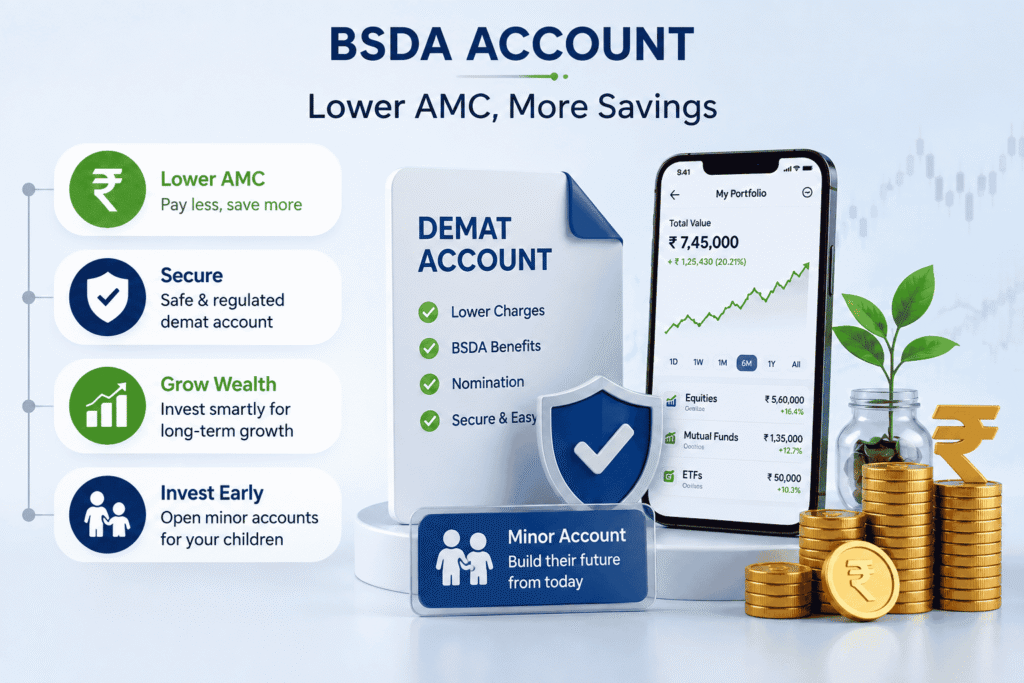
Minor Demat Accounts: A Useful Wealth-Creation Tool
Parents often ask whether they can start investing in the name of their child.
Yes, a Demat account can be opened in the name of a minor, subject to applicable rules and the broker/DP’s process.
The account is operated by the guardian until the minor becomes a major.
SEBI’s guidance also makes it clear that a minor cannot be a joint holder in a Demat account.
This makes a minor Demat account useful for long-term investing and financial education.
Can a Minor Trade Like an Adult?
No. A minor’s trading account is subject to strict limitations. SEBI’s framework allows a minor’s trading account primarily for selling securities that the minor already possesses through specified routes such as inheritance, IPO allotment or certain transfers.
A minor cannot independently enter into a normal broker contract for buying and selling securities like an adult investor.
Therefore, parents should not treat a minor Demat account as a normal active trading account.
Intraday, F&O and other trading activities are subject to applicable eligibility and account restrictions.
Also Read: Which Stock Broker Is Better: Full-Service or Discount?
Is Zero AMC for Minor Accounts a SEBI Benefit?
This point needs special attention.
There is no universal SEBI rule that says every minor Demat account must have zero AMC.
Instead, some brokers may provide zero-AMC or reduced-AMC pricing for minor accounts as part of their commercial policy.
So, if a broker advertises “Zero AMC for Minor Account”, check the broker’s current tariff and terms.
This distinction is important because regulatory eligibility and broker pricing are two different things.
What Happens When the Child Turns 18?
“Turning 18 is an important milestone.”
The minor becomes a major and must complete the applicable KYC and account-status formalities to operate the account independently.
The investor may need to provide updated PAN, KYC details, bank details and other documents requested by the DP.
Until the required status-change process is completed, account operations can be restricted. Similar principles apply to investments held in a minor’s name.
Therefore, parents should not wait until the last minute.
Start the major-conversion process around the child’s 18th birthday after checking the broker’s current procedure.
BSDA vs Regular Demat vs Minor Account
The three account situations serve different purposes.
BSDA: Best suited for eligible investors with smaller holdings who want lower maintenance costs.
Regular Demat: Suitable when BSDA eligibility is not available or when the investor needs a regular account structure.
Minor Demat: Designed for investments held in the minor’s name and operated through the guardian under applicable rules.
Therefore, there is no single “best” account for everyone.
The correct choice depends on your holdings, account structure, investment purpose and broker charges.
A Real-Life Indian Investor Scenario
Imagine Ravi, a 35-year-old salaried employee.
He has Rs.2.5 lakh invested in shares and rarely trades. His main goal is long-term wealth creation.
If his account qualifies for BSDA, he may fall within the zero-AMC slab.
Now imagine his friend has Rs.8 lakhs in eligible holdings. If he qualifies for BSDA, his AMC may be capped at Rs.100 per year under the applicable slab.
Meanwhile, another investor opens a regular Demat account because he has multiple Demat accounts and does not meet the one-account eligibility condition.
The lesson is simple: account structure matters.
STOP before opening a Demat account only because you see “Zero AMC”.
Check your BSDA eligibility, second-year AMC, transaction charges and account conditions first.
A few minutes of checking today can prevent years of unnecessary charges.
[CHECK YOUR DEMAT ACCOUNT COSTS BEFORE OPENING]
FAQs
For eligible BSDA accounts, holdings up to ₹4 lakh have nil AMC, while holdings above ₹4 lakhs and up to ₹10 lakh have AMC capped at ₹100 per year, subject to the applicable SEBI framework and DP terms.
No. First-year AMC waivers are generally broker-specific offers. For example, Zerodha currently offers the waiver for new resident individual accounts opened from June 1, 2026.
No. Zero AMC for minors is not a universal SEBI requirement. It depends on the broker or DP’s pricing policy.
Minor accounts have strict restrictions. A minor cannot normally enter into a standard trading contract to buy and sell securities like an adult. Trading-account use is restricted to permitted situations under SEBI rules.
The account holder must complete the applicable KYC and status-conversion formalities to operate the account as a major. The exact process depends on the DP’s current requirements.
Conclusion:
A Demat account is a tool for investing. It should support your financial goals rather than quietly add unnecessary costs.
The enhanced BSDA framework allows eligible small investors to reduce AMC significantly.
At the same time, first-year AMC waivers can be useful, but they are usually broker-specific offers and should not be confused with SEBI’s BSDA rules.
Minor accounts can also help parents start long-term investing for children, provided the applicable restrictions are understood.
Finally, do not focus only on “zero AMC”.
Look at the complete cost structure, account eligibility, future charges, nomination requirements and operational rules.
When these small details are handled properly, your Demat account becomes a more efficient part of your long-term wealth-creation strategy.
Important: This article is for investor education only. Rules, charges and broker policies can change. Always verify the latest SEBI circulars and your DP’s tariff sheet before opening or modifying an account.
Need Help Choosing the Right Demat Account?
Contact Alfinz today for beginner-friendly financial guidance, investment planning, SIP support, and Demat Account assistance.
Contact Alfinz Today for Personalized Investment Guidance Before You Start Investing
Need personalized financial guidance?
Contact Alfinz today for Investments, Insurance, Loans, Taxation & Financial Planning assistance.
Disclaimer: This article is published for general educational and informational purposes only. The content shared is based on common financial planning principles and personal finance awareness. It should not be considered professional financial, investment, tax, legal, or insurance advice. Financial decisions should always be made based on individual goals, risk profile, income, and personal circumstances. Readers are advised to consult a qualified financial advisor or professional before making any financial or investment decisions. Alfinz shall not be responsible for any financial loss or decisions taken based on this content.

Shiva Kumar is the Founder of ALFINZ, a financial planning and investment advisory platform dedicated to helping individuals make informed financial decisions. He holds NISM certifications in Equity Derivatives, Currency Derivatives, Equity Research Analysis, and Mutual Fund RTA. Through ALFINZ, he shares practical insights on financial planning, stock market investing, mutual funds, insurance, taxation, and wealth creation.