
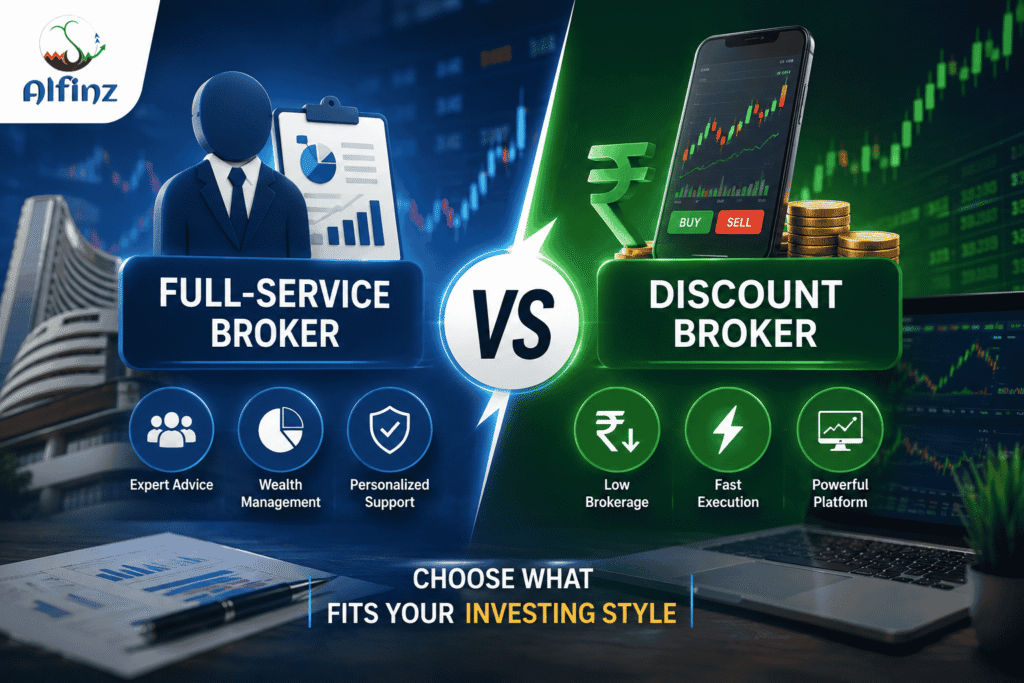
Introduction
Choosing a stock broker looks simple until you compare brokerage, research, advice, technology, customer service and investment options.
For a beginner, the cheapest broker may look like the obvious choice.
However, the lowest price doesn’t mean the best user experience.
On the other hand, paying more for a full-service broker does not automatically mean better investment results.
The right decision depends on your knowledge, time, portfolio size, investment goals and ability to control emotions during market volatility.
This is where understanding full-service vs discount brokers becomes important.
A broker is more than an app for buying and selling shares. The right platform should support your investment process without encouraging unnecessary trading.
Therefore, investors should compare the total value they receive, not just the brokerage displayed on the pricing page.
Defining the Brokerage Landscape in India
India’s broking industry has changed significantly over the last decade.
Earlier, investors often depended on relationship managers, telephone dealers and physical branches.
Today, technology allows investors to open accounts, analyse investments and place orders from a smartphone within minutes.
This has created two broad models: traditional or full-service brokers and technology-led discount brokers.
However, the difference is not simply “expensive broker versus cheap broker”.
The bigger difference is the level of human support, research, advisory services, product access, technology and execution control.
What Is a Full-Service Stock Broker?
A full-service broker generally provides brokerage along with additional services such as research, investment ideas, relationship management and financial planning support.
Examples in India include established platforms such as ICICI Direct, HDFC Securities and other traditional brokerage houses.
For example, ICICI Direct describes its platform as offering equities, derivatives, mutual funds, IPOs, fixed income, insurance and financial planning services.
Its private wealth offering also includes relationship management, portfolio allocation, family-office services and alternative investment solutions.
The attraction is simple.
You are not only paying for order execution. You may also be paying for research, support, convenience and access to a wider wealth-management ecosystem.
This can be valuable for an investor who has money but does not have enough time or confidence to manage everything independently.
However, investors should always check whether a service is advisory, execution-only, distribution-based or referral-based.
The regulatory structure and fee arrangement can differ between services.
What Is a Discount Stock Broker?
A discount broker generally focuses on technology-driven execution with a simpler pricing structure.
The investor usually takes greater responsibility for research, security selection, asset allocation and portfolio monitoring.
Zerodha is a well-known example.
Zerodha currently lists zero brokerage for equity delivery, while intraday and futures are charged at the lower of 0.03% or ₹20 per executed order, and options are charged at ₹20 per executed order.
Groww is another technology-led investment platform.
Groww currently lists equity brokerage at ₹20 or 0.1% per executed order, whichever is lower, subject to its stated minimum charge and applicable regulatory and statutory costs.
This highlights an important point.
“Discount” does not mean “free”.
Even when brokerage is zero, investors may still pay STT, exchange transaction charges, GST, stamp duty, DP charges and other applicable costs.
Therefore, compare the total cost of ownership, not only the headline brokerage.
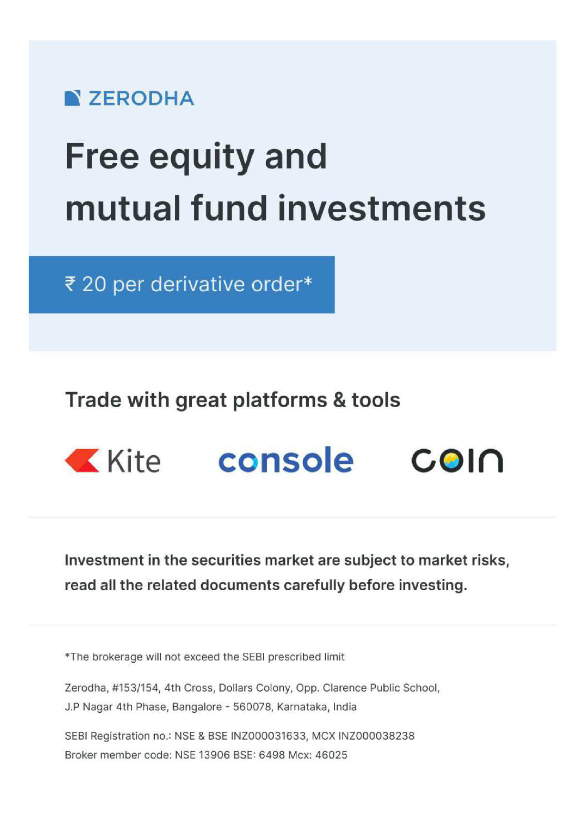
Fee Structures Compared: Commissions vs. AUM
Brokerage structures can vary widely between brokers and plans.
A traditional broker may charge percentage-based brokerage, fixed charges or bundled plans.
Some wealth-management arrangements may also use advisory or wrap-style fees based on assets under management. A 1% to 1.5% annual AUM fee can sound small.
But on a Rs.50 lakh portfolio, 1% represents Rs.50,000 a year before considering taxes or other charges.
At 1.5%, the same portfolio would represent Rs.75,000 a year.
The actual fee charged by any broker or adviser depends on the service and agreement.
Therefore, do not assume that every full-service broker charges a 1% or 1.5% AUM fee.
The real question is whether the additional service can justify the additional cost.
Scenario:
Imagine two investors who each start with Rs.50 lakh.
One pays an additional 1% every year for a service that does not improve portfolio behaviour or decision-making.
Over a long period, that recurring cost can reduce the amount available for compounding.
Consequently, fees deserve attention even when the percentage looks small.
At the same time, avoiding every fee is not always wise.
If professional guidance prevents panic selling, poor diversification or repeated speculative trades, the value of that guidance may outweigh its cost.
Also Read: How to Open a Demat Account for Beginners in India
Strategic Trade-Offs: Human Capital vs. Self-Direction
The key question is not simply: “Which broker is cheaper?”
A better question is:
“How much investment work am I prepared to do myself?”
This is the heart of full-service vs discount brokers.
A self-directed investor may prefer control, speed and low execution costs.
Another investor may value research, personal interaction, structured reviews and assistance during difficult market conditions.
Neither model is universally better.
Do not choose a platform only because its interface looks attractive.
Implementation Strategy: Matching Profile to Broker
Once your portfolio framework is clear, choosing the broker becomes easier.
The broker should support the strategy instead of influencing you to trade unnecessarily.
When to Deploy a Full-Service Stock Broker
A full-service relationship may be useful when your financial situation is complex.
For example,
- you may have a large portfolio, multiple family goals, business income, property, retirement planning needs or estate-planning requirements.
- It may also help if you lack the time to conduct research and review your portfolio.
Another situation is behavioural discipline.
- If you repeatedly panic during market corrections, structured professional support may help you follow a predetermined investment plan.
However, always verify the qualifications, registration, fee model and scope of the service. Do not confuse a sales pitch with personalised investment advice
When to Leverage a Discount stock Broker
A discount broker can be attractive for investors who are comfortable making their own decisions.
This can include investors who understand asset allocation, read financial statements, compare funds and maintain their own investment records.
The model can also be useful for long-term investors who mainly need efficient execution.
For example, an investor who invests monthly through index funds or ETFs may not need extensive relationship-management services.
Similarly, a knowledgeable equity investor may prefer direct control over research and execution.
The lower brokerage can be useful, but it should not encourage unnecessary trading.
Combining Both Stock Broker
A hybrid approach lets you enjoy the benefits of both.
For example, one investor may use a low-cost platform for self-directed long-term investments while separately paying a qualified professional for financial planning.
Another investor may use a full-service relationship for complex wealth planning while maintaining some investments independently.
The key is to avoid paying twice for the same service.
Before choosing a hybrid structure, list every fee you are paying.
Then ask:
“What am I receiving for this fee?”
If the answer is unclear, review the arrangement.
Also Read: IPO Process : The Complete Beginner’s Guide to start
Real-Life India Scenario: Two Investors, Two Decisions
# Consider Ravi, a 32-year-old salaried professional in Hyderabad.
He earns Rs.12 lakh annually and invests ₹25,000 every month.
His portfolio is relatively simple.
He has a few mutual funds, an index fund and some direct stocks.
Ravi enjoys researching companies and regularly tracks his investments.
For him, a discount stock broker may be suitable because he values low execution costs and self-direction.
# Now consider Suresh, aged 52.
He has Rs.1.5 crore across shares, mutual funds, fixed income, property and business assets.
He is preparing for retirement and wants to organise his family’s wealth.
His concern is not saving Rs.20 on an order.
His bigger concern is whether his portfolio is properly diversified and whether his family can manage the assets later.
For Suresh, a broader financial-planning or wealth-management relationship may provide more value.
The lesson is simple.
The “best broker” can be different for Ravi and Suresh.
That is why full-service vs discount brokers should be evaluated through your financial situation rather than through online popularity alone.
Consultation-Based Approach: Ask These Questions First
Before recommending or selecting a stock broker, start with the investor.
First, understand the goal.
- Is the money for retirement, children’s education, wealth creation, a house or short-term liquidity?
Next, understand the time horizon.
- A five-year goal requires a different approach from a twenty-year goal.
Then assess risk capacity.
Risk capacity is not only about how comfortable you feel when markets fall.
- It also depends on income stability, liabilities, emergency savings and the importance of the investment goal.
Finally, understand behaviour.
- Will the investor remain invested during a 20% market decline?
- Will they frequently change strategies after watching social-media videos?
- Will they trade because the app sends constant market notifications?
These questions can be more important than brokerage alone.
Core Checklist for Final Broker Selection
Before opening an account, compare these areas.
Pricing
Check brokerage, AMC, DP charges, platform fees and other applicable costs.
Do not focus only on the advertised brokerage.
Products
Check whether the platform supports the investments you actually need.
Today, many discount platforms also offer mutual funds, ETFs and IPOs.
Therefore, do not assume product access based only on the broker’s category.
Research
If research is important to you, check the quality, frequency and independence of the research.
Do not assume that more research automatically means better investment decisions.
Advisory
Understand whether advice is actually included.
Also check whether the person or entity providing investment advice has the required regulatory registration.
Technology
Review the app, website, reporting tools, portfolio tracking and order functionality.
Technology should make investing easier without encouraging excessive trading.
Customer Support
Check how you can contact the broker during account, settlement or technical issues.
Support quality becomes especially important when you need help quickly.
Transparency
Ask for a complete schedule of charges.
Look beyond brokerage.
Check taxes, exchange charges, DP charges, AMC, pledge charges and other applicable fees.
Security
Review account-security processes, authentication, alerts and communication practices.
Never share passwords, OTPs or trading credentials with anyone.
Also Read: The Ultimate Beginner’s Guide to Stock Market Investing in India
Don’t Choose in a Hurry
- First compare the complete charges.
- Then understand the services.
- Next, check whether you actually need research or advisory support.
- Finally, select the broker that fits your investment process.
Your portfolio can remain invested for decades. Take one extra hour to choose the right structure.
If you are confused between a full-service relationship and a low-cost self-directed platform, get your investment goals and risk profile assessed before making the decision.
Need Help Choosing the Right Stock Broker ?
FAQs
Not necessarily. A full-service broker may offer more human support and wealth-management services.
A discount broker may offer lower execution costs and greater self-direction.
The better choice depends on your needs.
No. Some brokers offer zero brokerage on selected transactions.
However, statutory taxes, exchange charges, DP charges and other applicable fees may still apply.
For example, Zerodha and Groww publish detailed charge schedules on their websites.
Yes. However, beginners should understand that a simple app does not replace investment knowledge.
Before investing, learn about diversification, risk, asset allocation and basic financial planning.
No broker can guarantee market returns.
Research, advisory services and relationship management can support decision-making, but investment outcomes remain uncertain.
They can have higher costs depending on the plan and services selected.
However, “expensive” should be judged against the actual value received.
A fee may be worthwhile if it provides useful planning and behavioural support.
No. Brokerage is only one part of the decision.
Technology, customer support, research, advisory, security, product availability and total charges should also be considered.
Yes, investors can maintain accounts with multiple brokers.
However, multiple accounts can make portfolio tracking and tax reporting more complicated.
Use a second broker only when there is a clear reason.
There is no universal answer.
A long-term investor should prioritise low total costs, reliable execution, suitable investment products, good reporting and disciplined portfolio management.
Conclusion:
Choosing between full-service and discount stock broker is not simply about high or low fees.
The right broker should match your experience, financial goals, risk profile and investment style.
Therefore, understand your portfolio and asset allocation first, then choose a broker that offers the right balance of cost, control, guidance and convenience.
Contact Alfinz Today for Personalized Investment Guidance Before You Start Investing
Need personalized financial guidance?
Contact Alfinz today for Investments, Insurance, Loans, Taxation & Financial Planning assistance.
Disclaimer: This article is published for general educational and informational purposes only. The content shared is based on common financial planning principles and personal finance awareness. It should not be considered professional financial, investment, tax, legal, or insurance advice. Financial decisions should always be made based on individual goals, risk profile, income, and personal circumstances. Readers are advised to consult a qualified financial advisor or professional before making any financial or investment decisions. Alfinz shall not be responsible for any financial loss or decisions taken based on this content.

Shiva Kumar is the Founder of ALFINZ, a financial planning and investment advisory platform dedicated to helping individuals make informed financial decisions. He holds NISM certifications in Equity Derivatives, Currency Derivatives, Equity Research Analysis, and Mutual Fund RTA. Through ALFINZ, he shares practical insights on financial planning, stock market investing, mutual funds, insurance, taxation, and wealth creation.





This is a well-structured comparison that goes beyond just looking at brokerage charges. I particularly liked the discussion on choosing a broker based on individual needs, investment style and the level of support required. The examples make the difference between full-service and discount brokers much easier to understand. A useful guide for investors.