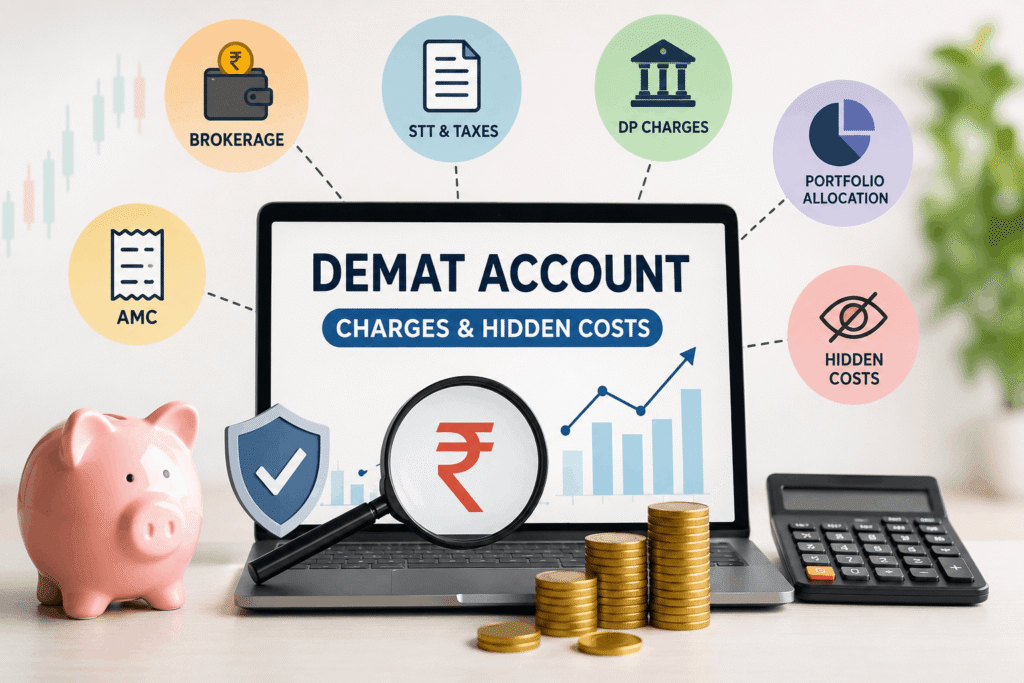
Opening a Demat account is easy today. You can complete the process online within minutes and start investing in shares, ETFs, IPOs and other securities.
However, many beginners look only at the headline offer.
- Zero brokerage,
- Free account opening,
- Low-cost investing
These offers may sound attractive. However, the actual cost of investing can include several other charges.
Some are clearly shown on the broker’s tariff page. Others appear only when a particular transaction happens.
Therefore, understanding Demat account charges is important before you choose a broker or start investing.
The good news is that most charges are not complicated once you understand what they mean.
This guide explains them in simple Indian English so that a beginner can read a contract note or ledger without feeling confused.
It also explains how charges can affect long-term returns and how your investment strategy should match your risk profile.
Most importantly, the objective is not to find the cheapest broker at any cost.
The objective is to understand what you are paying and whether the service you receive is worth that cost.
What Is a Demat Account?
A Demat account is an electronic account used to hold securities such as shares, ETFs, bonds and certain other investment products in digital form.
It acts like a secure digital vault for your money.
Your trading account is generally used to place buy and sell orders.
Your Demat account is used to hold securities electronically.
Therefore, a person investing in the stock market may use both a trading account and a Demat account.
For beginners, understanding this difference makes the charges much easier to understand.
Why Is Understanding Demat Account Charges Important?
Imagine two investors who invest ₹5 lakh in the stock market.
Both earn the same gross return.
However, one investor trades frequently, while the other invests patiently and makes fewer transactions.
The first investor may pay more in brokerage, taxes, DP charges and other transaction-related costs.
Consequently, the final return can be different even when the investment performance is similar.
This is why investment cost matters.
A small charge may look insignificant on one transaction.
However, repeated charges over many years can reduce the amount available for compounding.
Moreover, frequent trading can increase costs without necessarily improving returns.
Therefore, beginners should understand costs before focusing only on returns.
Also Read: Which Stock Broker Is Better: Full-Service or Discount?
1. What Are the Standard Demat Fees?
The visible charges are usually the easiest to understand.
However, even these charges can vary between brokers and account types.
Before opening an account, always check the latest tariff sheet of the broker or Depository Participant.
Account Opening Charges
Some brokers offer free account opening.
Others may charge an account-opening fee or collect charges for specific services.
The important point is simple.
Do not select a broker only because the account opening is free.
Account opening is usually a one-time event.
The charges you pay repeatedly can have a much bigger impact over the long term.
Therefore, check AMC, brokerage, DP charges and other transaction costs before making a decision.
Annual Maintenance Charges
Annual Maintenance Charges, or AMC, are charges for maintaining your Demat account.
The amount depends on the broker, account type and applicable regulations.
Some brokers offer zero AMC under specific conditions.
However, zero AMC does not mean zero cost for every transaction.
For example, you may still have brokerage, taxes, DP charges or statutory levies when you trade.
Therefore, look at the complete tariff structure rather than one promotional benefit.
* What Is BSDA?
Basic Services Demat Account, or BSDA, is designed for eligible investors with smaller Demat holdings.
Under the revised framework, the holding value can be up to ₹10 lakh for BSDA eligibility.
AMC is nil for holdings up to ₹4 lakh.
For holdings above ₹4 lakh and up to ₹10 lakh, AMC is capped at ₹100 per year. If holdings exceed the applicable BSDA limit, regular Demat charges may apply.
What Is Brokerage?
Brokerage is the fee charged by a broker for executing trades.
The brokerage structure can differ significantly between brokers.
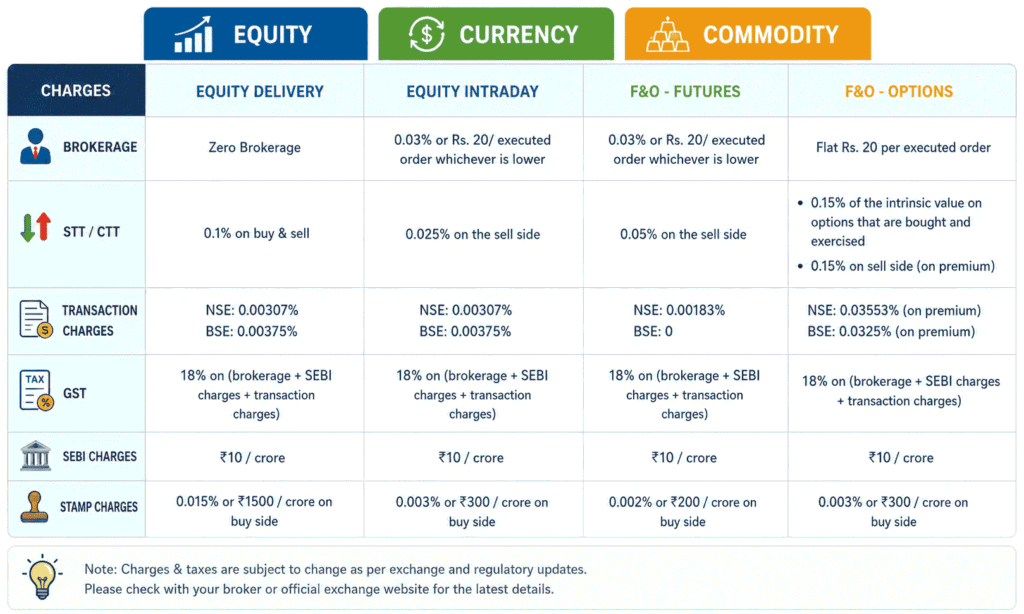
Delivery trades, intraday trades and derivatives may have different pricing structures.
Some brokers advertise zero brokerage for certain equity delivery transactions.
However, other statutory and transaction charges can still apply.
Therefore, “zero brokerage” should never be interpreted as “zero total cost.”
* Delivery Trading
Delivery investing generally means purchasing shares and taking delivery into your Demat account.
For long-term investors, brokerage may be low or zero with some brokers.
However, STT, stamp duty, exchange-related charges, SEBI turnover fees, GST where applicable and DP charges on eligible debits may still affect the final cost.
* Intraday Trading
Intraday trading involves buying and selling within the same trading session.
The brokerage structure is usually different from delivery investing.
There can also be exchange charges, STT, GST, stamp duty and other applicable levies.
Consequently, frequent intraday trading can create a much larger cumulative cost.
* Futures and Options
F&O transactions have their own charge structure.
The taxation and statutory levies can differ from equity delivery.
Beginners should not look only at basic fees when comparing short-term trading with long-term investing.
Always calculate the complete transaction cost.
2. What Are the Hidden Costs of a Demat Account?
The word “hidden” does not always mean that the broker is secretly charging you.
Usually, it means that the investor does not notice the charge until it appears in the contract note, ledger or transaction statement.
Understanding these costs can prevent unpleasant surprises.
What Are DP Charges?
DP stands for Depository Participant.
CDSL and NSDL are the two major depositories in India.
Your broker or financial institution may act as your Depository Participant.
When securities are debited from your Demat account, a DP transaction charge may apply depending on the broker’s tariff.
This is one of the most misunderstood charges among beginners.
For example, suppose an investor sells a small quantity of shares.
The investor may think:
The broker charged zero brokerage, I saved on all selling costs.
However, the contract note may contain DP charges and statutory levies.
The exact DP charge varies by broker and account structure.
Therefore, never assume that one fixed amount applies to every Demat account.
* Why Small Sales Can Be Expensive:
Suppose a broker charges a fixed DP fee for an eligible debit.
Selling ₹5,000 worth of shares and selling ₹1 lakh worth of shares may trigger a similar fixed DP component.
Consequently, the charge becomes proportionally larger when the transaction value is small.
For example, a ₹20 charge on a ₹5,000 sale is 0.40% before considering other charges.
The same ₹20 on a ₹1 lakh sale is only 0.02%.
Therefore, repeatedly selling very small quantities can increase your effective transaction cost.
This does not mean investors should avoid necessary portfolio changes.
Instead, it means you should understand the cost before splitting transactions unnecessarily.
How Does GST Increase Investment Costs?
GST can apply to certain services and charges.
It is important to understand that GST is generally not charged on the investment amount itself.
Instead, it can apply to eligible service components such as brokerage and certain other charges.
For example, if a service charge is ₹100 and GST is applicable at 18%, the GST component would be ₹18.
Therefore, the total becomes ₹118. The percentage may look small.
However, when multiple service charges occur regularly, the cumulative amount becomes noticeable.
What Is Securities Transaction Tax?
Securities Transaction Tax, commonly called STT, is a government levy on specified securities transactions.
The applicable rate depends on the type of transaction.
Equity delivery, intraday transactions, futures and options can have different STT treatment.
Therefore, investors should not assume that the same STT rate applies everywhere.
For a long-term equity investor, STT is one of the important transaction costs to understand.
However, calling it the “largest cost” for every investor would be misleading.
The total impact depends on the transaction type, turnover and other charges.
What Are SEBI Turnover Fees and Stamp Duty?
SEBI turnover fees are regulatory charges linked to transaction turnover.
The amount per transaction may be very small.
However, frequent traders can see the cumulative effect because the charge is linked to turnover.
Stamp duty is another statutory charge.
It generally applies according to the type of security and transaction.
The rate and payer can differ depending on the transaction. Therefore, investors should check the latest exchange and broker information before calculating exact costs.
Also Read: How to Open a Demat Account for Beginners in India
3. What Are Operational and Penalty Charges?
Not every charge happens every day.
Some charges occur only when you use a particular service.
These are often called operational or situational costs. Understanding them is useful because they can appear unexpectedly.
Pledge and Unpledge Charges
Investors may pledge securities as collateral for certain facilities.
For example, an investor may use eligible securities as collateral for margin-related purposes.
Pledge creation, confirmation, invocation or other related actions may attract charges.
The exact amount depends on the broker and service.
Therefore, before using margin against securities, understand both the financial risk and operational charges. Remember, reducing brokerage does not reduce market risk.
What Are Dematerialization Charges?
Dematerialization means converting eligible physical securities into electronic form.
This may be relevant if someone still holds old physical share certificates.
The process can involve charges for processing, certificates, courier or other applicable services.
The exact amount depends on the DP’s tariff.
Therefore, investors holding old physical certificates should check the latest charges before starting the process.
What Are Off-Market Transfer Charges?
An off-market transfer happens when securities are transferred outside the normal exchange settlement process.
For example, securities may be transferred from one Demat account to another for certain legitimate purposes.
Such transfers may attract charges.
Inter-depository transfers can also have separate charges.
Therefore, if you plan to transfer shares between Demat accounts, check the applicable tariff first.
Failed Transaction and Payment Charges
Failed instructions can sometimes result in charges.
Examples may include failed debit instructions, rejected transactions, payment failures or other operational issues.
The exact treatment depends on the broker and transaction type.
Therefore, keeping your bank account, trading account and Demat details properly updated can reduce avoidable problems.
Real-Life Indian Scenario: ₹10,000 Investment
Let us take a simple example.
Ravi invests ₹10,000 in a stock.
He sees a broker advertisement saying “zero brokerage.”
He assumes that his entire ₹10,000 is available without any additional cost.
However, the actual transaction can involve statutory levies and other applicable charges.
Now imagine Ravi makes ten small trades instead of following a long-term plan.
Each transaction can generate its own cost components.
Consequently, his effective cost can become higher than expected.
Now consider another investor, Priya.
She invests ₹10,000 regularly but focuses on long-term holding.
She checks charges before investing and avoids unnecessary buying and selling.
Her transaction frequency is lower.
Therefore, her avoidable trading costs may also be lower.
The lesson is not that Ravi’s broker is bad. The lesson is that investor behaviour affects the total cost.
Also Read: The Ultimate Beginner’s Guide to Stock Market Investing in India
A Consultation-Based way to Review Your Demat Costs
When reviewing a client’s Demat account, do not start with:
“Which broker charges the least?”
Start with:
“How do you actually use the account?”
If the investor buys stocks twice a year, brokerage may not be the biggest concern.
If the investor trades every day, brokerage and turnover-related costs may become much more important.
If the investor holds a small portfolio, AMC may deserve more attention.
If the investor frequently sells small quantities, DP charges may become relevant.
Similarly, an investor using pledge or margin facilities should carefully review operational charges and financial risk. Therefore, the correct cost analysis should begin with behaviour.
Common Mistakes Beginners Make
Mistake 1: Choosing Only Based on Zero Brokerage
Zero brokerage sounds attractive.
However, it does not mean zero transaction cost.
Therefore, compare the complete tariff.
Mistake 2: Ignoring DP Charges
Many investors notice brokerage but ignore Demat debit charges.
Consequently, small sell transactions may cost more than expected.
Mistake 3: Maintaining Too Many Demat Accounts
Multiple accounts may create multiple AMC obligations.
They can also make portfolio tracking more difficult.
Therefore, keep accounts only when there is a genuine reason.
Mistake 4: Trading to Save a Few Rupees
Saving ₹20 while making a poor investment decision can cost much more.
Investment quality should always come before tiny cost savings.
Mistake 5: Confusing Aggressive Investing With Speculation
An aggressive portfolio can still be diversified.
It does not require random small-cap bets or excessive leverage.
Most importantly, risk should be planned.
Also Read: Mutual Funds Investing: Best Ways to Build Wealth for beginners
FAQs
Not necessarily. Some brokers offer free account opening or zero AMC under specific conditions.
However, transaction-related and statutory charges may still apply.
Therefore, check the complete tariff before opening an account.
There is no single charge that matters most for every investor.
AMC may matter to long-term holders.
DP charges may matter to investors who frequently sell.
Brokerage may matter more to active traders.
Statutory charges depend on transaction type and turnover.
No. DP charges are broker or Depository Participant specific.
Therefore, never assume that a charge quoted by one broker applies to another broker.
No. Zero brokerage only refers to brokerage under the applicable conditions.
STT, stamp duty, GST on applicable services, exchange charges, SEBI turnover fees and DP charges may still apply.
Yes, investors can have multiple Demat accounts subject to applicable rules.
However, maintaining multiple accounts may increase costs and reduce simplicity.
It depends on your requirements.
A self-directed investor who mainly needs an execution platform may prefer a low-cost model.
An investor who values research, support or additional services may prefer a full-service model.
Therefore, compare value rather than price alone.
Yes. Charges reduce the money available for investment or the net amount received after selling.
No. Charges are a normal part of the financial market ecosystem.
The objective is not to eliminate every cost.
The objective is to understand the costs, avoid unnecessary expenses and choose services appropriately.
Conclusion:
Do Demat Account Charges Really Matter?
Demat accounts have made investing easier for Indian investors.
However, convenience should not mean ignoring costs.
The key lesson is simple.
Do not judge a broker by one number.
Look beyond “zero brokerage”.
Understand AMC, DP charges, STT, GST, stamp duty and other applicable costs.
At the same time, do not let a small fee dominate your investment decisions.
Your asset allocation, diversification, risk management and investment discipline matter far more.
A good investor controls unnecessary costs without compromising investment quality.
That is the real objective.
Whether your profile is conservative, moderate or aggressive, start with an allocation that matches your risk capacity.
Then review the portfolio periodically instead of reacting to every market movement.
Finally, remember this simple rule:
* Know the cost.
* Control the unnecessary cost.
* Focus on the long term.
Contact Alfinz Today for Personalized Investment Guidance Before You Start Investing
Need personalized financial guidance?
Contact Alfinz today for Investments, Insurance, Loans, Taxation & Financial Planning assistance.
Disclaimer: This article is published for general educational and informational purposes only. The content shared is based on common financial planning principles and personal finance awareness. It should not be considered professional financial, investment, tax, legal, or insurance advice. Financial decisions should always be made based on individual goals, risk profile, income, and personal circumstances. Readers are advised to consult a qualified financial advisor or professional before making any financial or investment decisions. Alfinz shall not be responsible for any financial loss or decisions taken based on this content.

Shiva Kumar is the Founder of ALFINZ, a financial planning and investment advisory platform dedicated to helping individuals make informed financial decisions. He holds NISM certifications in Equity Derivatives, Currency Derivatives, Equity Research Analysis, and Mutual Fund RTA. Through ALFINZ, he shares practical insights on financial planning, stock market investing, mutual funds, insurance, taxation, and wealth creation.