
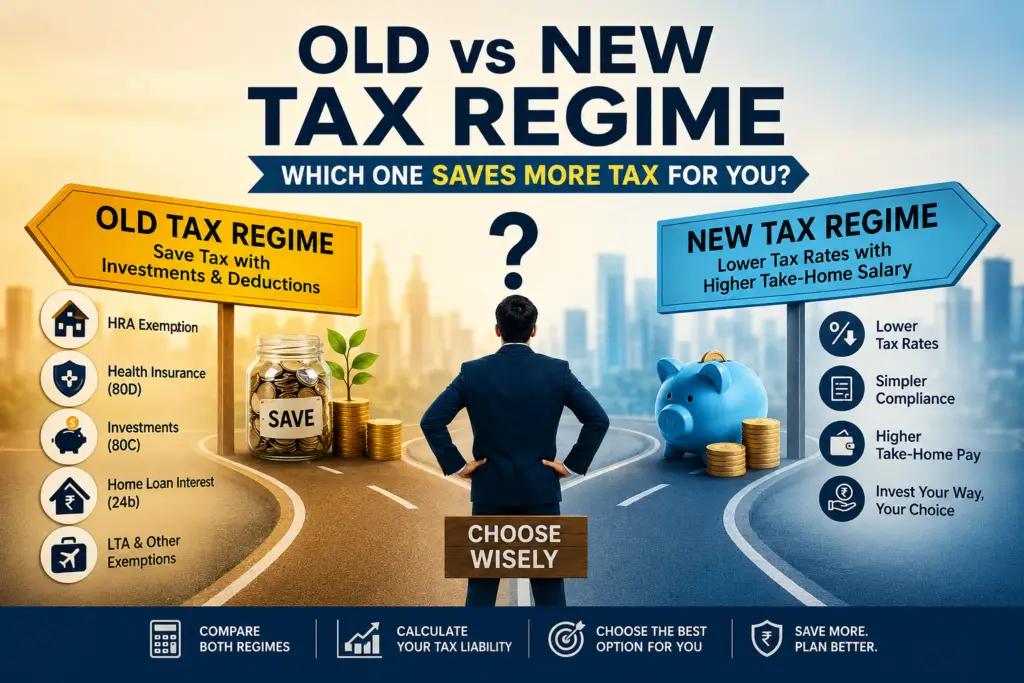
Why Understanding Old and New Tax Regimes Matters
Income tax planning is no longer just about filing returns. Today, every taxpayer in India must choose between two parallel tax systems i.e., Old and New tax regime
The Old Tax Regime rewards disciplined saving and investing. On the other hand, the New Tax Regime focuses on simplicity and higher take-home income.
As a result, many taxpayers are confused about which option is better.
The answer depends on your income, investments, home loan commitments, insurance premiums, and financial goals.
Before selecting a regime, it is important to understand how both systems work and where each one offers an advantage.
The Indian Tax Evolution: Why Old and New Tax Regimes Exist
Traditionally, the Indian tax system encouraged saving through deductions and exemptions.
Therefore, taxpayers invested in PPF, ELSS, LIC, NPS, health insurance, and home loans to reduce taxes.
However, the government later introduced the New Tax Regime to simplify taxation and reduce compliance burden.
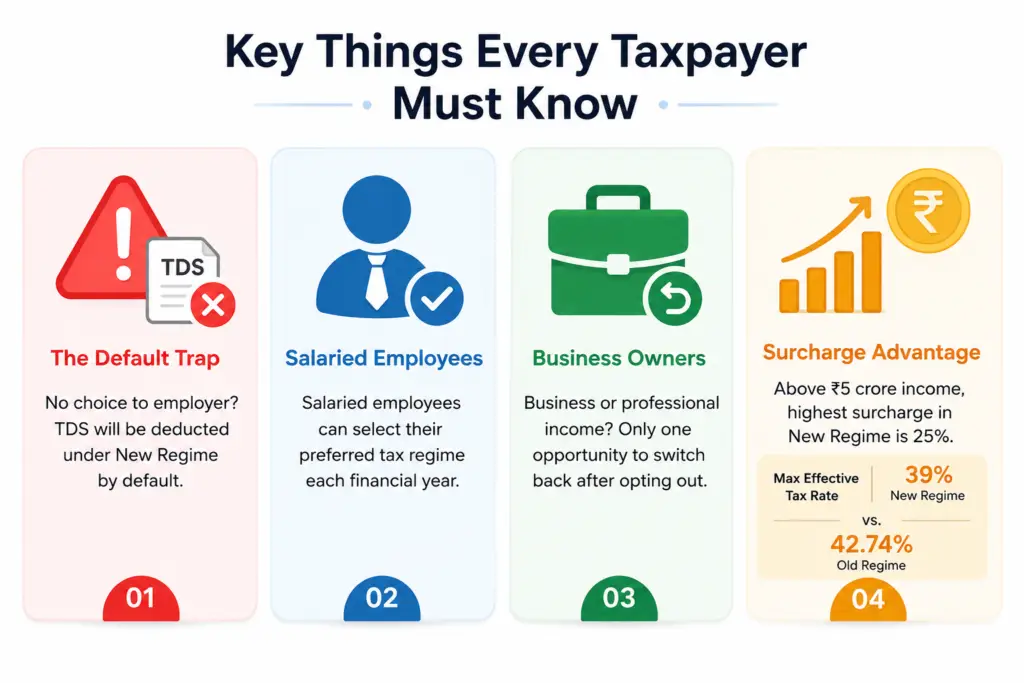
Today, the New Tax Regime is the default regime for most taxpayers unless they specifically choose otherwise.
Income Tax Filing in India: Why It Matters, Key Benefits & Easy Filing Process
The Main Philosophy Behind Both Regimes : Old vs New Tax
The Old Tax Regime follows a “Save First, Spend Later” approach.
Meanwhile, the New Tax Regime follows a “Spend or Invest as You Wish” approach.
One encourages wealth creation through structured savings.
The other provides flexibility and higher disposable income.
Neither is universally better. The best choice depends on your personal financial situation.
Structural Differences Between the Two Regimes
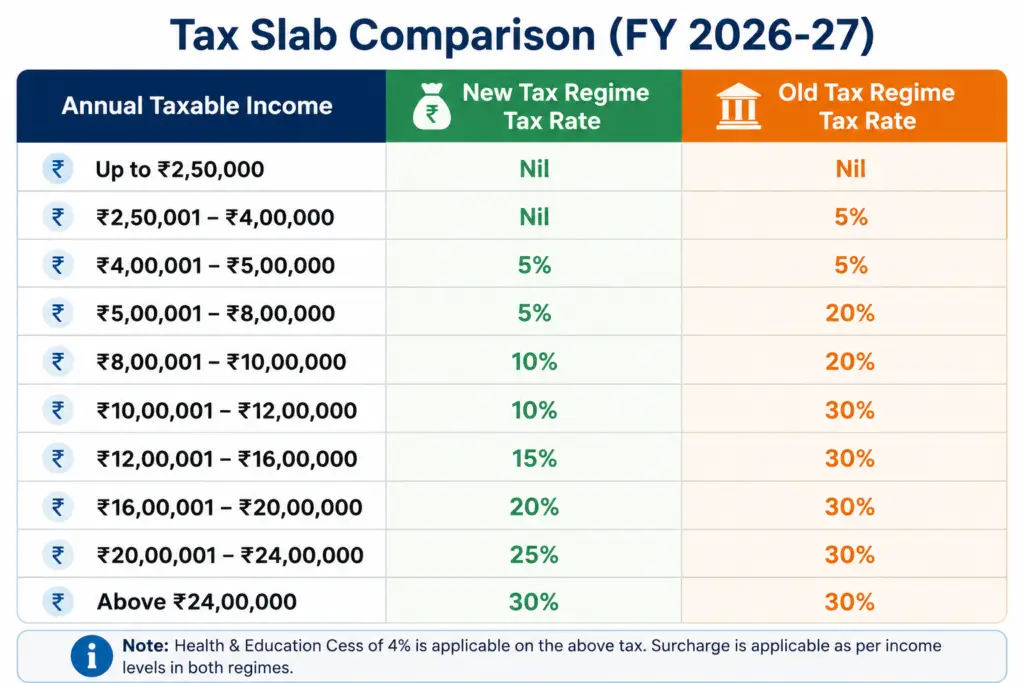
The Deductions Dilemma
The biggest difference is deductions.
The Old Regime allows more than 70 deductions and exemptions.
The New Regime removes most of them.
Therefore, taxpayers lose tax-saving opportunities but gain simplicity.
The Old Tax Regime
Key Characteristics
The Old Regime charges higher tax rates. However, it offers multiple deductions and exemptions.
Popular deductions include:
- Section 80C (PPF, ELSS, LIC): ₹1.5 lakh
- Section 80D (Health Insurance)
- Section 24(b) Home Loan Interest: ₹2 lakh
- HRA Exemption
- LTA Exemption
- NPS Additional Deduction
| Merits Of Old Tax Regime | Demerits Of Old Tax Regime |
| Encourages disciplined savings | Requires extensive documentation |
| Supports long-term wealth creation | Multiple proofs and compliance requirements |
| Benefits home loan borrowers | Investments may have lock-in periods |
| Allows HRA and LTA exemptions | Lower monthly liquidity |
| Offers Section 80C, 80D, and other deductions | Tax planning can become complex |
| Can substantially reduce taxable income | Not suitable for taxpayers with few deductions |
The New Tax Regime
Key Characteristics
The New Regime provides lower tax rates with fewer deductions.
Taxpayers enjoy greater flexibility in managing their money.
Benefits Still Available
- Standard Deduction: ₹75,000
- Employer NPS Contribution under Section 80CCD(2)
- Family Pension Deduction (subject to limits)
Zero Tax Benefit
Under the New Regime, eligible individuals can enjoy zero tax liability up to ₹12 lakh of taxable income because of the enhanced rebate provisions.
Additionally, marginal relief ensures that a small increase in income does not create a disproportionately high tax burden.
| Merits of New Tax Regime | Demerits of New Tax Regime |
| Higher monthly take-home pay | No major home loan tax benefits |
| Simpler tax filing process | Limited deductions and exemptions |
| Lower tax slab rates | Less encouragement for long-term savings |
| Minimal documentation required | Reduced tax planning opportunities |
| Greater flexibility in using money | Investors and non-investors get similar treatment |
| Suitable for taxpayers with few deductions | May not benefit individuals with significant tax-saving investments |
Detailed Case Study on Old vs New Tax Regime : Income ₹15,00,000
Let’s compare both regimes using a practical example.
Taxpayer Profile
Annual Salary: ₹15,00,000
Eligible Deductions:
- Section 80C: ₹1,50,000
- Section 80D: ₹50,000
- Home Loan Interest: ₹2,00,000
- HRA Benefit: ₹1,00,000
Total Deductions = ₹5,00,000
Old Tax Regime Calculation
| Particulars | Amount |
| Gross Income | ₹15,00,000 |
| Less Standard Deduction | ₹50,000 |
| Less 80C | ₹1,50,000 |
| Less 80D | ₹50,000 |
| Less Home Loan Interest | ₹2,00,000 |
| Less HRA | ₹1,00,000 |
| Taxable Income | ₹9,50,000 |
Tax Calculation
| Slab | Tax |
| Up to ₹2.5L | Nil |
| ₹2.5L to ₹5L | ₹12,500 |
| ₹5L to ₹9.5L @20% | ₹90,000 |
| Total Tax | ₹1,02,500 |
| Health & Education Cess (4%) | ₹4,100 |
| Final Tax Liability | ₹1,06,600 |
New Tax Regime Calculation
| Particulars | Amount |
| Gross Income | ₹15,00,000 |
| Less Standard Deduction | ₹75,000 |
| Taxable Income | ₹14,25,000 |
Tax Calculation
| Slab | Tax |
| ₹0 – ₹4L | Nil |
| ₹4L – ₹8L @5% | ₹20,000 |
| ₹8L – ₹12L @10% | ₹40,000 |
| ₹12L – ₹14.25L @15% | ₹33,750 |
| Total Tax | ₹93,750 |
| Health & Education Cess (4%) | ₹3,750 |
| Final Tax Liability | ₹97,500 |
Comparison Summary
| Particulars | Old Regime | New Regime |
| Gross Income | ₹15,00,000 | ₹15,00,000 |
| Total Deductions | ₹5,00,000 | ₹75,000 |
| Taxable Income | ₹9,50,000 | ₹14,25,000 |
| Final Tax | ₹1,06,600 | ₹97,500 |
Judgment:
Even after claiming ₹5 lakh worth of deductions, the New Tax Regime saves approximately ₹9,100 in this example.
However, outcomes vary depending on income levels and deductions.
In many practical situations, the breakeven threshold is around ₹3.75 lakh to ₹4 lakh of total deductions.
Therefore, taxpayers with lower deductions generally benefit more from the New Regime.
Real-Life Indian Scenarios
A young software engineer with no home loan often benefits from the New Regime.
A family person paying EMI, health insurance, and children’s investments may benefit from the Old Regime.
Similarly, senior professionals with substantial tax-saving investments should compare both options carefully before deciding.
Why Professional Tax Consultation Matters
Many taxpayers select a regime based on assumptions.
However, the right choice depends on calculations rather than opinions.
A professional review can identify hidden tax-saving opportunities and prevent costly mistakes.
FAQs
This depends entirely on your personal deductions, investments, and financial goals.
Yes, salaried individuals can switch every year
No, HRA exemption is generally not available.
No, Section 80C deductions are not available under the New Tax Regime
In many cases, yes. However, calculations should always be performed before deciding.
Conclusion:
The debate around Old vs New Tax Regime does not have a universal answer.
The Old Regime rewards disciplined savers and long-term planners.
The New Regime rewards simplicity, flexibility, and higher monthly cash flow.
Therefore, the smartest approach is to calculate tax under both systems before filing your return.
A few minutes of comparison can potentially save thousands of rupees every year.
Need Help Choosing the Right Tax Regime?
Don’t wait until the last minute. Missing deadlines can lead to penalties, delayed refunds, and unnecessary stress.
File Your Income Tax Return with Alfinz Today
- Expert Assistance
- Maximum Eligible Deductions
- Fast & Hassle-Free Filing Support
Need personalized financial guidance?
Contact Alfinz today for Investments, Insurance, Loans, Taxation & Financial Planning assistance.
Disclaimer: This article is published for general educational and informational purposes only. The content shared is based on common financial planning principles and personal finance awareness. It should not be considered professional financial, investment, tax, legal, or insurance advice. Financial decisions should always be made based on individual goals, risk profile, income, and personal circumstances. Readers are advised to consult a qualified financial advisor or professional before making any financial or investment decisions. Alfinz shall not be responsible for any financial loss or decisions taken based on this content.

Shiva Kumar is the Founder of ALFINZ, a financial planning and investment advisory platform dedicated to helping individuals make informed financial decisions. He holds NISM certifications in Equity Derivatives, Currency Derivatives, Equity Research Analysis, and Mutual Fund RTA. Through ALFINZ, he shares practical insights on financial planning, stock market investing, mutual funds, insurance, taxation, and wealth creation.