
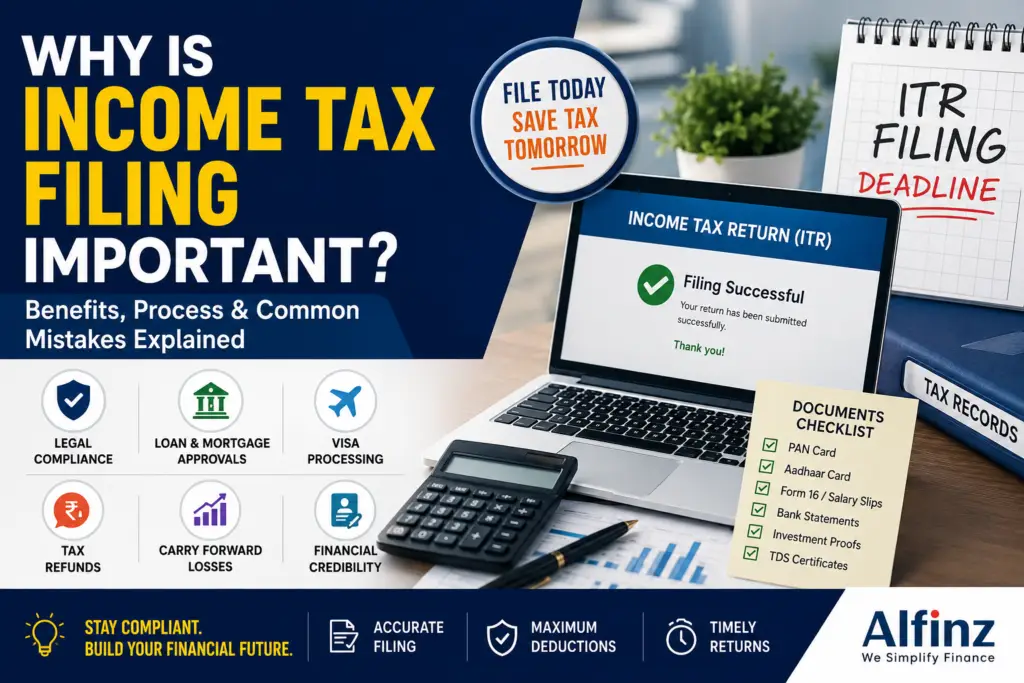
Why Is Income Tax Filing Important? Benefits, Process & Common Mistakes Explained
Every financial year, millions of Indians prepare to file their Income Tax Return (ITR). However, many people still view Income Tax Filing as just another government requirement. But in reality, it is more important than that.
Income Tax Filing is a powerful financial activity that helps individuals stay compliant, build financial credibility, and access several benefits in the future. Whether you are a salaried employee, freelancer, business owner, or retired individual, filing your tax return on time can strengthen your financial foundation.
At Alfinz, we often meet people who realize the importance of Income Tax Filing only when applying for a loan, visa, or tax refund. Therefore, understanding its benefits today can save significant trouble tomorrow.
What Is Income Tax Filing?
Income Tax Filing is the process of reporting your annual income, deductions, taxes paid, and investments to the Income Tax Department of India.
After calculating your total taxable income, you submit the appropriate Income Tax Return (ITR) form through the government portal. This declaration helps determine whether additional tax is payable or whether you are eligible for a refund.
In simple terms, Income Tax Filing acts as your official financial report card for the completed (previous) year just like “The document serves as a comprehensive annual school report card.”
Importance of Income Tax Filing in India
Many taxpayers focus only on paying taxes. However, the importance of Income Tax Filing goes beyond tax payments.
Filing your return creates a documented financial history. As a result, it becomes easier to prove income, claim benefits, and maintain transparency with financial institutions.
Moreover, timely filing demonstrates financial discipline and responsible citizenship
Core Benefits of Filing Your Tax Return
Legal Compliance and Avoiding Penalties
The first and most important benefit is compliance with Indian tax laws.
When eligible individuals fail to file returns within the prescribed deadline, penalties, interest charges, and notices may arise. Therefore, filing on time helps avoid unnecessary legal complications.
Furthermore, regular compliance reduces the chances of future tax disputes.
Seamless Loan and Mortgage Approvals
Banks frequently ask for the last two to three years of Income Tax Returns while processing home loans, personal loans, business loans, and vehicle loans.
In our experience, applicants with consistent Income Tax Filing records often receive faster approvals because lenders can verify their income easily.
Consequently, maintaining updated tax returns improves financial credibility.
Also Read: Which Tax Regime (Old Or New)is Better ? Complete Comparison Guide
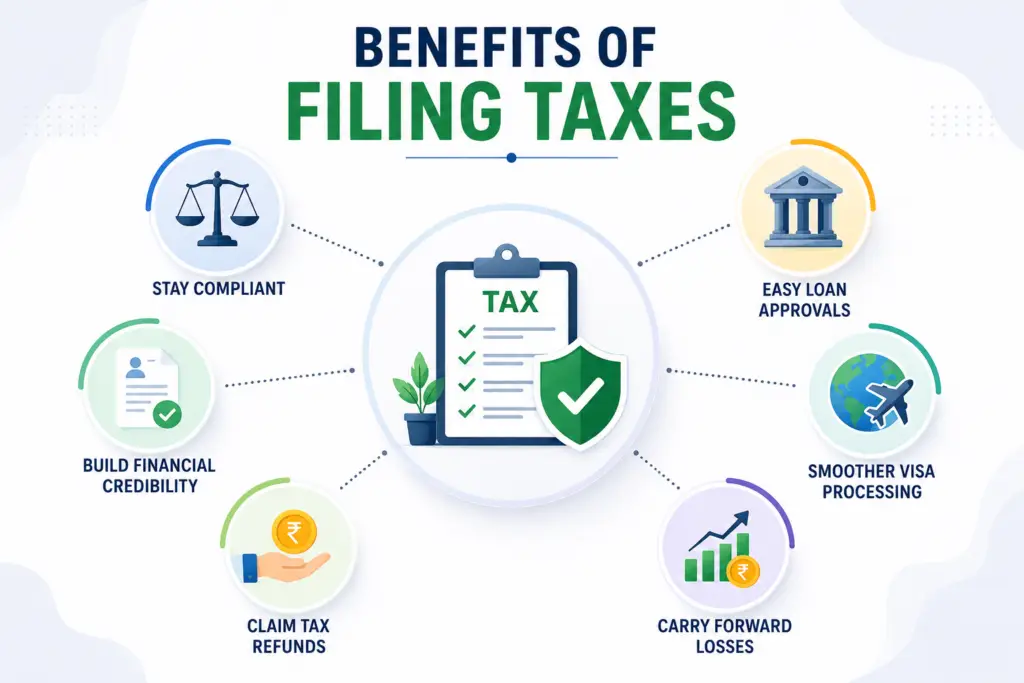
Quick Visa Processing and Document Verification
Many countries require Income Tax Returns as proof of financial stability during visa applications.
Embassies often review tax documents to assess whether applicants have a stable source of income in their home country.
Therefore, regular Income Tax Filing can simplify international travel plans significantly.
Claiming Tax Refunds for Excess Deductions
Sometimes employers, banks, or clients deduct more tax than necessary through TDS.
If you do not file your return, recovering this excess tax becomes difficult.
By completing Income Tax Filing, taxpayers can claim eligible refunds directly into their bank accounts.
Carrying Forward Financial Losses
Investors frequently experience losses in stocks, mutual funds, property transactions, or businesses.
One major benefit of Income Tax Filing is the ability to carry forward eligible losses to future years and adjust them against future gains.
As a result, taxpayers may reduce future tax liabilities legally.
Real-Life Indian Scenario
Consider Rahul, a software employee earning ₹8 lakh annually.
For several years, he ignored Income Tax Filing because his employer deducted TDS regularly. Later, when applying for a home loan, the bank requested three years of ITR records.
Since he lacked proper returns, his loan approval was delayed.
On the other hand, his colleague who filed returns consistently received quick approval and better processing.
This example highlights why Income Tax Filing is not merely about taxes. Instead, it supports major financial goals.
Who Is Mandated to File Income Tax Returns?
Income Thresholds and Age Categories
Individuals whose income exceeds the prescribed exemption limits under current tax laws are generally required to file returns.
These limits may vary based on age category and tax regime selected.
Therefore, taxpayers should verify applicable thresholds every financial year.
Mandatory Filing Criteria Regardless of Income
In certain situations, filing may be mandatory even if income remains below taxable limits.
Examples include:
- High-value bank deposits
- Significant foreign travel expenditure
- Large electricity consumption
- Foreign asset ownership
- Certain business transactions
Therefore, taxpayers should review all applicable filing conditions carefully.
NRIs and Foreign Income Holders
Non-Resident Indians (NRIs) may also need Income Tax Filing depending on income earned or accrued in India.
Similarly, individuals holding foreign assets or earning overseas income may have additional reporting requirements.
Professional consultation can help ensure compliance in such cases
Also Read: The Ultimate Beginner’s Guide to Stock Market Investing in India
Essential Documentation Checklist
Proper documentation makes the filing process smoother and more accurate.
Identity and Tax Registration Proofs
Keep the following ready:
- PAN Card
- Aadhaar Card
- Updated contact information
Income Breakdown Statements
Collect:
- Form 16
- Salary slips
- Professional income statements
- Rental income details
Investment and Deduction Certificates
Maintain records of:
- Section 80C investments
- Health insurance premiums
- Education loan interest
- Home loan certificates
Bank Statements and Interest Certificates
Do not forget:
- Savings account statements
- Fixed deposit interest certificates
- Dividend income records
These documents help avoid underreporting income.
Step-by-Step Income Tax Filing Process
Choose the Correct ITR Form
Selecting the appropriate return form is crucial.
Different forms apply to salaried individuals, businesses, professionals, and investors.
Therefore, always verify eligibility before filing.
Aggregate and Verify Total Income
Combine income from:
- Salary
- Business
- House property
- Capital gains
- Other sources
Afterward, cross-check all details carefully.
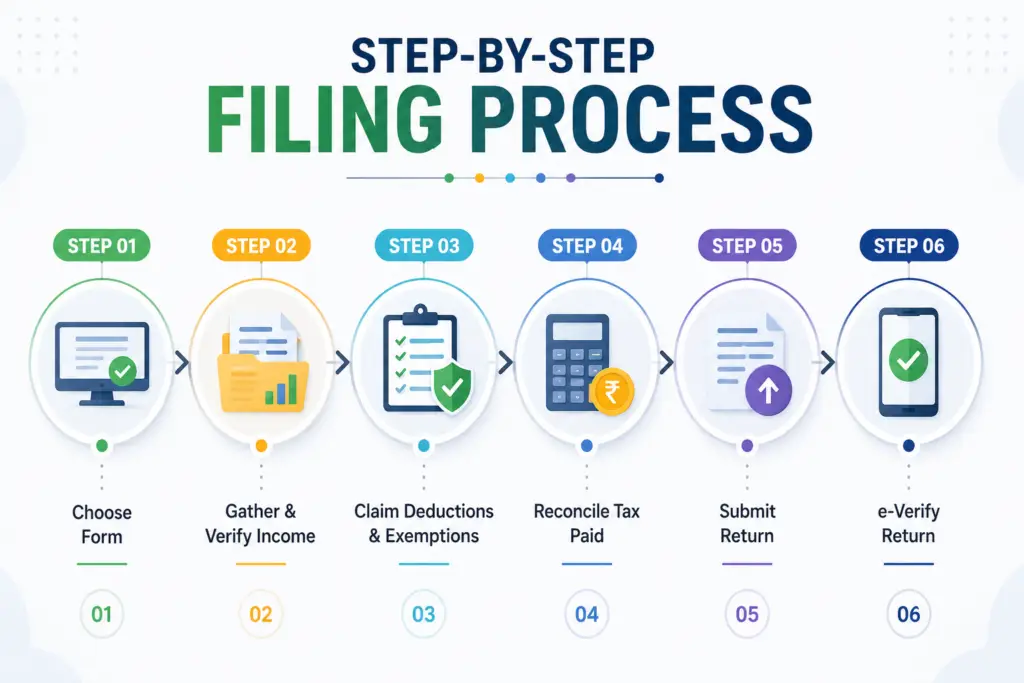
Claim Eligible Deductions and Exemptions
Next, claim deductions available under applicable sections.
Proper tax planning can reduce taxable income while remaining fully compliant.
Reconcile TDS and Advance Tax
Compare taxes already paid through:
- TDS
- Advance tax
- Self-assessment tax
This step ensures accuracy before submission.
Submit and Complete e-Verification
Many taxpayers overlook the final verification step.
However, an Income Tax Return is considered incomplete until e-Verification is successfully completed.
Therefore, always verify immediately after submission.
Common Mistakes to Avoid
Missing the Filing Deadline
Missing the deadline may attract penalties and interest charges
Therefore, begin preparation well before the deadline.
Underreporting Additional Income
Interest income, rental income, freelance earnings, and dividends are frequently missed.
Always disclose all income sources accurately.
Selecting the Wrong ITR Form
Using an incorrect return form can result in defective return notices.
Hence, verify form applicability carefully.
Ignoring e-Verification
Even after successful submission, failing to complete e-Verification can invalidate the return.
Always confirm filing status after verification.
When Should You Seek Professional Help?
While many individuals can file returns independently, professional assistance becomes valuable when dealing with:
- Capital gains taxation
- Multiple income sources
- Business income
- Foreign assets
- NRI taxation
- Tax notices
At Alfinz, we recommend seeking guidance whenever tax calculations become complex or financial decisions involve significant amounts.
FAQs
Yes. TDS deduction does not automatically replace Income Tax Filing requirements.
Yes, but penalties and restrictions may apply
No. Refund claims generally require filing a valid Income Tax Return.
Most lenders prefer at least two to three years of Income Tax Filing records.
Yes. If income conditions apply or refunds need to be claimed, students can also file returns.
Conclusion:
Tax Filing as a first sign of Financial Responsibility
Income Tax Filing is not merely a compliance requirement. It is an essential part of responsible financial management.
It helps build credibility, supports loan approvals, enables tax refunds, and creates a transparent financial history. Moreover, timely filing prevents unnecessary legal complications and future stress.
Therefore, instead of viewing tax season as a burden, consider it an annual financial health check-up. The earlier you start and file return, the smoother the process it becomes.
Need Help In Filing Your Income Tax Return Before the Deadline?
Don’t wait until the last minute. Missing deadlines can lead to penalties, delayed refunds, and unnecessary stress.
👉 File Your Income Tax Return with Alfinz Today
Expert Assistance
✅ Accurate Tax Calculation
✅ Maximum Eligible Deductions
✅ Fast & Hassle-Free Filing Support
Need personalized financial guidance?
Contact Alfinz today for Investments, Insurance, Loans, Taxation & Financial Planning assistance.
Disclaimer: This article is published for general educational and informational purposes only. The content shared is based on common financial planning principles and personal finance awareness. It should not be considered professional financial, investment, tax, legal, or insurance advice. Financial decisions should always be made based on individual goals, risk profile, income, and personal circumstances. Readers are advised to consult a qualified financial advisor or professional before making any financial or investment decisions. Alfinz shall not be responsible for any financial loss or decisions taken based on this content.

Shiva Kumar is the Founder of ALFINZ, a financial planning and investment advisory platform dedicated to helping individuals make informed financial decisions. He holds NISM certifications in Equity Derivatives, Currency Derivatives, Equity Research Analysis, and Mutual Fund RTA. Through ALFINZ, he shares practical insights on financial planning, stock market investing, mutual funds, insurance, taxation, and wealth creation.