
What Is An IPO ?
Have you ever wondered how a private company becomes a publicly traded company? The answer lies in an Initial Public Offer, commonly known as an IPO.
An IPO is the process through which a private company offers its shares to the general public for the first time. After the IPO, investors can buy and sell those shares on stock exchanges.
In simple words, an Initial Public Offer allows ordinary investors to become shareholders in a growing business. This step often marks a major milestone in a company’s journey. As India’s capital markets continue to grow, more investors are exploring IPO opportunities.
Therefore, understanding the IPO process has become increasingly important for beginners.
Why Is an Initial Public Offer Important?
An Initial Public Offer serves as a bridge between private ownership and public participation.
It helps companies raise substantial capital without depending entirely on bank loans. At the same time, investors gain access to businesses that were previously unavailable to the public.
Moreover, IPOs contribute to economic growth by supporting innovation, expansion, and job creation across industries.
For investors, IPOs provide an opportunity to participate in a company’s future growth story from an early stage.
Also Read: The Ultimate Beginner’s Guide to Stock Market Investing in India
Transition: From Private Company to Public Company
Before launching an IPO, ownership usually remains limited to founders, promoters, venture capital firms, and private investors.
However, once the company goes public, ownership becomes distributed among thousands of shareholders.
As a result, the company must follow stricter regulations, maintain transparency, and regularly communicate financial performance to investors.
This transition can significantly improve the company’s market reputation and credibility.
Why Companies Choose to Go Public
Raising Large-Scale Capital
One of the primary reasons for an Initial Public Offer is fund raising.
Businesses often require significant capital to expand operations, develop new products, enter new markets, or reduce existing debt.
Instead of relying solely on borrowings, companies can raise funds by issuing shares to the public. Consequently, they gain access to long-term capital while reducing financial pressure from loans.
Providing Exit Options for Early Investors
Many start-ups receive funding from angel investors, venture capital firms, and private equity investors.
Over time, these investors may wish to monetize their investments.
An IPO provides a structured exit opportunity, allowing early investors to sell part of their holdings while maintaining market transparency.
Therefore, IPOs often reward investors who supported the company during its early growth stages.
Enhancing Corporate Visibility and Credibility
Publicly listed companies generally enjoy higher visibility in the market.
Customers, suppliers, lenders, and investors often view listed businesses as more trustworthy because they follow regulatory disclosure requirements.
Furthermore, media coverage and analyst attention increase after listing, helping strengthen brand recognition. As a result, companies may find it easier to attract customers and business partnerships.
Using Shares as Currency for Acquisitions
Listed shares can be used during mergers and acquisitions.
Instead of paying entirely in cash, companies may offer shares as part of acquisition deals.
This flexibility can accelerate growth while preserving cash resources.
Consequently, many businesses view an IPO as a strategic step toward future expansion.
Also Read: How Inflation Affects our Daily Life & Wealth creation
The Step-by-Step IPO Process
Appointing Investment Bankers and Underwriters
The IPO journey begins with appointing investment bankers and underwriters.
These professionals help determine valuation, structure the issue, and guide the company throughout the public offering process.
Their expertise helps ensure a smoother market entry.
Due Diligence and Drafting the DRHP
Then, the company prepares a Draft Red Herring Prospectus (DRHP).
This document contains detailed information about financial performance, business operations, risks, management, and future plans.
Investors should carefully review the DRHP before making investment decisions.
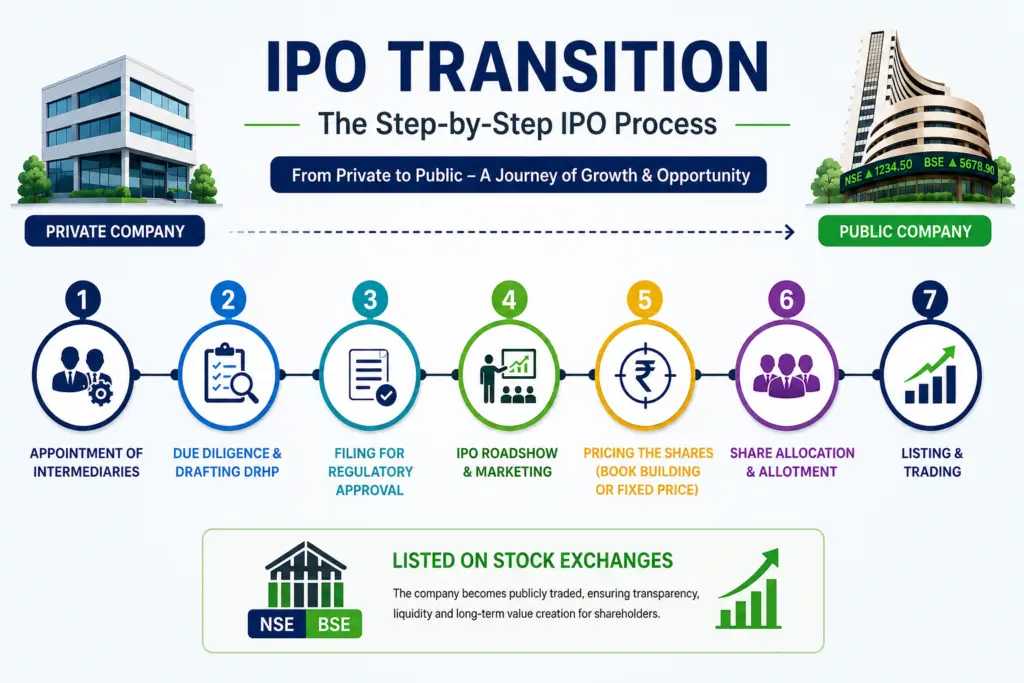
Filing for Regulatory Approval
The draft documents are submitted to regulatory authorities for review.
In India, regulators assess whether all required disclosures have been provided accurately. Only after approval can the company proceed with the public offering.
The IPO Road show and Marketing
Before launching the issue, management teams often conduct road shows.
These presentations help explain the company’s business model, growth plans, and investment potential to institutional investors.
Effective communication can improve investor interest and participation.
Pricing the Shares
Companies generally use either the Book Building Method or the Fixed Price Method.
Under book building, investors place bids within a specified price range.
The final issue price is determined based on demand and market interest. This process helps establish a fair valuation.
Share Allocation and Allotment
After subscription closes, shares are allocated to eligible investors.
If demand exceeds available shares, allotment may occur on a proportionate basis. Successful applicants receive shares, which are then credited to their Demat accounts
Open Demat Account and Start your Journey with upcoming IPO
Why Listing on Stock Exchanges Is Essential
Creating Liquidity for Shareholders
Listing allows investors to buy and sell shares in the secondary market.
This liquidity makes investments more attractive because shareholders can exit whenever market conditions are favorable.
Without listing, selling ownership stakes would be considerably more difficult.

Establishing Fair Market Valuation
Stock exchanges help determine a company’s market value through continuous buying and selling activity.
As investor sentiment changes, share prices adjust accordingly.
Therefore, listed companies benefit from real-time market valuation.
Access to Secondary Market Trading
Once listed, shares become available for trading among investors.
This creates continuous market participation and broadens ownership. Furthermore, active trading improves price discovery and market efficiency.
Boosting Public and Institutional Trust
Institutional investors often prefer companies that maintain transparency and governance standards.
Listing requirements encourage better disclosures and accountability.
Consequently, public confidence tends to increase over time.
Real-Life Indian Scenario to Launch IPO
Imagine a successful Indian technology start up operating privately for several years.
The company wants to expand nationally, hire talent, and launch new products. However, bank loans alone may not be sufficient.
By launching an Initial Public Offer, the company raises funds from investors across India.
As a result, expansion becomes possible while investors participate in the company’s future growth journey. This is one reason why many well-known Indian businesses eventually choose the public market route.
Should You Invest in Every IPO?
Many beginners assume every IPO generates profits. However, this assumption can be risky.
Before investing, evaluate the company’s financial health, growth prospects, valuation, industry position, and risk factors.
Reading the DRHP, understanding business fundamentals, and aligning investments with personal goals can improve decision-making.
An IPO should be viewed as an investment opportunity, not a guaranteed profit source.
FAQ
An Initial Public Offer is the first sale of company shares to public investors through stock exchanges
Companies launch IPOs to raise capital, improve visibility, provide investor exits, and support future growth plans.
No. IPO performance depends on business fundamentals, valuation, market conditions, and investor sentiment.
Yes. However, investors should understand the company and associated risks before applying.
The company’s shares are listed on stock exchanges where investors can buy and sell them.
Conclusion:
Is an IPO Right for Every Company?
An Initial Public Offer can unlock growth opportunities, improve credibility, and provide access to public capital. However, it also brings regulatory responsibilities, market scrutiny, and increased accountability.
For businesses, going public should be a strategic decision rather than a trend. For investors, understanding how IPOs work is essential before investing hard-earned money.
Ultimately, successful IPO investing begins with knowledge, research, and disciplined decision-making.
Need Help Understanding an IPO Before Investing?
Don’t invest based on market hype alone.
✅ Understand company fundamentals
✅ Review IPO valuation
✅ Analyze risks and opportunities
✅ Make informed investment decisions
Contact Alfinz Today for Personalized Investment Guidance Before You Apply for Any IPO.
Need personalized financial guidance?
Contact Alfinz today for Investments, Insurance, Loans, Taxation & Financial Planning assistance.
Disclaimer: This article is published for general educational and informational purposes only. The content shared is based on common financial planning principles and personal finance awareness. It should not be considered professional financial, investment, tax, legal, or insurance advice. Financial decisions should always be made based on individual goals, risk profile, income, and personal circumstances. Readers are advised to consult a qualified financial advisor or professional before making any financial or investment decisions. Alfinz shall not be responsible for any financial loss or decisions taken based on this content.

Shiva Kumar is the Founder of ALFINZ, a financial planning and investment advisory platform dedicated to helping individuals make informed financial decisions. He holds NISM certifications in Equity Derivatives, Currency Derivatives, Equity Research Analysis, and Mutual Fund RTA. Through ALFINZ, he shares practical insights on financial planning, stock market investing, mutual funds, insurance, taxation, and wealth creation.