

Introduction:
A few years ago, investing in the stock market felt complicated. Many people believed it was only for finance professionals or full-time traders.
Today, things have changed dramatically. Mobile apps, online KYC, and easy access to information have made stock market investing in India more accessible than ever.
However, easy access does not guarantee success.
Many beginners open a Demat account and start buying random stocks without understanding risk, diversification, or long-term wealth creation.
As a result, some investors lose money and conclude that the market is risky.
In reality, the problem is often a lack of knowledge rather than the market itself.
This Beginner’s Guide to Stock Market Investing will help you understand the foundations, avoid common mistakes, and build a disciplined investment approach.
Why Is Stock Market Investing Important?
Inflation silently reduces the purchasing power of money every year.
Money kept only in a savings account or low-return products may not grow fast enough to meet future goals.
Meanwhile, quality businesses listed on Indian stock exchanges continue to grow over time.
As these businesses grow, shareholders participate in that growth through rising stock prices and dividends.
Therefore, long-term investing can become an effective tool for wealth creation, retirement planning, children’s education, and financial independence.
We Will look at A Real-Life Indian Scenario
Imagine two friends, Rahul and Kiran.
Rahul keeps all his money in a bank account earning modest returns.
Kiran creates an emergency fund and gradually starts investing through SIPs into diversified equity funds.
After 15 to 20 years, Kiran’s investments benefit from compounding and market growth.
Meanwhile, Rahul’s money grows slowly and struggles to keep pace with inflation.
This simple example highlights why learning stock market investing India has become essential.
8 Pillar’s to know Before starting investing in Stock market
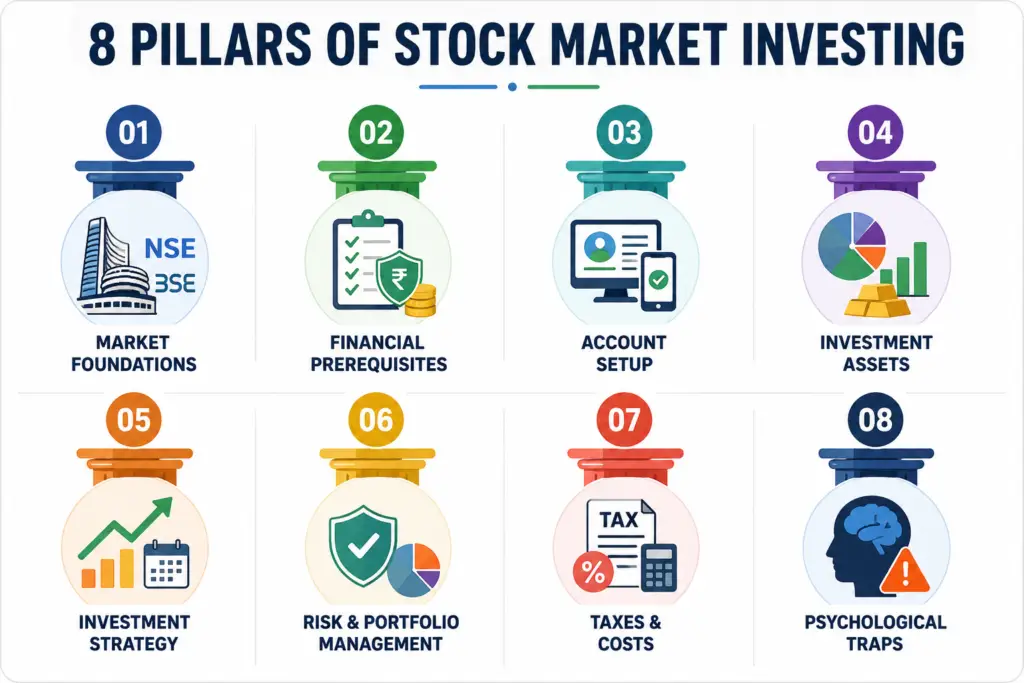
Pillar 1: The Indian Stock Market Foundations
The Two Major Exchanges: NSE and BSE
Before investing, it is important to understand where stocks are traded.
The National Stock Exchange (NSE) is India’s largest market place for buying and selling listed shares. Most active traders and investors use NSE-listed stocks.
The Bombay Stock Exchange (BSE) is Asia’s oldest stock exchange and hosts thousands of listed companies.
Both exchanges provide a regulated platform where buyers and sellers can transact securely.
Although prices are usually similar on both exchanges, liquidity often tends to be higher on NSE.
Market Indices Explained: Nifty 50 & Sensex
Many beginners hear terms like Nifty and Sensex every day. However, these are simply market indicators.
Nifty 50 represents 50 large and well-established companies listed on NSE. Sensex represents 30 major companies listed on BSE.
When these indices rise, they generally indicate positive market sentiment.
When they fall, it reflects broader market weakness.
Therefore, indices act like a health report for the Indian stock market.
The Role of SEBI
The Securities and Exchange Board of India (SEBI) regulates and monitors India’s securities market.
SEBI works to protect investors, improve transparency, and prevent unfair market practices.
Because of SEBI regulations, listed companies must disclose important information regularly. As a result, retail investors receive better protection and access to reliable information.
Pillar 2: Financial Prerequisites Before Investing
Clear High-Interest Debt First
Many people rush to invest while carrying expensive debt. This can be a costly mistake.
For example, credit card debt may charge 30% to 40% annual interest.
Meanwhile, stock market returns are never guaranteed.
Therefore, eliminating high-interest debt should usually be the first priority.
Build an Emergency Cash Buffer
Unexpected situations can occur at any time.
Medical emergencies, job loss, business disruptions, or family expenses can create financial pressure.
Hence, maintain an emergency fund equal to at least six months of essential expenses.
This money should remain in liquid funds or bank fixed deposits for easy access.
An emergency fund prevents forced selling of investments during difficult times.
Invest Only Surplus Capital
One of the golden rules of investing is simple.
Never invest money that may be needed soon. Instead, invest only surplus capital meant for long-term goals.
If you expect to use funds within the next five years for a house purchase, education, or business requirement, avoid putting them into volatile assets.
This approach reduces emotional stress and improves decision-making.
Pillar 3: Setting Up Your Investment Infrastructure
Understanding the 2-in-1 Account System
Every beginner should understand the connection between two important accounts.
These both accounts work together to place you buy, sell, and hold investments.
The Trading Account
A trading account acts as the transaction platform.
It allows investors to place buy and sell orders through a broker’s application or website.
Without a trading platform or application, stock market transactions cannot take place.
The Demat Account
A Demat account stores shares electronically.
In the past, investors received physical share certificates.
Today, shares are held digitally for convenience and security.
Two major depositories manage these holdings:
• NSDL (National Securities Depository Limited)
• CDSL (Central Depository Services Limited)
Whenever you purchase shares, they are credited to your Demat account.
The KYC Process
Opening an account has become remarkably simple.
Open Demat Account and Start your Investment Journey in Stock Market

Generally, investors need:
• PAN Card
• Aadhaar Card
• Bank Account Proof
• Passport-size Photograph
• Signature Verification
• In-Person Verification (Video KYC)
Most brokers now complete this process online within a short period.
Pillar 4: Choosing the Right Investment Assets Is Very important
Direct Equity (Stocks)
Direct equity means buying ownership in a company.
Stocks are generally classified into three categories.
Large-Cap Stocks
These are established market leaders with relatively stable business models.
Examples often include major banking, IT, and consumer companies.
Large-cap stocks generally offer lower risk compared to smaller companies.
Mid-Cap Stocks
Mid-cap companies have higher growth potential.
However, they may also experience greater volatility during market fluctuations.
Small-Cap Stocks
Small-cap companies can generate substantial returns.
On the other hand, they also carry significantly higher risk.
Therefore, beginners should approach small-cap investments carefully.
Index Funds and ETFs: The Ideal Starting Point
Many beginners feel overwhelmed while selecting individual stocks.
This is where Index Funds and Exchange Traded Funds (ETFs) become valuable.
These funds simply track an index such as Nifty 50 or Nifty Next 50.
Instead of betting on a few companies, you gain exposure to a basket of quality businesses.
As a result, diversification improves while investment costs remain low.
It is always advisable for the first-time investors, a Nifty 50 Index Fund can be an best starting point.
ETFs Explained: The Simple Investment Strategy Anyone Can Use
Gold Alternatives: Better Than Physical Gold?
Gold has always been a preferred investment in Indian households.
However, storing physical gold involves making charges, purity concerns, and security risks.
Today, investors have smarter alternatives.
Sovereign Gold Bonds (SGBs)
SGBs are issued by the Our Government of India.
They provide gold price exposure and also offer additional interest income.
Gold ETFs
Gold ETFs allow investors to buy gold digitally through their Demat account.
This removes storage concerns while maintaining liquidity. Therefore, many investors now prefer digital gold alternatives over physical gold.
Gold EGRs
Gold EGRs is a modern and secure way to invest in gold through stock exchanges.
Gold EGR allows investors to hold gold in electronic form, similar to shares held in a Demat account.
It eliminates concerns related to storage, purity, and security associated with physical gold.
Moreover, investors can buy, sell, and convert EGRs into physical gold if required.
As a result, Gold EGR offers a transparent, regulated, and convenient alternative for gold investment.
Why Electronic Gold Receipts (EGRs) Are Better Than Physical Gold
Pillar 5: Executing Your Investment Strategy
The SIP Route: Why Consistency Wins
Many beginners wait for the “perfect market level” before investing. Unfortunately, nobody can consistently predict market movements.
This is where SIP Investment becomes powerful.
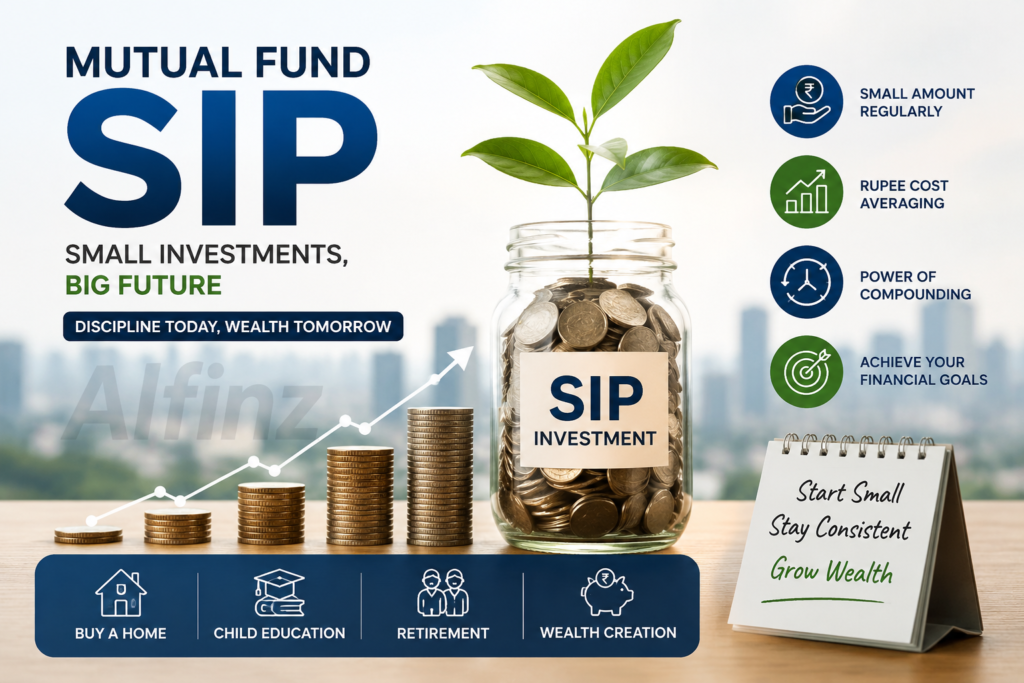
A Systematic Investment Plan is a disciplined investment option it allows investors to invest fixed amounts at regular intervals on a specific date.
When markets fall, more units are purchased. When markets rise, fewer units are purchased.
This process is called rupee-cost averaging.
Over time, it helps reduce the impact of market volatility.
More importantly, SIPs encourage disciplined investing habits.
lump-sum Investing
Sometimes investors receive a large amount through bonuses, inheritance, business profits, or asset sales.
In such situations, lumpsum investing may be appropriate.
However, if market valuations appear expensive, investors may consider staggered deployment over several months.
This can reduce the psychological stress of investing everything at once.
Placing Your First Order
Before investing, it is important to understand basic order types.
Delivery Trading
In delivery trading, shares are purchased and held in the Demat account.
This approach is suitable for long-term investors.
Intraday Trading
Intraday trading involves buying and selling on the same day.
While it may appear attractive, it carries significantly higher risk.
Most beginners should focus on delivery investing rather than short-term speculation.
Market Order
A market order buys or sells a stock right away at the current price.
This ensures execution but not necessarily the exact desired price.
Limit Order
A limit order executes only at a specific price chosen by the investor.
This provides better price control but may not execute if the market does not reach that level.
Pillar 6: Risk Management and Portfolio Construction
Diversification Across Sectors
One common mistake among beginners is concentrating investments in a single sector.
For example, an investor may become overly confident in banking or IT stocks.
However, sector-specific challenges can impact returns.
Therefore, diversification remains essential.
A balanced portfolio may include sectors such as:
• Banking
• Information Technology
• Pharmaceuticals
• FMCG
• Manufacturing
• Infrastructure
• Energy
By spreading investments, overall portfolio risk can be reduced.
Understanding Your Risk Profile
Every investor has a different financial situation and comfort level.
Therefore, investment strategies should align with risk tolerance.
Conservative Investor
Prefers stability over high returns.
Usually allocates more money to debt funds and safer assets.
Moderate Investor
Balances growth and stability.
Generally combines equity and debt investments.
Aggressive Investor
Focuses on High Short term returns
Can tolerate higher volatility in pursuit of potentially greater returns.
Choosing the right risk profile helps investors remain committed during market fluctuations.
The Power of Compounding
Many Advisors call compounding the eighth wonder of the world because it grows money so fast.
It occurs when investment returns generate additional returns.
For example, dividends can be reinvested instead of being withdrawn.
Over long periods, this creates exponential growth.
The earlier an investor starts, the greater the compounding benefit.
Even small monthly investments can become substantial wealth over decades.
Pillar 7: Indian Tax Laws and Hidden Costs
Understanding Capital Gains Tax
Every investor should understand taxation before investing.
Short-Term Capital Gains (STCG)
If equity shares are sold within one year, gains are generally taxed at applicable short-term capital gains rates under prevailing tax laws.
Long-Term Capital Gains (LTCG)
If shares are held beyond one year, gains qualify for long-term capital gains treatment.
Since tax rules can change periodically, investors should always verify the latest regulations before filing returns.
Understanding taxes helps avoid unpleasant surprises later.
The Hidden Charges Checklist
Many beginners focus only on profits and overlook transaction costs.
However, these charges directly affect returns.
Important costs include:
• Brokerage Charges
• Securities Transaction Tax (STT)
• SEBI Turnover Charges
• Exchange Transaction Charges
• Stamp Duty
• Depository Charges
• GST on Applicable Charges
Although individual charges appear small, frequent trading can significantly increase costs.
Therefore, long-term investing often proves more efficient than excessive trading.
Pillar 8: Psychological Traps Every Beginner Must Avoid
Chasing Penny Stocks and Multibagger Dreams
Everyone wants extraordinary returns.
Unfortunately, this desire often leads investors towards speculative stocks.
Many so-called “multibagger opportunities” promoted through social media, SMS messages, WhatsApp groups, or Telegram channels are highly risky.
Successful investing rarely happens overnight.
Instead, wealth is usually created through patience, discipline, and quality businesses.
The Danger of F&O Trading
Futures and Options attract many new investors because of leverage.
However, leverage can magnify losses just as quickly as gains.
Data released by regulators has repeatedly shown that a large majority of retail traders lose money in derivatives trading.
Therefore, beginners should focus on learning investing before considering advanced instruments.
Avoid Panic Selling During Corrections
Market corrections are normal.
Every major bull market experiences temporary declines.
Unfortunately, many investors panic and sell during these periods.
Experienced investors understand that volatility is part of wealth creation.
Instead of reacting emotionally, they focus on business quality and long-term goals.
Patience often becomes the difference between success and failure.
India-Specific Investing Insights
The Shift from Physical to Digital Investing
A generation ago, investing involved paperwork, physical certificates, and lengthy procedures.
Today, technology has transformed the experience.
Opening a Demat Account India can take less than an hour.
Investments can be tracked through smartphones anytime and anywhere.
This convenience has significantly increased retail participation across India.
Inflation vs Market Returns
Many investors underestimate inflation.
If inflation averages 6% annually, money must grow faster simply to maintain purchasing power.
Historically, quality equity investments have delivered returns that often exceed inflation over long periods.
This is why stock market investing India remains an important wealth-building tool.
Traditional vs Discount Brokers
Most beginners are unaware of this difference.
Traditional brokers (ICICI) levy higher transactional charges which will have high impact on profits margins
Discount brokers (Zerodha) mostly offer investments for free. As a result, Break Even Point is lower
Although the difference may appear small initially, it can significantly improve long-term wealth accumulation.
What we (Alfinz) Usually Recommend
When clients ask how to start investing, we rarely discuss stock tips first.
Instead, we focus on financial foundations.
First, high-interest debt should be cleared.
Second, an emergency fund should be established.
Third, insurance protection should be reviewed.
Only after these steps do we discuss investment options.
For most beginners, diversified mutual funds and index funds provide a sensible starting point.
As knowledge grows, direct equity exposure can gradually increase.
FAQs
Even with Rs.100 per month is enough to start initially via Stock SIP.
Investing carries risk. However, diversified and long-term investing is generally less risky than speculative trading.
Most beginners may find mutual funds and index funds easier because professional fund managers handle portfolio decisions.
While individual stocks can perform poorly, diversification significantly reduces risk.
The correct & best time is as early as possible. Starting young allows compounding to work for a longer period.
Market corrections often create opportunities for long-term investors. However, investment decisions should always align with financial goals and risk tolerance.
Don’t Wait for the “Perfect Time” to Start Investing
Every year of delay reduces the power of compounding.
Inflation does not wait.
Financial goals do not wait.
Retirement does not wait.
The best time to start investing was years ago. The second-best time is today.
Conclusion:
The Indian stock market offers tremendous opportunities for long-term wealth creation.
However, successful investing is not about finding the next multibagger or predicting market movements.
Instead, it is about building strong financial foundations, investing consistently, managing risk, and staying disciplined.
This Beginner’s Guide to Stock Market Investing demonstrates that investing can be simple when approached systematically.
- Start with education.
- Invest with patience.
- Stay diversified.
- Allow compounding to work.
Most importantly, remember that building wealth takes time, so do not rush
Need guidance before making your first investment?
Book a personalized financial consultation and build an investment road-map designed around your goals, risk profile, and time horizon.
Contact Alfinz Today for Personalized Investment Guidance Before You Start Investing
Need personalized financial guidance?
Contact Alfinz today for Investments, Insurance, Loans, Taxation & Financial Planning assistance.
Disclaimer: This article is published for general educational and informational purposes only. The content shared is based on common financial planning principles and personal finance awareness. It should not be considered professional financial, investment, tax, legal, or insurance advice. Financial decisions should always be made based on individual goals, risk profile, income, and personal circumstances. Readers are advised to consult a qualified financial advisor or professional before making any financial or investment decisions. Alfinz shall not be responsible for any financial loss or decisions taken based on this content.

Shiva Kumar is the Founder of ALFINZ, a financial planning and investment advisory platform dedicated to helping individuals make informed financial decisions. He holds NISM certifications in Equity Derivatives, Currency Derivatives, Equity Research Analysis, and Mutual Fund RTA. Through ALFINZ, he shares practical insights on financial planning, stock market investing, mutual funds, insurance, taxation, and wealth creation.




Useful information for investors