Why Does Everything Feel More Expensive Today?
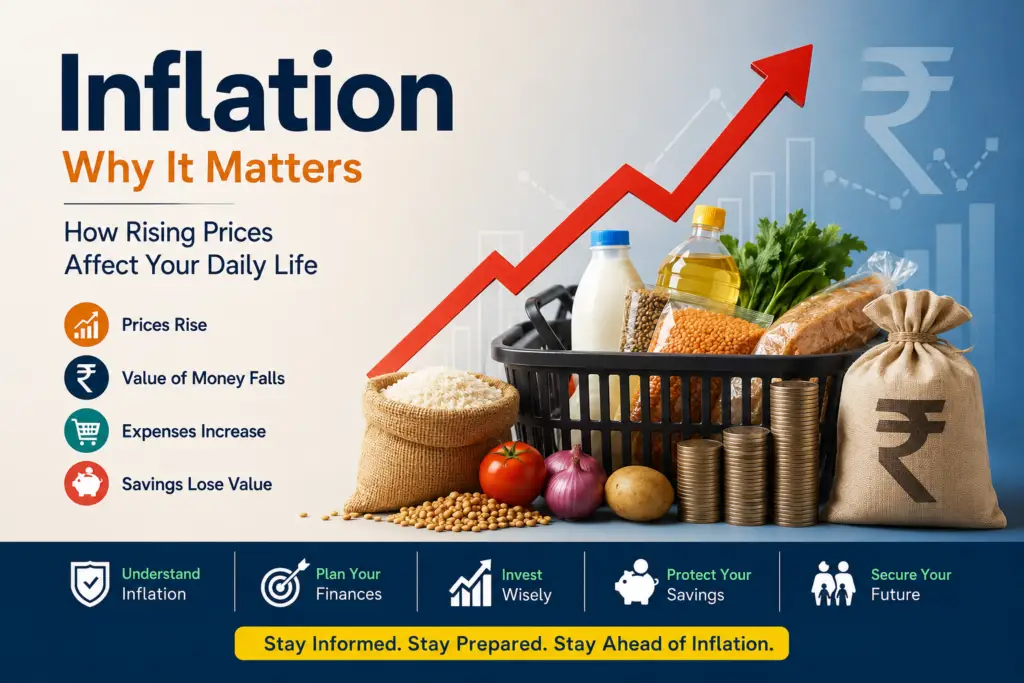
Have you noticed grocery bills increasing every month? A tea that cost ₹10 earlier may now cost ₹15. Petrol prices, school fees, house rents, and even movie tickets keep rising slowly. This is called inflation.
In simple words, inflation means the increase in prices of goods and services over time. Because of inflation, the value of money decreases gradually. What could Rs.100 buy five years ago can’t buy the same with Rs.100 today. Many Indian families feel this pressure daily. Salaries may increase slowly, but expenses often rise faster. Therefore, understanding inflation in India becomes very important for proper financial planning.
Importance of Understanding Inflation
Inflation is not just an economic term used by experts. It directly affects our kitchen budget, savings, investments, and future goals.
If your savings grow at 5% but inflation rises at 7%, your money is actually losing value. That is why simply saving money in a bank account may not always be enough.
Moreover, inflation impacts every age group differently. Students face higher education costs. Families struggle with monthly expenses. Retired people worry about medical costs and fixed income.
Therefore, learning how inflation affects daily life helps people make smarter financial decisions.
What Is Purchasing Power?
Purchasing power means how much goods or services your money can buy.
For example, ten years ago, ₹1,000 could buy a full month of groceries for some families in smaller towns. Today, the same amount may cover only a few days of expenses.
This shows that inflation slowly reduces purchasing power.
Because of this, financial planning should always consider future inflation. Otherwise, long-term goals like buying a house, child education, or retirement planning may become difficult.
How Inflation Is Measured?
Consumer Price Index (CPI)
The Consumer Price Index (CPI) is one of the most important tools used to measure inflation. CPI measures the average price changes faced by consumers.
It includes daily essentials like:
- Rice
- Milk
- Petrol
- Electricity
- School fees
- Medical expenses
Therefore, CPI reflects the real inflation pressure on Indian households.
Producer Price Index (PPI)
PPI tracks inflation from the manufacturer’s side.
It measures the cost businesses pay for raw materials, transportation, and production.
If factory-level costs rise today, retail prices often increase later. That is why PPI helps economists predict future inflation trends.
Core Inflation vs Headline Inflation
Headline inflation includes everything, including food and fuel prices.
Core inflation excludes food and energy because these prices change very frequently.
For example, petrol prices may rise suddenly due to global events. Similarly, vegetable prices may fluctuate because of seasonal supply changes. Therefore, experts study both types to understand long-term inflation trends better
It tracks the prices of common household items like food, fuel, clothes, transport, education, and healthcare.
In India, government agencies monitor CPI regularly to understand how fast prices are increasing. When CPI rises continuously, inflation becomes a concern for both families and businesses.
Therefore, CPI helps policymakers decide whether actions are needed to control rising prices.
What Causes Inflation in India?
1. Demand-Pull Inflation
Demand-pull inflation happens when people spend more money than the economy can supply.
For example, during festive seasons like Diwali, demand for gold, electronics, and clothes rises sharply. If supply becomes limited, prices automatically increase.
Similarly, rapid urban growth and higher income levels can also push demand higher.
As a result, businesses increase prices because consumers are willing to pay more.
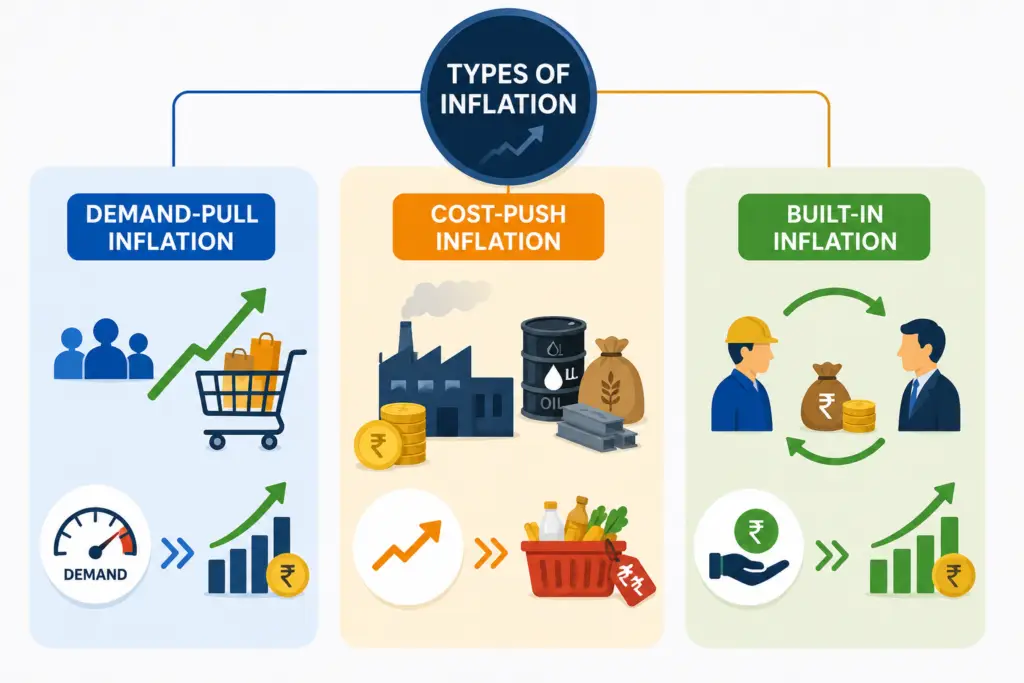
2. Cost-Push Inflation
Cost-push inflation occurs when production costs rise.
If fuel prices increase, transportation becomes expensive. Then vegetable prices, food delivery costs, and manufacturing expenses also rise.
In India, monsoon issues sometimes affect crop production. Consequently, food prices increase across markets.
Therefore, even when customer demand stays normal, businesses may still raise prices to protect profits.
3. Built-In Inflation
Built-in inflation is connected to salaries and wages.
When employees demand higher salaries due to rising living costs, companies spend more on payroll. Businesses then increase product prices to recover those costs.
This creates a cycle called the wage-price spiral. For example, if transportation workers demand higher pay due to fuel inflation, delivery charges may rise. Eventually, consumers pay more for products and services.
Real-Life Indian Scenario: How Inflation Affects Families
A middle-class family in Hyderabad may spend:
- ₹8,000 on groceries
- ₹3,000 on fuel
- ₹12,000 on rent
After a few years of inflation, the same family may spend nearly double for similar needs.
However, salaries may not increase at the same speed.
Because of this gap, many families reduce entertainment spending, postpone travel plans, or delay investments. This is exactly how inflation affects daily life across India.
Winners and Losers During Inflation
Winners
| Category | Winners During Inflation | Why They Benefit |
| Borrowers | Home loan borrowers, business loan holders | Fixed EMI stays same while income may increase over time |
| Real Estate Owners | Property investors | Property values and rents may rise during inflation |
| Businesses Selling Essentials | Grocery stores, medical shops, FMCG companies | Demand for essential products usually remains stable |
| Equity Investors | Long-term stock market investors | Strong companies may increase profits and prices |
| Gold Investors | Gold holders | Gold is often seen as a hedge against inflation |
Losers
| Category | Losers During Inflation | Why They Face Losses |
| Savings Account Holders | People keeping idle cash in banks | Savings growth may be lower than inflation rate |
| Retired Individuals | Pension-dependent people | Fixed income struggles to match rising expenses |
| Salaried Employees | Employees with low salary hikes | Purchasing power falls if salary growth is slow |
| Small Businesses | Businesses with weak pricing power | Rising costs reduce profit margins |
| Fixed Deposit Investors | Traditional FD investors | Returns may not beat long-term inflation |
| Situation | Before Inflation | After Inflation |
| Monthly Grocery Bill | ₹4,000 | ₹6,500 |
| Petrol Expense | ₹2,500 | ₹4,000 |
| Salary Increase | ₹40,000 | ₹42,000 |
| Actual Purchasing Power | Comfortable | Financial pressure increases |
Inflation creates both opportunities and challenges.
Therefore, smart investment planning, diversified assets, and long-term financial discipline become important to protect wealth during rising prices.
How Inflation Changes Everyday Spending Habits
Inflation not only increases prices but also changes how people spend money in daily life. Many families start reducing unnecessary expenses like eating outside, online shopping, or entertainment. Instead, they focus more on essential needs such as groceries, rent, fuel, and healthcare.
People also begin searching for discounts, budget-friendly products, and better savings options. Some may postpone buying vehicles, electronics, or property because prices become expensive.
At the same time, smart financial planning becomes more important. Families try to control monthly budgets, avoid unnecessary loans, and look for investments that can grow faster than inflation.
Therefore, understanding spending habits during inflation helps beginners make smarter money decisions and avoid financial stress in the future.
How Governments and Central Banks Control Inflation
Monetary Policy
The Reserve Bank of India controls inflation mainly through interest rates.
When inflation rises too much, interest rates may increase. This makes loans expensive and reduces unnecessary spending.
Consequently, demand slows down and prices stabilize gradually.
Fiscal Policy
The government also uses taxes and public spending to control inflation.
For example:
- Reducing fuel taxes can lower transportation costs.
- Increasing food supply can reduce price pressure.
Therefore, both government and central banks work together to maintain economic balance.
Why Zero Inflation Is Not Ideal
Many people think zero inflation sounds perfect. However, very low inflation can slow economic growth.
If prices continuously fall, businesses may reduce production and jobs. This situation is called deflation.
Therefore, moderate inflation is considered healthy for a growing economy like India.
Best Ways to Protect Yourself From Inflation
Build Smart Investments
Keeping all money in savings accounts may not beat inflation.
Instead, consider:
- SIP investments
- Equity mutual funds
- Gold
- Real estate
- Emergency funds
Long-term investments usually help money grow faster than inflation.

Increase Financial Awareness
Financial literacy helps families make smarter decisions.
Understanding budgeting, investing, insurance, and retirement planning can reduce inflation pressure significantly. Moreover, regular financial reviews help identify unnecessary expenses early.
Alfinz – Financial Planning Approach
Every family faces different financial challenges.
Some people want retirement security. Others focus on child education or wealth creation.
Therefore, a personalized financial planning approach works better than random investment decisions.
At Alfinz, we believe financial guidance should be simple, practical, and beginner-friendly.
Understanding inflation today can help protect your future tomorrow.
FAQ
No. Moderate inflation is normal in a growing economy. However, very high inflation can reduce purchasing power and increase financial stress
Inflation causes a progressive decline in purchasing power & reduces the real value of money over time. If savings grow slower than inflation, purchasing power decreases
Long-term investments like SIPs, mutual funds, and diversified assets may help money grow faster than inflation.
Food prices may rise due to weather issues, transportation costs, fuel prices, and supply shortages.
Yes. If salaries do not increase at the same pace as inflation, real income and purchasing power decline
Conclusion:
Inflation Cannot Be Stopped, But It Can Be Managed
Inflation is part of every growing economy. While rising prices may feel frustrating, proper planning can reduce financial pressure.
Understanding inflation in India helps people make better saving, spending, and investment decisions.
Small financial steps taken today can create stronger financial security tomorrow. Therefore, instead of fearing inflation, learn how to manage it wisely
Feeling Your Expenses Increasing Every Month?
Do not wait until savings become insufficient.
Start Your Financial Planning Today With Alfinz
✔ Understand your financial goals
✔ Protect savings from inflation
✔ Build long-term wealth
✔ Create a smarter investment strategy
Book Your Financial Consultation Now Before Inflation Impacts Your Future Further.
Need personalized financial guidance?
Contact Alfinz today for Investments, Insurance, Loans, Taxation & Financial Planning assistance.
Disclaimer: This article is published for general educational and informational purposes only. The content shared is based on common financial planning principles and personal finance awareness. It should not be considered professional financial, investment, tax, legal, or insurance advice. Financial decisions should always be made based on individual goals, risk profile, income, and personal circumstances. Readers are advised to consult a qualified financial advisor or professional before making any financial or investment decisions. Alfinz shall not be responsible for any financial loss or decisions taken based on this content.

Alfinz is a trusted financial advisory platform with 10+ years of experience in financial planning, wealth creation, retirement planning, mutual funds, stock market guidance, insurance, loans, and taxation services. We help individuals and families achieve financial freedom through personalized strategies, expert advice, transparent service, and long-term investment solutions.

Shiva Kumar is the Founder of ALFINZ, a financial planning and investment advisory platform dedicated to helping individuals make informed financial decisions. He holds NISM certifications in Equity Derivatives, Currency Derivatives, Equity Research Analysis, and Mutual Fund RTA. Through ALFINZ, he shares practical insights on financial planning, stock market investing, mutual funds, insurance, taxation, and wealth creation.