Choosing a stock brokers in India is one of the first financial decisions a new investor makes. But with so many apps and offers, selecting the right one can feel confusing.
The stock brokers in India are not necessarily the same for every investor. A beginner, long-term investor and active trader can have very different needs.
Therefore, instead of looking only at advertisements or Rs.0 brokerage offers, it is better to compare costs, technology, products, customer support and regulatory safeguards.
Why Does Choosing the Right Stock Broker Matter?
Your broker is the bridge between you and the stock market. The right platform can make investing simple, while the wrong choice can create unnecessary costs and frustration.
Moreover, brokerage is only one part of the picture. Platform stability, order execution, research tools, account charges and security also matter.
For example, imagine an investor buying shares worth Rs.2 lakh for long-term investment. Small changes in brokerage cost is very little
However, an active trader placing many orders every month can feel the impact of brokerage and other charges much more clearly.
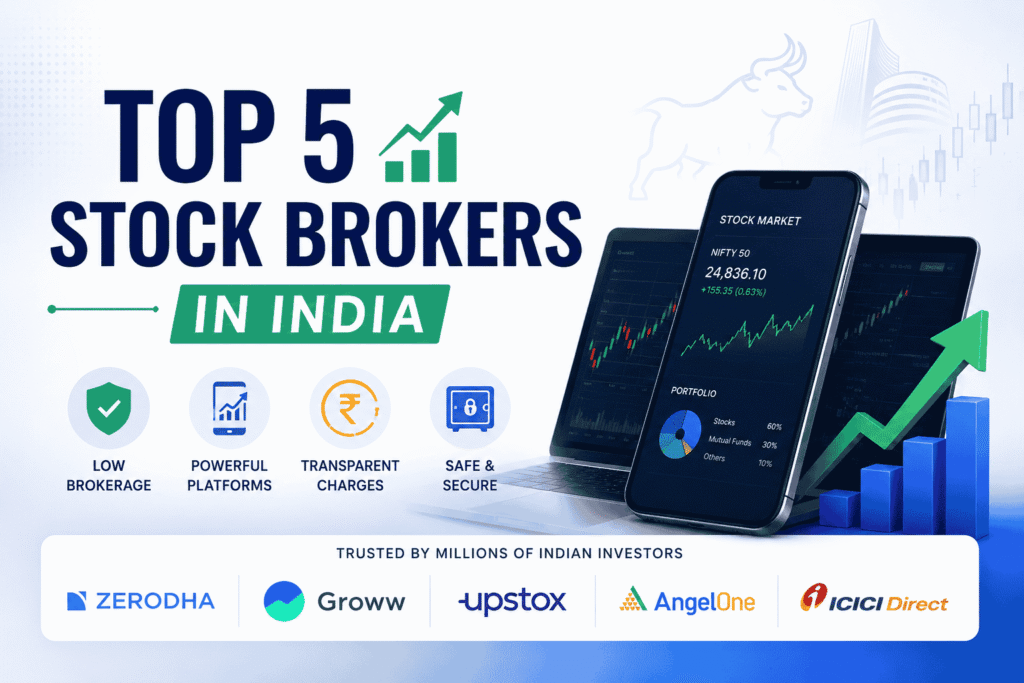
Therefore, the top 5 stock brokers in India should be evaluated according to the investor’s actual requirements.
Discount Broker vs Full-Service Broker
A discount broker generally focuses on low-cost execution and technology. These platforms are popular among investors who prefer to research and make decisions themselves.
A full-service broker may provide additional research, advisory support, relationship services and other financial products. However, the pricing structure can be different.
Neither model is automatically better.
Instead, the right choice depends on whether you need only a trading platform or want additional support around your investments.
Also Read: Which Stock Broker Is Better: Full-Service or Discount?
How We Evaluate the Top 5 Stock Brokers in India
There is no single formula for deciding which broker is best. However, some practical factors can make the comparison more meaningful.
1. Active Client Base
The number of active clients gives an indication of the scale of a broker. It does not prove that a broker is best, but it provides useful market context.
For July 2026, publicly reported NSE active-client data placed Groww, Zerodha, Angel One, ICICI Securities and Upstox among the largest brokers by active clients.
2. Brokerage and Other Charges
Investors should check brokerage, AMC, DP charges, statutory taxes and other transaction costs.
Most importantly, never assume that “zero brokerage” means zero cost.
Government and exchange charges can still apply to a trade.
3. Technology and Trading Platform
A good trading app should be easy to use, stable and responsive.
Investors should look at charts, watchlists, order types, portfolio tracking, market information and the quality of the web platform.
During highly volatile market sessions, platform reliability becomes even more important.
4. Regulation and Trust
Before opening an account, verify that the broker is properly registered and understand how your trading and demat accounts are structured.
SEBI-registered intermediaries operate within India’s regulatory framework, while exchanges and depositories provide additional market infrastructure.
Top 5 Stock Brokers in India
1. Groww
Groww has become one of India’s largest retail investing platforms. Its simple interface has made it especially popular among beginners and first-time investors.
You can place orders for stocks, mutual funds, IPOs and F&O in one place. Groww currently states that it has more than 1.4 crore active customers and identifies itself as a SEBI-registered stock broker and CDSL/NSDL participant.
Account Opening and AMC
Groww currently lists Rs.0 for trading and Demat account opening and Rs.0 AMC on its pricing page.
Brokerage
For equity trading, Groww lists Rs.20 or 0.1% per executed order, whichever is lower, subject to its stated minimum brokerage rules.
F&O trades cost a flat Rs.20 per completed order.
Pros
- Beginner-friendly interface
- Stocks, mutual funds, IPOs and F&O
- Simple account-opening process
- Rs.0 AMC currently listed
- Useful research and charting features
Cons
- Active traders should carefully compare total costs
- Some advanced features may not suit every professional trader
Best suited for: Beginners and investors who prefer a simple investment experience.
2. Zerodha
Zerodha is one of India’s best-known discount brokers and has played a major role in popularising low-cost online investing.
Its Kite platform is widely used for stocks and trading, while its ecosystem also includes Console and Coin.
Zerodha currently have Over 1.6 Crore total users enrolled in their ecosystem & approximately 68 Lakh active traders.
Account Opening and AMC
Zerodha currently states that new resident individual accounts get the first year free, while non-BSDA Demat accounts are charged Rs.300 per year plus GST after the applicable free period.
Brokerage
Equity delivery is currently Rs.0 brokerage.
Intraday and futures are charged at 0.03% or Rs.20 per executed order, whichever is lower. Options are Rs.20 per executed order.
Pros
- Strong trading platform
- Rs.0 equity delivery brokerage
- Powerful charting and market tools
- Popular among active investors
- Direct mutual fund investing
Cons
- New investors might need a little time to understand the platform
- Investors looking for traditional relationship-based advisory support may prefer another model
Best suited for: DIY (Do It Yourself) investors, experienced users and active traders.
3. Angel One
Angel One combines discount broking with a wider range of investment and research-related features.
Its platform offers stocks, F&O, commodities and other investment services. The broker also provides different pricing plans.
Account Maintenance
Angel One currently states that AMC is zero for the first year. For non-BSDA clients, it lists Rs.60 plus GST per quarter from the second year, subject to its applicable conditions.
Brokerage
Its current Plus plan lists equity delivery at Rs.20 or 0.1%, whichever is lower, with a minimum brokerage of Rs.5.
Intraday and F&O brokerage are listed at Rs.20 per executed order under the Plus plan.
Pros
- Large active client base
- Strong mix of investing and trading features
- Research and screening tools
- MTF availability
- Multiple pricing plans
Cons
- Investors should understand which pricing plan applies
- MTF and other leveraged products can increase financial risk
Best suited for: Beginners who want more features as they progress and active market participants.
4. ICICI Direct
ICICI Direct follows a different model from many pure discount brokers. It offers brokerage plans designed for different investing and trading requirements.
This can appeal to investors who prefer an established financial-services ecosystem.
Brokerage
ICICI Direct currently lists delivery brokerage starting from 0.07% under its Prime 9999 plan.
Its iValue plan lists Rs.20 per order for equity intraday, futures, options and commodities.
MTF and Other Services
ICICI Direct also offers Margin Trading Facility and other financial products. Its published pricing currently shows MTF rates that vary by plan.
Pros
- Established financial-services brand
- Wide range of financial products
- Multiple brokerage plans
- Research and investment services
- Suitable for investors wanting a broader financial ecosystem
Cons
- Pricing can be more complex than a simple flat-fee broker
- Investors should compare the plan carefully before choosing
Best suited for: Investors who value an established full-service ecosystem and multiple financial products.
Also Read: How to Open a Demat Account for Beginners in India
5. Upstox
Upstox is another major technology-focused broker in India and has built a strong retail customer base.
You can invest in stocks, mutual funds, IPOs, and F&O entirely online through its digital platform.
Brokerage
Upstox currently lists Rs.20 per executed order for equity delivery, Rs.20 or 0.1% for intraday, whichever is lower, and Rs.20 or 0.05% for equity futures, whichever is lower.
Equity options are listed at Rs.20 per executed order.
AMC
Upstox currently states that there is no AMC during the first year for newly on boarded customers. Non-BSDA accounts are listed at ₹300 plus GST after the applicable period.
Pros
- Modern trading platform
- Competitive pricing
- Stocks, IPOs and mutual funds
- F&O facilities
- Useful tools for active users
Cons
- Active traders should compare total transaction costs
- MTF and leveraged products require careful risk management
Best suited for: Digital-first investors and active traders.
Top 5 Stock Brokers in India – Quick Comparison
| Broker | Equity Delivery | Intraday | F&O | AMC* |
| Groww | Rs.20 or 0.1%, lower | Rs.20 or 0.1%, lower | Rs.20/order | Rs.0 currently listed |
| Zerodha | Rs.0 (Zero) | Rs.20 or 0.03%, lower | Rs.20/order options | First year Rs.0 & Rs.300 + GST after applicable free period |
| Angel One | Rs.20 or 0.1%, lower | Rs.20/order | Rs.20/order | First year Rs.0 |
| ICICI Direct | Plan-based | Rs.20 under iValue | Rs.20 under iValue | Plan-based |
| Upstox | Rs.20/order | Rs.20 or 0.1%, lower | Rs.20/order options | First year Rs.0 |
*Charges can change. Brokerage plans, BSDA eligibility and other conditions may affect the actual amount payable. Always check the broker’s latest tariff before opening an account.
The comparison shows an important point: the top 5 stock brokers in India do not have identical pricing models.
So, the cheapest-looking option may not always be the most suitable option for your trading style.
What Are the Hidden Costs of Stock Trading?
Many beginners focus only on brokerage.
However, a trade can also involve STT, exchange transaction charges, SEBI turnover charges, GST, stamp duty and DP charges.
For example, Zerodha explicitly notes that STT can sometimes be significantly higher than brokerage.
Groww also separately lists STT, exchange charges, SEBI charges, stamp duty, GST and DP charges.
Therefore, always look at the total cost of trading, not just the advertised brokerage.
What Are DP Charges?
DP charges generally apply when securities are debited from your Demat account during a sale.
For example, Groww currently lists a DP charge structure involving depository and broker charges on eligible equity delivery sales.
Angel One similarly states that DP charges apply to equity delivery sell transactions and not to intraday trades or delivery purchases.
This is why a “₹0 brokerage” offer should never be interpreted as “₹0 total trading cost.”
Also Read: Demat Account Charges: The Hidden Wealth-Eaters Every Beginner should Know
A Real-Life Indian Investor Scenario
Imagine Rahul, a 28-year-old salaried employee, wants to start investing with Rs.10,000 every month.
He searches online for the best broker and immediately chooses the app offering zero brokerage.
However, Rahul later starts buying ETFs, participating in IPOs and occasionally trading intraday.
His requirements have changed.
Now he needs good portfolio tracking, research tools, reliable execution and a cost structure that suits his behaviour.
Similarly, imagine Priya, who trades several times a week.
For her, platform stability and order execution may matter more than saving a small amount on occasional delivery purchases.
Therefore, the best broker is not necessarily the one with the lowest advertised brokerage.
It is the broker that fits your investment behaviour, frequency and financial needs.
How Should a Beginner Choose a Stock Broker?
Start with your purpose.
If you are investing for 10–15 years, focus on platform simplicity, investment products, AMC and overall reliability.
If you trade frequently, compare brokerage, transaction costs, charting, order types and platform performance.
If you need research or broader financial services, consider whether a full-service model adds value for you.
Most importantly, check the latest pricing page before opening the account because brokerage and charges can change.
The stock brokers in India should therefore be treated as a starting point for comparison, not as a one-size-fits-all recommendation.
What About Account Security?
Security should be treated as seriously as brokerage.
Use strong passwords, enable available two-factor authentication, keep your registered mobile number and email updated and regularly check transaction alerts.
Never share your OTP, password or trading credentials with another person.
Also, monitor your Demat and trading statements regularly.
This is particularly important because a small saving in brokerage is meaningless if account security is ignored.
Which Broker Is Best for You?
Best for Beginners
A simple platform with easy navigation, transparent charges and useful educational features may be more suitable.
Best for Long-Term Investors
Look at delivery costs, AMC, mutual fund facilities, IPO access, portfolio tracking and ease of investing.
Best for Active Traders
Focus on order execution, platform reliability, charting, brokerage and total transaction costs.
Best for Full-Service Requirements
Investors who value research, relationship support and a wider financial ecosystem may prefer a full-service broker.
Therefore, don’t select a broker only because it appears first on a Google search or social media list.
FAQs
The best broker depends entirely on what a beginner needs. Groww, Zerodha, Angel One, Upstox and ICICI Direct all have different features and pricing structures.
Choose according to your investment style, budget and level of experience.
No. Zero brokerage generally refers to a particular transaction or segment.
STT, GST, exchange charges, stamp duty, SEBI charges and DP charges may still apply depending on the transaction.
For long-term investing, compare equity delivery brokerage, AMC, DP charges, mutual funds, IPOs, platform usability and reliability.
Do not choose only on the basis of intraday or F&O brokerage.
Yes, an investor can maintain multiple Demat and trading accounts with different brokers, subject to applicable KYC and account requirements.
However, maintaining multiple accounts may also mean additional administrative work and AMC.
Yes. Brokers can revise their pricing structures and charges.
Therefore, always verify the latest official pricing page and tariff sheet before opening an account or placing trades.
Alfinz Final Verdict
The top 5 stock brokers in India—Groww, Zerodha, Angel One, ICICI Direct and Upstox—offer different combinations of pricing, technology, products and services.
However, choosing a broker should not become a popularity contest.
A beginner may value simplicity. An active trader may prioritise platform performance. A long-term investor may care more about delivery investing, AMC and portfolio facilities.
Therefore, compare the complete cost and service experience before making your decision.
Most importantly, remember that a broker is only a tool. Your investment goals, asset allocation, risk management and financial discipline ultimately have a much greater impact on long-term wealth creation.
🚨 Don’t Choose a Broker in a Hurry
Before opening a Demat account, compare brokerage, AMC, DP charges, platform features and your actual investment requirements.
If you’re confused about which type of broker or investment approach may suit your financial goals, get professional guidance before committing your hard-earned money.
Need Help Choosing the Right Demat Account?
Contact Alfinz today for beginner-friendly financial guidance, investment planning, SIP support, and Demat Account assistance.
Contact Alfinz Today for Personalized Investment Guidance Before You Start Investing
Need personalized financial guidance?
Contact Alfinz today for Investments, Insurance, Loans, Taxation & Financial Planning assistance.
Disclaimer: This article is published for general educational and informational purposes only. The content shared is based on common financial planning principles and personal finance awareness. It should not be considered professional financial, investment, tax, legal, or insurance advice. Financial decisions should always be made based on individual goals, risk profile, income, and personal circumstances. Readers are advised to consult a qualified financial advisor or professional before making any financial or investment decisions. Alfinz shall not be responsible for any financial loss or decisions taken based on this content.

Shiva Kumar is the Founder of ALFINZ, a financial planning and investment advisory platform dedicated to helping individuals make informed financial decisions. He holds NISM certifications in Equity Derivatives, Currency Derivatives, Equity Research Analysis, and Mutual Fund RTA. Through ALFINZ, he shares practical insights on financial planning, stock market investing, mutual funds, insurance, taxation, and wealth creation.