
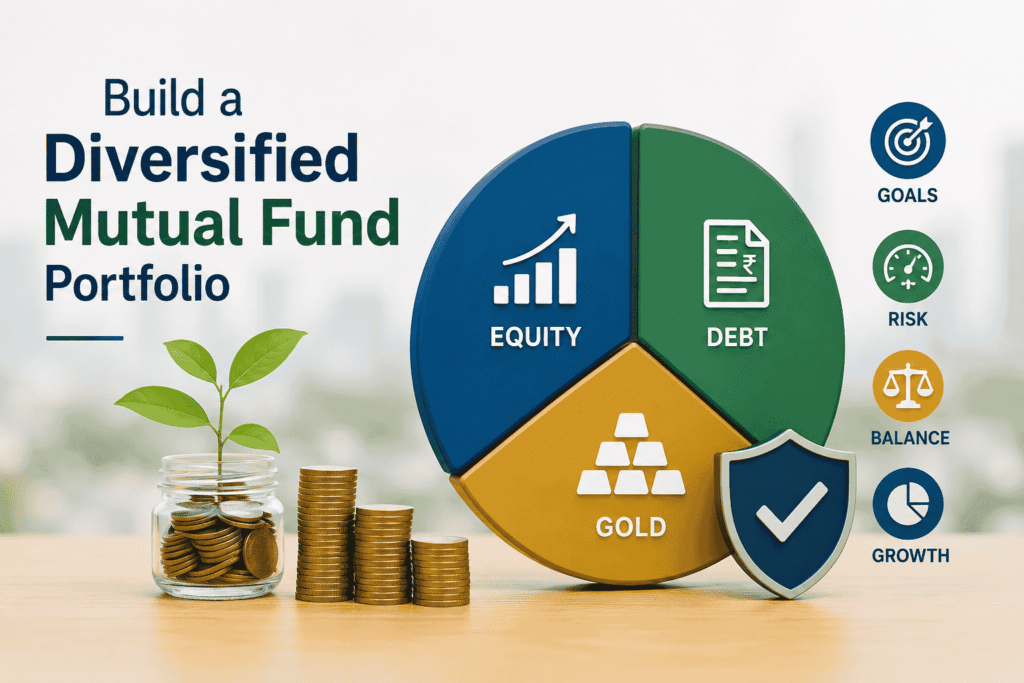
Building wealth through mutual funds is not only about investing regularly. More importantly, it is about investing wisely. Many investors believe diversified mutual fund automatically creates portfolio protection & wealth creation.
However, that is one of the biggest misconceptions in investing.
A diversified mutual fund portfolio helps you spread investments across different asset classes, industries, and market segments.
As a result, your portfolio becomes more stable during market ups and downs while still giving your money an opportunity to grow over the long term.
At Alfinz, we often meet investors who own five or six mutual funds. Surprisingly, all those funds invest in almost the same companies. Sharing money across multiple funds did not lower their risk.
This guide explains everything in simple Indian English. Moreover, it shares practical portfolio allocation frameworks that conservative, moderate, and aggressive investors can use confidently.
Why Is Building a Diversified Mutual Fund Portfolio Important?
Every investment carries some level of risk. However, not every risk can be avoided. The good news is that many investment risks can be reduced through proper diversification.
Imagine travelling from Hyderabad to Bengaluru using only one road. If that road gets blocked, your journey stops. Instead, if multiple routes are available, you still reach your destination. Investing works in a similar way.
A diversified mutual fund portfolio spreads your money across different investment options. Consequently, if one investment performs poorly, another may balance the overall returns.
This strategy helps investors stay calm during market corrections. Moreover, it prevents one poor-performing asset from damaging long-term wealth creation.
Most importantly, diversification encourages disciplined investing instead of emotional decision-making.
A Real-Life Indian Scenario
Rajesh, a 35-year-old software engineer from Hyderabad, wanted to start investing for his daughter’s education and retirement. He searched online and selected five popular large-cap mutual funds because each had excellent ratings.
Initially, he felt confident because he believed owning five funds meant good diversification.
However, during a portfolio review, we noticed that nearly 65% of his investments were in the same companies, including Reliance Industries, HDFC Bank, ICICI Bank, Infosys, and TCS.
Although he owned multiple schemes, his actual diversification was very limited.
Instead of adding more similar funds, we redesigned his portfolio by combining equity, debt, and gold. We also included different fund categories based on his financial goals.
Consequently, his portfolio became more balanced without increasing the number of funds. This is one of the most common situations we see while reviewing investor portfolios.
I. Understanding Portfolio Diversification in Mutual Funds
What Is Mutual Fund Diversification?
Many beginners think diversification simply means buying multiple mutual funds.
However, true diversification means investing in different asset classes and investments that do not move exactly in the same direction.
For example, a portfolio containing only five large-cap funds is not diversified because most of those funds own similar companies.
Instead, a well-balanced diversified mutual fund portfolio may include:
- Equity Mutual Funds
- Debt Mutual Funds
- Gold ETFs or Gold Mutual Funds
- Hybrid Funds
- International Funds (where suitable)
Each investment reacts differently to market conditions. Therefore, overall portfolio risk reduces over time.
Also Read:- Types of Investing: A Beginner’s Guide to Wealth Creation
Moving Beyond Owning Multiple Funds
Owning more funds does not automatically reduce risk.
Imagine buying five different brands of rice. Although the packaging differs, the product remains almost the same.
Similarly, many mutual funds hold identical stocks.
For example,
| Fund A | Fund B | Fund C |
| * Reliance Industries * HDFC Bank * Infosys | * Reliance Industries * ICICI Bank * TCS | * Reliance Industries * HDFC Bank * Larsen & Toubro |
Although these are different funds, the underlying investments overlap significantly.
Consequently, investors may unknowingly take concentrated exposure instead of diversification.
Core Benefits of a Diversified Mutual Fund Portfolio
1. Reduces Non-Systematic Risk
Company-specific risks cannot be predicted.
If one company faces poor earnings or regulatory issues, diversified investments reduce the overall impact.
Therefore, your portfolio becomes more resilient.
2. Provides Smoother Returns
Different asset classes rarely perform well at the same time.
When equity markets fall, debt funds or gold may perform better.
Consequently, portfolio volatility decreases.
This smoother journey helps investors remain invested for longer periods.
3. Protects Against Major Losses
No investment performs well every year.
However, diversification ensures that one weak investment does not destroy your entire portfolio.
Most importantly, it protects long-term wealth creation.
4. Improves Emotional Discipline
Sharp market corrections often create panic.
However, investors holding diversified portfolios usually experience lower portfolio declines.
As a result, they are less likely to sell investments at the wrong time.
Also Read: The Ultimate Beginner’s Guide to Stock Market Investing in India
The Hidden Danger of Over-Diversification
Many investors believe adding more funds always improves diversification.
Unfortunately, that is not true.
Investment experts often call this “Diworsification.”
Diworsification happens when investors continue adding similar mutual funds without improving actual diversification.
For example,
- Large Cap Fund A
- Large Cap Fund B
- Large Cap Fund C
- Large Cap Fund D
Although four funds are held, all may own nearly identical stocks.
Instead of reducing risk, investors only increase:
- Portfolio complexity
- Tracking difficulty
- Expense ratio
- Tax reporting effort
Meanwhile, investment performance remains almost unchanged.
Therefore, quality diversification is always better than quantity.
II. Assessing Your Risk Profile and Investment Horizon
Before selecting any mutual fund, investors must understand themselves first.
Choosing funds without knowing your risk profile is similar to buying shoes without checking the size.
Eventually, discomfort becomes unavoidable.
Risk Tolerance vs Risk Capacity
These two terms sound similar, but they are completely different.
Risk Tolerance
Risk tolerance measures how comfortable you feel during market volatility.
For example, if your portfolio falls by 20%, will you stay invested or panic?
Your emotional response determines your risk tolerance.
Risk Capacity
Risk capacity measures how much financial risk you can actually afford.
For example, a 28-year-old software engineer with stable income and no major liabilities usually has higher risk capacity than someone retiring next year.
Therefore, investment decisions should balance emotions with financial reality.
Also Read: Why Should One Invest? Importance of Investing for a Better Future
Align Your Portfolio with Financial Goals
Every financial goal has a different investment strategy.
For example,
Short-Term Goals (Less than 3 Years)
Examples include:
- Emergency fund
- Vacation
- Vehicle purchase
Suitable investments generally include:
- Liquid Funds
- Overnight Funds
- Ultra Short Duration Funds
Capital safety becomes the priority.
Medium-Term Goals (3–7 Years)
Examples include:
- Higher education
- Home down payment
- Business expansion
Balanced portfolios combining equity and debt usually work well.
Long-Term Goals (More than 7 Years)
Examples include:
- Retirement
- Child’s education
- Financial independence
- Wealth creation
Equity mutual funds generally play a larger role because they have more time to recover from market fluctuations.
Therefore, investors can tolerate higher short-term volatility in exchange for better long-term growth potential.
III. Implementing the 3 Safe Portfolio Allocation Frameworks
Many investors ask us one common question:
“Which mutual fund portfolio is the best?”
Our answer is always the same.
There is no one-size-fits-all portfolio. Instead, the best diversified mutual fund portfolio depends on your financial goals, risk profile, and investment horizon.
Below are three practical frameworks we commonly discuss with investors. These are educational examples and should be tailored to individual circumstances.
Framework 1: Conservative Portfolio (Capital Preservation Focus)
Who Is This Suitable For?
This framework may suit investors who:
- Prefer stability over high returns
- Are nearing retirement
- Need regular income
- Are saving for short to medium-term goals
- Feel uncomfortable with sharp market fluctuations
The primary objective is capital protection with moderate growth.
Suggested Asset Allocation
| Asset Class | Allocation |
| Debt Funds | 70% |
| Equity Funds | 25% |
| Gold | 5% |
The larger allocation to debt aims to reduce volatility, while equity provides growth potential. Gold can act as a diversification component during uncertain periods.
Framework 2: Moderate Portfolio (Balanced Growth Focus)
This is one of the most popular allocations among long-term investors.
It aims to balance growth with stability.
Suitable For
This framework may fit investors who:
- Have a 7–15year investment horizon
- Want wealth creation with controlled risk
- Can tolerate temporary market declines
- Invest through monthly SIPs
Suggested Asset Allocation
| Asset Class | Allocation |
| Equity Funds | 50% |
| Debt Funds | 40% |
| Gold & Alternatives | 10% |
This allocation balances wealth creation with risk management. The larger equity portion aims to deliver long-term capital appreciation, while debt funds help reduce portfolio volatility.
Gold and other alternative assets provide additional diversification and may offer stability during periods of market uncertainty.
Also Read: Why Financial Planning is important in Every Human life
Framework 3: Aggressive Portfolio (Wealth Maximization Focus)
This framework is intended for investors who seek long-term capital appreciation and can tolerate significant market fluctuations.
Suitable For
This framework may be appropriate if you:
- Have a long investment horizon (10–20+ years)
- Are building retirement wealth
- Have stable income
- Can stay invested during market corrections
Suggested Asset Allocation
| Asset Class | Allocation |
| Equity | 80% |
| Debt | 15% |
| International / Sectoral | 5% |
A higher equity allocation increases growth potential but also increases short-term volatility.
Which Framework Should You Choose?
| Investor Type | Risk Level | Suggested Framework |
| Retired Investors | Low | Conservative |
| First-Time Investors | Moderate | Moderate |
| Salaried Professionals | Moderate | Moderate |
| Young Investors (Long Horizon) | High | Aggressive |
| Entrepreneurs | Depends on Cash Flow | Moderate or Aggressive |
| Parents Saving for Children | Depends on Goal Timeline | Moderate |
Remember, these are illustrative examples. Your actual allocation should reflect your financial goals, income, liabilities, and risk capacity.
IV. Selecting the Right Mutual Fund Categories
Choosing the correct category is often more important than choosing the highest-rated fund.
Many investors compare only recent returns. However, experienced investors look at how each category fits into the overall diversified mutual fund portfolio.
Equity Mutual Fund Categories
Large Cap Funds
Large-cap funds invest in well-established companies.
Advantages
- Lower volatility compared to mid and small caps
- Suitable for beginners
- Often form the foundation of an equity portfolio
Best suited for long-term wealth creation with relatively lower risk.
Mid Cap Funds
Mid-cap companies are in a growth phase.
They may offer higher return potential than large caps but usually come with greater volatility.
Choose these funds only if you plan to keep your money invested long-term.
Small Cap Funds
Small-cap funds invest in emerging businesses.
They can generate strong returns during favourable market conditions. However, they may also experience sharper declines during market downturns.
Therefore, keep the allocation limited within your portfolio.
Flexi Cap Funds
Flexi-cap funds can invest across large, mid, and small-cap companies.
Professional fund managers adjust allocations based on market opportunities.
This flexibility makes them a popular core holding for many investors.
ELSS Funds
Equity Linked Savings Schemes (ELSS) combine equity investing with tax benefits under prevailing tax laws.
They also have a mandatory lock-in period.
ELSS can be useful for investors seeking tax-efficient long-term investing, subject to eligibility.

Debt Mutual Fund Categories
Debt funds also vary in risk and purpose.
Understanding the differences helps you choose the right category.
Overnight Funds
These invest in securities with a one-day maturity.
They generally have very low interest rate risk and are commonly used for parking surplus money.
Ultra Short Duration Funds
Suitable for investors with investment horizons of a few months to around a year.
They generally aim to provide better return potential than savings accounts while carrying market-linked risks.
Gilt Funds
Gilt funds invest mainly in government securities.
While credit risk is relatively low, their prices can fluctuate significantly when interest rates change.
Therefore, understand interest rate risk before investing.
Multi-Asset Allocation Funds
These funds invest across:
- Equity
- Debt
- Gold
- Other asset classes
Because the allocation changes over time, they may offer built-in diversification.
Gold ETFs
Gold often behaves differently from equity markets.
During periods of uncertainty, it may help cushion portfolio volatility.
However, returns are not guaranteed, and performance can vary.
Silver ETFs
Silver has additional industrial demand alongside investment demand.
Although more volatile than gold, it can provide diversification when used in moderation.
V. Maintaining and Rebalancing Your Portfolio
Building a portfolio is only half the journey.
Maintaining it is equally important.
Market movements gradually change your original asset allocation.
Consequently, your portfolio may become riskier than intended.
Why Rebalancing Matters
Suppose your target allocation is:
- Equity – 50%
- Debt – 40%
- Gold – 10%
After a strong equity rally, the allocation becomes:
- Equity – 60%
- Debt – 32%
- Gold – 8%
Although your investments have grown, your risk level has also increased.
Rebalancing helps restore your desired allocation.
Avoid Emotional Investing
Market corrections are very common in long-term investing.
However, panic-selling during temporary declines can permanently damage wealth creation.
Successful investors generally follow a disciplined process:
- Continue SIPs during volatility.
- Avoid chasing the latest top-performing fund.
- Stick to the chosen asset allocation.
- Review the portfolio periodically instead of reacting to daily market movements.
Patience and consistency are often more valuable than trying to predict every market move.
FAQs
There is no fixed number. For many investors, a carefully selected portfolio of 4 to 6 complementary funds can provide adequate diversification without unnecessary complexity.
Not necessarily. Many large-cap funds own similar companies, leading to significant portfolio overlap.
It depends on their financial goals, risk tolerance, and time horizon. A mix of equity, debt, and other suitable asset classes is often more balanced than relying only on equity.
Gold may behave differently from equities and can help diversify a portfolio during certain market conditions. However, it should usually remain a limited allocation.
Many long-term investors review their portfolio at least once a year or when asset allocation deviates significantly from the target.
Neither is universally better. SIPs help with disciplined investing, while lumpsum investments may suit investors with available surplus funds and an appropriate long-term strategy.
Conclusion:
A diversified mutual fund portfolio is not about collecting the highest-rated funds or chasing recent winners. It is about creating a thoughtful mix of investments that work together to support your financial goals.
By understanding your risk profile, choosing the right fund categories, checking for portfolio overlap, using risk-adjusted performance metrics, and rebalancing periodically, you can build a portfolio that is more resilient across different market conditions.
Remember, successful investing is a marathon—not a sprint. Stay disciplined, review your portfolio regularly, and let long-term compounding work in your favour.
🚨 Don’t Build Your Mutual Fund Portfolio Alone
A poorly diversified portfolio can expose you to unnecessary risks, hidden fund overlap, and emotional investment decisions.
Contact Alfinz Today for Personalized Investment Guidance Before You Start Investing
Need personalized financial guidance?
Contact Alfinz today for Investments, Insurance, Loans, Taxation & Financial Planning assistance.
Disclaimer: This article is published for general educational and informational purposes only. The content shared is based on common financial planning principles and personal finance awareness. It should not be considered professional financial, investment, tax, legal, or insurance advice. Financial decisions should always be made based on individual goals, risk profile, income, and personal circumstances. Readers are advised to consult a qualified financial advisor or professional before making any financial or investment decisions. Alfinz shall not be responsible for any financial loss or decisions taken based on this content.

Shiva Kumar is the Founder of ALFINZ, a financial planning and investment advisory platform dedicated to helping individuals make informed financial decisions. He holds NISM certifications in Equity Derivatives, Currency Derivatives, Equity Research Analysis, and Mutual Fund RTA. Through ALFINZ, he shares practical insights on financial planning, stock market investing, mutual funds, insurance, taxation, and wealth creation.