
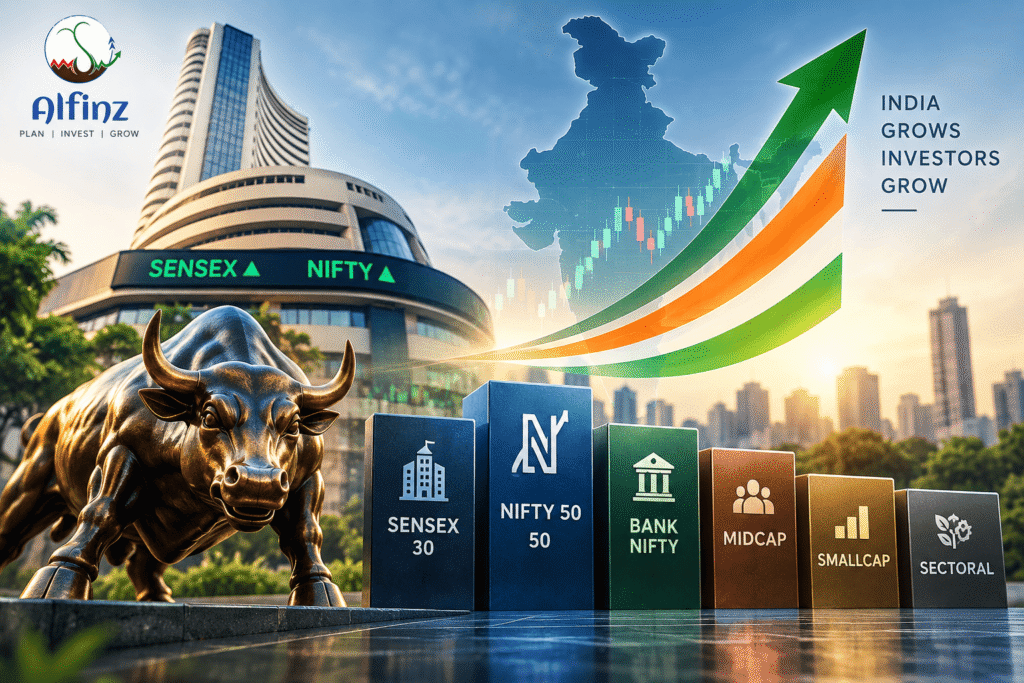
Stock market indices play a major role in Indian markets. Let us why?
When we hear on the news that “Nifty is up 150 points” or “Sensex fell 500 points,” many beginners immediately ask one question: What exactly moved?
Did all Indian stocks move in the same direction?”
No, this is where indices become important. An index is like a summary number that helps us understand how a selected group of stocks is performing.
Think of an index like a thermometer.
A thermometer does not measure the temperature of every object in your body. Instead, it gives you a quick indication of the overall temperature.
Similarly, an index does not represent every listed company. Instead, it tracks a selected group of companies and gives investors a quick picture of a particular part of the market.
Also Read: What are Depositories (CDSL/NSDL) in India? A Complete Guide
What Is a Stock Market Index?
A stock market index is a basket of selected stocks whose combined performance is represented by a single number.
For example, the Nifty 50 acts as a snapshot of the Indian economy by tracking 50 major companies. Its value is based on “free-float market capitalization,” which means it only looks at shares available for everyday trading.
Therefore, when Nifty moves up, it generally means that the combined weighted value of its constituent companies has increased.
However, this does not mean every stock has increased.
Some stocks may rise, some may fall, and others may remain almost unchanged.
That is why understanding the composition of an index is more useful than simply looking at its daily points.
How Did Stock Market Indices Develop in India?
India’s equity market has evolved significantly over several decades.
BSE SENSEX
The BSE SENSEX has been a trusted guide for Indian investors since its launch in 1986.
According to the BSE, it serves as a market benchmark by measuring 30 of the biggest, most stable, and easily tradable companies across key sectors.
To understand its growth, it helps to know that the index started with a baseline score of 100 during 1978–79.
The word SENSEX comes from Sensitive Index.
In simple terms, when you see SENSEX rising or falling, you are looking at the performance of this selected group of major companies.
Nifty 50
The Nifty 50 is the National Stock Exchange’s (NSE) main index and a key health indicator for the market.
It tracks 50 major companies from critical industries that drive the Indian economy.
The index started on November 3, 1995, with an initial value of 1,000, and calculates its numbers using only the shares available for public trading.
Investors and fund managers widely use it as a standard to measure portfolio performance, index funds, and ETFs.
Other Important Indian Stock Market Indices
Sensex and Nifty 50 aren’t the only options. The stock market has separate indices specifically designed to slice and dice the market into smaller, focused segments.
Examples include:
- Nifty Next 50
- Nifty Mid-cap
- Nifty Small-cap
- Nifty Bank etc
Nifty official index list includes broad-market, sectoral and strategy indices covering several segments.
For example, Take the Nifty Next 50, for instance: it features the next 50 companies from the Nifty 100 list once you remove the top 50 that make up the Nifty 50.

What Is the Composition of an Index?
This is very initial and the most important concepts for early learners to know.
Index composition simply means:
Which companies are included in the index, how much weight each company gets, and what rules decide inclusion or removal?
Imagine a classroom with 50 students.
If every student receives equal importance, everyone’s contribution is the same.
But if some students represent larger groups, their contribution may be different.
Indices work similarly.
Companies with more weight in an index have a bigger influence on whether the index goes up or down.
How Are Companies Selected for an Index?
Index providers use predefined rules.
These rules can include factors such as:
- Market capitalisation
- Free-float market capitalisation
- Liquidity
- Trading frequency
- Listing requirements
- Sector representation
- Availability of shares for public trading
Therefore, a company cannot simply enter Nifty 50 because its share price has increased sharply.
It must satisfy the relevant index methodology.
Liquidity is particularly important because an index should be investable and reasonably representative of actively traded companies.
Also Read: Large, Mid & Small Cap Stocks: What Investors Should Know
What Is Free-Float Market Capitalization?
This sounds complicated, but the idea is simple.
Suppose a company has:
1 crore shares × ₹100 = ₹100 crore market capitalisation
Now assume only 60 lakh shares are considered available for public trading.
The free-float market capitalisation would be:
60 lakh × ₹100 = ₹60 crores
Instead of treating every single stock the same, the index only looks at the shares that regular people can actually buy and sell.
This can exclude certain strategic or closely held holdings, depending on the methodology.
To calculate each company’s importance, the Nifty 50 uses the free-float market capitalization method.
Why Does Weightage Matter?
Suppose Nifty has two stocks.
Company A: 10% weight
Company B: 1% weight
If both stocks rise by 5%, Company A will have a much larger effect on the index.
Therefore, simply counting how many stocks are rising is not enough.
You also need to understand how much weight those stocks carry.
This explains why the main index can drop even if a lot of smaller companies are seeing their stock prices go up.
What Is Index Rebalancing?
Index composition is not permanent.
Companies can enter or leave an index when they no longer meet the required criteria or when another company becomes eligible.
This process is called index reconstitution or rebalancing, depending on the specific methodology.
For example, Nifty 50’s scheduled changes are implemented semi-annually, generally on the last working day of March and September.
Therefore, index composition can change over time as India’s corporate landscape changes.
Also Read: What Is SEBI & Why Is It Important for Investors?
Understanding the Different Ways Stock Indices
1. Benchmark Indices
These are used as broad indicators of market performance.
Examples include:
- BSE SENSEX
- Nifty 50
They are commonly used by investors, financial media and portfolio managers.
2. Market-Capitalisation Indices
These indices focus on companies according to their market-cap segment.
Examples include:
- Nifty Mid-cap 150
- Nifty Small-cap 100
- Nifty 500
- BSE Mid-cap
Therefore, investors can study different sections of the market rather than looking only at large companies.
3. Sectoral Indices
Sectoral indices focus on a particular industry.
Examples include:
- Nifty Bank
- Nifty IT
- Nifty Pharma
- Nifty Auto
- Nifty FMCG
For example, if you want to understand how the banking sector is performing, Nifty Bank may provide more relevant information than Nifty 50.
4. Thematic and Strategy Indices
These indices follow specific investment characteristics or themes.
Examples include:
- Nifty ESG
- Nifty Dividend Opportunities
- Nifty Alpha
- Nifty Low Volatility
- Nifty Value
- Nifty Quality
For instance, Nifty500 Value 50 selects companies based on value-related factors such as earnings-to-price, book-value-to-price, sales-to-price and dividend yield.
Why Are Stock Market Indices Important?
1. They Act as a Market Barometer
An index gives investors a quick snapshot of market movement.
When Nifty or Sensex moves sharply, investors immediately get an indication that major companies are experiencing significant buying or selling pressure.
However, an index should not be treated as a complete picture of every listed company.
2. They Help Investors Compare Performance
Suppose your portfolio generated 10% in one year.
Is that good or bad?
The answer cannot be understood by looking at your return alone.
You could compare your portfolio with an appropriate benchmark.
For example, a diversified large-cap portfolio may be compared with a relevant broad-market benchmark.
Therefore, indices provide a common reference point for performance evaluation.
Also Read: Why Is a Demat Account Important in India? Benefits
3. They Make Passive Investing Possible
This is where indices become directly relevant to ordinary investors.
Index mutual funds attempt to replicate the performance of a selected index instead of actively choosing stocks to outperform it.
Similarly, ETFs can track indices such as Nifty or Sensex and trade on stock exchanges like shares.
Consequently, investors can obtain exposure to a basket of companies through a single investment product.
4. They Are Used in Derivatives (F&O)
Nifty and Sensex are also incredibly popular because traders use them to bet on and protect against future market moves.
Futures and options can be based on major indices.
Therefore, traders and investors use index movements to understand market direction, hedge portfolios and construct different strategies.
However, derivatives involve significant risk and should not be approached simply because an index is moving rapidly.
Real-Life India Scenario: Why Index Composition Matters
Imagine you see this headline:
“Nifty falls 1% today.”
A beginner may think the entire Indian stock market has fallen equally.
But after checking the index composition, you may discover that large-weight companies declined sharply while many smaller companies were relatively stable.
This is why we always recommend looking beyond the headline.
The index is a weighted representation, not a simple count of rising and falling stocks.
5 Things Beginners Should Remember
1. An index is not the entire market
It represents a selected group of securities.
2. Weightage matters
Stocks with a higher percentage of the index have a much stronger influence on its overall movement.
3. Composition can change
Indices are periodically reviewed and reconstituted.
4. Sector exposure matters
An index can have meaningful exposure to particular industries.
5. Index movement does not equal your portfolio return
Your portfolio can perform differently depending on its stocks, allocation and investment strategy.
Also Read: How to List a Company in India: Sole Proprietor to BSE/NSE
FAQs
1. What is mean by stock market indices in India?
Stock market indices in India are baskets of selected stocks represented through a single index value. In India, Nifty 50 and BSE SENSEX are two major indices.
2. What is the main difference between Nifty and Sensex?
Nifty 50: Top 50 companies listed on NSE, while SENSEX: Top 30 companies listed on BSE.
Their methodologies, constituent selection and index calculations are governed by their respective index providers.
3. How are stocks weighted in Nifty?
Nifty 50 framed based on the free-float market capitalization methodology. Therefore, companies with larger eligible free-float market values generally receive larger weights.
4. Can we invest directly in an Indian index?
While you cannot purchase the actual index itself, you can easily copy its performance. Investors do this by putting their money into products like ETFs and index funds.
5. Why should beginners understand index composition?
Because the index level alone does not tell the complete story. Understanding constituents, weightage, sectors and methodology help investors interpret market movements more accurately.
Conclusion:
Stock market indices are much more than numbers displayed on a television screen.
They provide investors with a structured way to understand market performance, compare portfolios and access passive investment products.
More importantly, learning about stock market indices in India helps beginners understand why some stocks influence the market more than others.
Need Help Choosing the Right Demat Account?
Contact Alfinz today for beginner-friendly financial guidance, investment planning, SIP support, and Demat Account assistance.
Contact Alfinz Today for Personalized Investment Guidance Before You Start Investing
Need personalized financial guidance?
Contact Alfinz today for Investments, Insurance, Loans, Taxation & Financial Planning assistance.
Disclaimer: This article is published for general educational and informational purposes only. The content shared is based on common financial planning principles and personal finance awareness. It should not be considered professional financial, investment, tax, legal, or insurance advice. Financial decisions should always be made based on individual goals, risk profile, income, and personal circumstances. Readers are advised to consult a qualified financial advisor or professional before making any financial or investment decisions. Alfinz shall not be responsible for any financial loss or decisions taken based on this content.

Shiva Kumar is the Founder of ALFINZ, a financial planning and investment advisory platform dedicated to helping individuals make informed financial decisions. He holds NISM certifications in Equity Derivatives, Currency Derivatives, Equity Research Analysis, and Mutual Fund RTA. Through ALFINZ, he shares practical insights on financial planning, stock market investing, mutual funds, insurance, taxation, and wealth creation.