Depositories in India have major role. Imagine buying shares of a company and receiving a paper certificate for every investment. Keeping those certificates safe, transferring them and proving ownership could become a big headache.
Thankfully, that is no longer how the Indian stock market works. Today, most securities are held electronically through depositories in India.
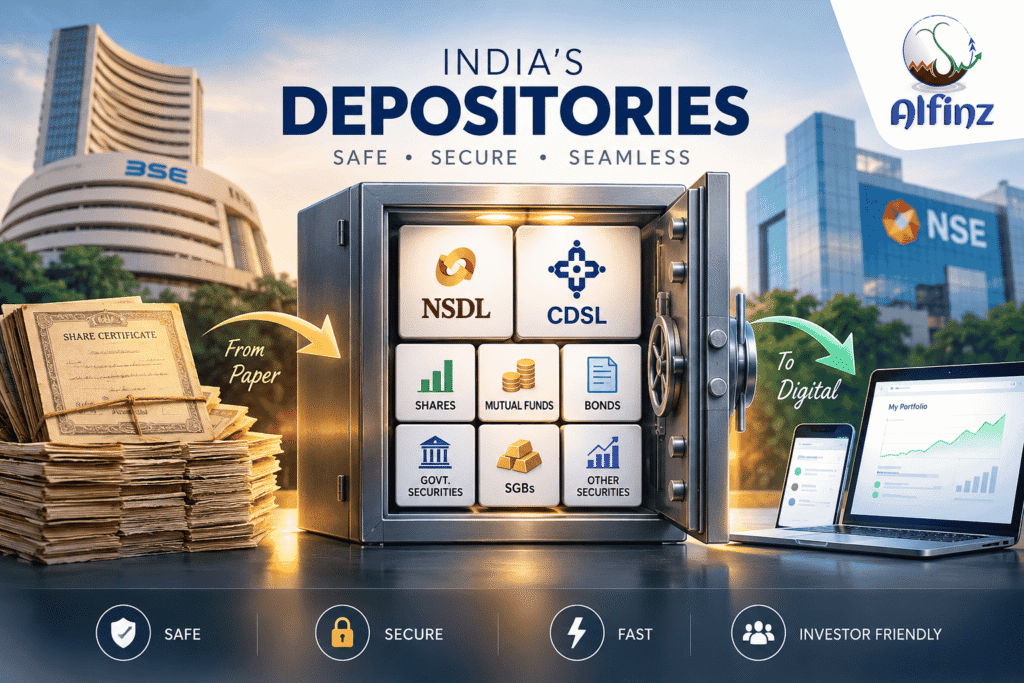
Think of a depository like a bank for your investments. A bank keeps your money electronically, while a depository keeps your securities such as shares, bonds and other eligible securities in electronic form.
Therefore, when you buy shares through a stockbroker, the shares are ultimately recorded electronically in your Demat account.
What Are Depositories in India?
A depository is an organisation that holds securities in electronic form and facilitates their transfer between investors.
The legal framework for this system comes mainly from the Depositories Act, 1996. The system was introduced to reduce the problems associated with physical share certificates, including loss, theft, forgery, paperwork and lengthy transfers.
Today, NSDL and CDSL are India’s two principal depositories.
However, a beginner may not directly open an account with NSDL or CDSL. Instead, you normally access their services through a Depository Participant (DP).
How Does the Depository System Work?
There are four important participants in this system.
1. Depository – NSDL or CDSL
The depository maintains electronic records of securities ownership and facilitates transactions involving those securities.
2. Depository Participant – DP
A DP acts as the bridge between you and the depository.
Your stockbroker, bank or financial institution may provide Demat services as a registered DP. Therefore, your broker’s app may be where you see your shares, but the underlying securities are maintained within the depository framework.

3. Company and RTA
The issuing company works with its Registrar and Transfer Agent, commonly called an RTA, for activities such as maintaining investor records and processing corporate actions.
4. Investor
You are the Beneficial Owner (BO) of the securities held in your Demat account.
So, when you buy 100 shares, you remain the beneficial owner even though the electronic records are maintained through the depository system.
NSDL vs CDSL: What Is the Difference?
| Feature | NSDL (National Securities Depository Limited) | CDSL (Central Depository Services Limited) |
| Established | 1996 (India’s first depository) | 1999 |
| Primary Promoter | National Stock Exchange (NSE) | Bombay Stock Exchange (BSE) |
| Market Focus | Historically preferred by large institutional investors and corporations. | Historically popular among retail investors due to early competitive DP pricing. |
| Account Structure | Standardized electronic account formats managed via its extensive DP network. | Features distinct account formats and unique investor utility portals like Myeasi. |
Also Read: What Is SEBI & Why Is It Important for Investors?
Why Are Depositories Important for Investors?
Before electronic holdings became common, physical certificates created several practical problems.
Certificates could be lost or damaged. Transfers could take considerable time. Fake certificates and bad deliveries were also serious concerns.
The introduction of depositories in India changed this process significantly.
Safe Electronic Holding
Your securities can be held electronically instead of keeping physical certificates at home.
Consequently, risks related to physical loss, damage and forgery are greatly reduced.
Faster Transfer of Securities
Electronic records make the transfer of securities much more efficient.
Moreover, investors can buy and sell securities without physically exchanging certificates.
Easier Corporate Actions
Corporate actions such as bonus issues and stock splits can be processed electronically.
Similarly, eligible securities and benefits can be reflected through the appropriate electronic processes.
Pledging Securities
Eligible securities held in Demat form can also be used for pledging or other permitted purposes.
For example, an investor may pledge eligible securities as collateral for a financial facility, subject to the applicable rules and lender requirements.
How Does a Demat Transaction Actually Work?
Let’s understand this with a simple Indian example.
Suppose Ravi opens a Demat account through a stockbroker. The broker is connected with a depository as a DP.
Ravi buys 50 shares of a listed company through his trading account.
What Happens After Ravi Buys?
The trade is executed on the stock exchange.
Then, the clearing and settlement process takes place. The securities are transferred through the market infrastructure and eventually appear in Ravi’s Demat account.
Therefore, Ravi does not receive any physical share certificate.
Instead, his electronic holding shows the quantity of securities he owns.
What Happens When Ravi Sells?
When Ravi sells the shares, the securities need to be delivered from his Demat account as part of settlement.
Depending on the transaction method and broker setup, Ravi may authorize the transaction through mechanisms such as e-DIS and TPIN.
This makes the process easier while adding an additional layer of investor authorization.
Depositories Hold More Than Just Shares
Many beginners think that depositories are only used for equity shares.
However, the ecosystem can cover several types of securities and financial instruments.
Depending on eligibility and the applicable framework, electronic holdings can include:
- Equity shares
- Bonds
- Government securities
- Mutual fund units
- Commercial paper
- Sovereign Gold Bonds
- Other eligible securities
Therefore, the depository system in India is much broader than simply storing stocks.
Also Read: What Are Stock Exchanges in India and Why Are They Important?
Why Are Depositories Important for the Indian Capital Market?
Depositories are not only useful for individual investors.
They also support the wider capital market by making securities ownership and settlement more efficient.
For Investors
Electronic holdings reduce paperwork and make portfolio tracking easier.
Moreover, electronic settlement reduces problems associated with physical certificates and bad deliveries.
For Companies
Companies can avoid many costs and administrative difficulties associated with printing and managing physical certificates.
They can also process eligible corporate actions through electronic systems.
For the Market
Efficient electronic settlement supports liquidity and smoother market operations.
India’s move from older settlement cycles such as T+5 and T+3 to T+2 and then T+1 required strong electronic market infrastructure.
Consequently, depositories in India have become an important part of the country’s modern capital-market infrastructure.
Also Read: Why Is a Demat Account Important in India? Benefits
Is Your Money and Shares Safe if Your Broker Closes?
This is a question we hear a lot from beginners
One thing beginners should keep in mind “Broker (DP) and NSDL/CDSL (Depositories) both perform different functions.
A broker may provide the trading platform and DP services, while the securities are maintained within the depository framework in your Demat account.
Therefore, a broker facing financial or operational problems does not simply mean that the shares you own become the broker’s property.
However, investors should always deal with regulated intermediaries and regularly verify their holdings.
Most importantly, investors should check their transaction records and Demat statements for any unfamiliar activity.
What Should a Beginner Remember?
If you are new to investing, remember these four names:
Stock Exchange: Where securities are traded.
Broker: Provides trading services and may also act as your DP.
Depository: NSDL or CDSL maintains the electronic securities infrastructure.
Demat Account: The account through which you hold securities electronically as the beneficial owner.
Once these roles are clear, the stock market becomes much easier to understand.
FAQs
1. What are depositories in India?
NSDL and CDSL are India’s two principal depositories. Their main role is to hold securities electronically and facilitate their transfer.
2. Does NSDL/CDSL provide Demat account?
No. NSDL is a depository. Your Demat account is provided through a registered Stock Broker (DP).
3. Does NSDL and CDSL has same role?
Both are depositories that provide electronic securities infrastructure. But, your DP determines which depository your Demat account is associated with.
4. Can shares be held without a broker?
Bought securities can be held through a Demat account with a registered Stock Broker (DP). A trading account and a Demat account serve different purposes, although brokers often provide both together.
5. What is the Depositories Act, 1996?
India’s depository system is governed by the Depositories Act, 1996, which provides the legal framework for electronic security ownership and transfers.
Conclusion
The introduction of depositories in India transformed the way investors hold and transfer securities.
Depositories are the quiet, invisible backbone of India’s robust financial architecture. By digitizing wealth, eliminating structural friction, and providing institutional-grade security, NSDL and CDSL have democratized investing for hundreds of millions of retail market participants. They ensure that every time you click “Buy” or “Sell,” your hard-earned capital is settled accurately, transparently, and safely.
Need Help Choosing the Right Demat Account?
Contact Alfinz today for beginner-friendly financial guidance, investment planning, SIP support, and Demat Account assistance.
Contact Alfinz Today for Personalized Investment Guidance Before You Start Investing
Need personalized financial guidance?
Contact Alfinz today for Investments, Insurance, Loans, Taxation & Financial Planning assistance.
Disclaimer: This article is published for general educational and informational purposes only. The content shared is based on common financial planning principles and personal finance awareness. It should not be considered professional financial, investment, tax, legal, or insurance advice. Financial decisions should always be made based on individual goals, risk profile, income, and personal circumstances. Readers are advised to consult a qualified financial advisor or professional before making any financial or investment decisions. Alfinz shall not be responsible for any financial loss or decisions taken based on this content.

Shiva Kumar is the Founder of ALFINZ, a financial planning and investment advisory platform dedicated to helping individuals make informed financial decisions. He holds NISM certifications in Equity Derivatives, Currency Derivatives, Equity Research Analysis, and Mutual Fund RTA. Through ALFINZ, he shares practical insights on financial planning, stock market investing, mutual funds, insurance, taxation, and wealth creation.