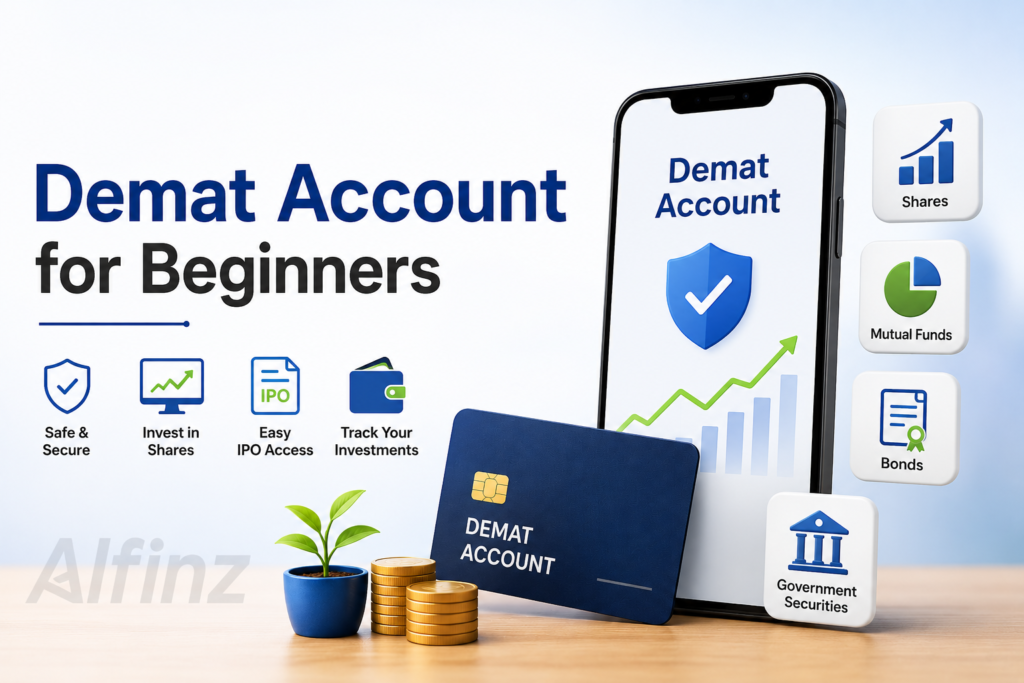
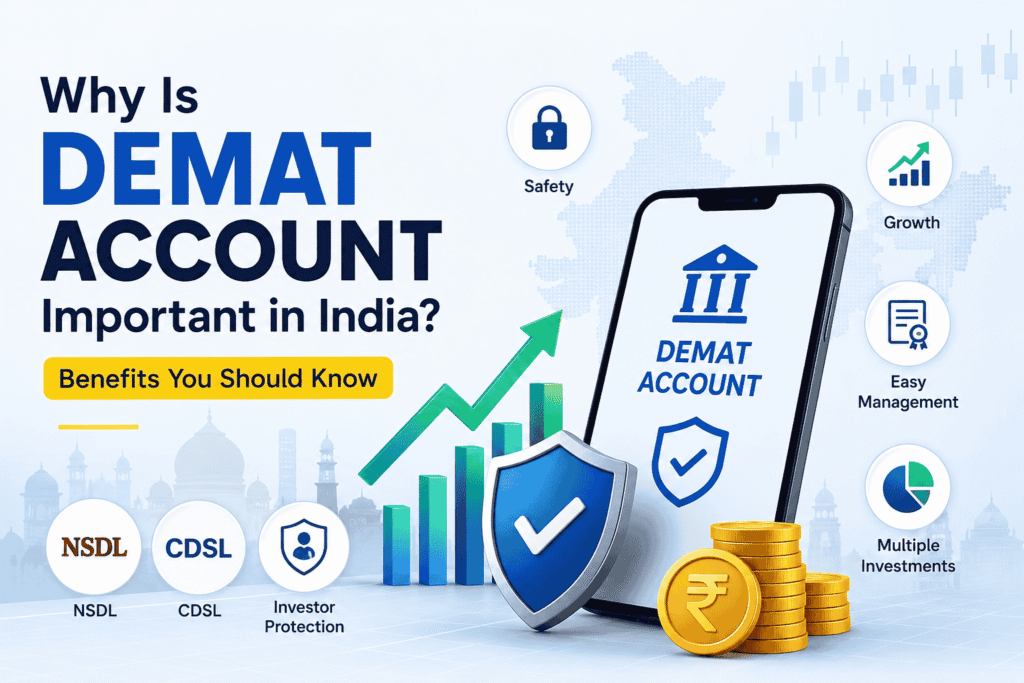
Indian investing has changed drastically from paper format to Demat format. Today, most securities are held electronically through a Demat account, making investing faster, easier, and more convenient.
So, what is the importance of Demat account for an ordinary Indian investor? Simply put, the Demat Account stores eligible securities electronically.
The word “Demat” comes from “dematerialisation”. It means converting physical securities into electronic records. Think of it like a bank account, but instead of keeping money, it holds your securities.
For a beginner, the importance of Demat account becomes clear when you understand one simple point. Buying an investment is only one part of investing; holding and managing it safely is equally important.
What Is the Importance of Demat Account in India?
The biggest importance of Demat account is convenience. Investors no longer need to manage physical certificates for securities that are held electronically.
Your holdings can be viewed through digital statements, mobile applications, and online platforms. Consequently, tracking investments has become much easier for ordinary investors.
Another important benefit is safety. Physical certificates could be lost, damaged, stolen, or forged. Electronic records reduce these physical risks.
However, digital investing does not mean investors can ignore security. Passwords, OTPs, mobile numbers, email IDs, and account credentials must always be protected.
SEBI’s investor charter also advises investors to check transaction statements and report unauthorised debits or credits promptly.
From Paper Certificates to Digital Investing
Earlier, Indian investors had to depend heavily on physical share certificates. Selling or transferring securities could involve paperwork, signatures, courier services, and long processing times.
The introduction of the depository system changed this process. Securities could be maintained as electronic records instead of physical certificates.
Today, a person in Hyderabad, Mumbai, Delhi, Bengaluru, or a smaller Tier-2 city can manage investments using a smartphone.
Moreover, digital KYC and online account-opening processes have reduced the need for physical visits. CDSL notes that Demat accounts can be opened digitally with information submission and video-based verification.
This technology shift has made investing more accessible to a much wider group of Indians.
NSDL vs CDSL: Where Are Your Shares Actually Held?
Many beginners believe their broker physically owns their shares. The system does not work that way.
A stockbroker acts as an intermediary that helps you buy and sell securities. The depository system maintains securities in electronic form through NSDL or CDSL.
NSDL stands for National Securities Depository Limited & CDSL stands for Central Depository Services Limited.
Both are recognized depositories in India’s securities market. Your Depository Participant, or DP, connects you to the depository system.
So, the simple structure is:
Investor → Depository Participant → NSDL/CDSL → Securities held electronically
Therefore, the importance of Demat account is also connected to the strong infrastructure supporting India’s securities market.
The Three-in-One Account: Bank + Trading + Demat
A beginner may wonder why three accounts are involved when buying shares.
The answer is simple. Each account performs a different job.
1. Bank Account
Your bank account handles money. Funds are transferred when you buy securities, and sale proceeds can eventually be credited back to your bank account.
2. Trading Account
Your trading account connects you to the stock market. It is used to place buy and sell orders through your broker.
3. Demat Account
Your Demat account holds eligible securities electronically after purchase. It is the digital ownership record for your securities.
SEBI describes the bank, trading, and Demat accounts as separate but connected parts of the securities investment process.
For example, suppose you want to buy 100 shares of xyz company, your bank account handles the money, your trading account executes the order, and your Demat account receives the shares after settlement.
That is why these three accounts work like one financial engine.
Also Read: Top 5 Stock Brokers in India: How to Choose the Best?
Importance of Demat Account
# Safety
One of the biggest reasons investors prefer electronic holdings is reduced physical risk.
Imagine keeping share certificates worth Rs.10 lakhs in a cupboard for ten years. If those documents are lost or damaged, proving ownership and completing the required process could become difficult.
With electronic holdings, securities are maintained through the depository system.
Moreover, investors can receive transaction statements and monitor holdings digitally. This creates a clearer record of securities held in the account.
However, investors should still remain alert. A secure Demat account depends on both the regulated system and responsible investor behaviour.
Never share your OTP, password, trading login, or depository credentials with another person.
# Faster and Easier Transactions
Earlier, transferring physical securities could involve several manual steps. Today, electronic settlement has made the process much smoother.
When securities are purchased and settled, they can be credited electronically to the investor’s Demat account.
Similarly, when securities are sold, the required holdings can be transferred electronically as part of the settlement process.
Therefore, the importance of demat account is not only about storage. It is also about making the entire investment process more efficient.
Investors should still understand brokerage, taxes, exchange charges, DP charges, and other applicable costs before trading.
# Managing Multiple Investments in One Place
A Demat account can hold several types of securities, depending on the product and how the investment is structured.
These may include listed shares, ETFs, bonds, government securities, and other eligible securities.
Mutual fund units can also be held in Demat form when the investor chooses that route. However, mutual funds do not always need to be held through a Demat account.
Similarly, eligible SGB holdings and other securities may be maintained electronically where permitted. This makes portfolio monitoring easier for investors who want a consolidated view of their securities
# Corporate Actions Become Easier
Companies regularly announce corporate actions. These may include dividends, bonus shares, stock splits, rights issues, and other benefits.
The depository system supports electronic processing of such corporate actions. SEBI explains that depositories facilitate corporate actions such as dividends, bonus issues, stock splits, and rights issues.
For investors, this reduces paperwork and makes the process more convenient.
For example, if a company announces a bonus issue and you are eligible, the additional shares can be credited electronically according to the applicable process.
Consequently, investors do not need to maintain physical certificates for every corporate benefit.
Also Read: Which Stock Broker Is Better: Full-Service or Discount?
# Can Be Used as Collateral
Eligible securities held in Demat form can be pledged as collateral, subject to applicable rules and the lender’s requirements.
For example, an investor may pledge certain securities to obtain a loan or meet eligible collateral requirements.
SEBI notes that depository systems support pledging and hypothecation of securities.
However, pledging shares is not free money. If the borrower fails to meet the agreed obligations, the pledged securities may be subject to action under the applicable terms.
Therefore, investors should understand the interest, margin, risks, and repayment conditions before using securities as collateral.
Real-Life India Scenario:
Let us take a simple example.
Ravi is a 29-year-old salaried employee from Hyderabad. He has Rs.1,00,000 available for long-term investing and wants to start investing in listed companies.
Initially, Ravi thinks opening a Demat account is unnecessary. He believes he can simply buy shares through a mobile app.
However, after understanding the process, he realizes that the app is only part of the system.
“His bank account provides the funds. His trading account places the order. His Demat account holds the shares after settlement”.
Now Ravi can view his holdings, receive corporate benefits, monitor transactions, and maintain an electronic record of his investments.
However, easier access does not mean easier profits. Market investments still involve risk.
The technology makes investing easier. Good financial decisions still require knowledge, discipline, diversification, and patience.
This is where the importance of demat account becomes practical rather than theoretical.
What Does It Cost to Maintain a Demat Account?
The cost depends on the Depository Participant and the services you use.
Common charges may include account opening charges, Annual Maintenance Charges, brokerage, and Depository Participant transaction charges.
However, charges vary significantly between brokers and DPs.
SEBI’s investor charter states that there is no charge payable for opening a Demat account and no minimum balance requirement. However, DPs may levy applicable service or maintenance charges according to their tariff structure.
Therefore, do not select a broker only because of a “free Demat account” advertisement.
Check the complete tariff structure, including AMC and transaction-related charges.
Documents Required to open a Demat Account
For an individual investor, account-opening requirements generally include KYC information and identity and address details.
PAN is a key requirement for securities-market KYC. Aadhaar or another accepted document may be used for identity or address verification, depending on the process.
Bank details are also commonly required to connect the investment account with the investor’s payment account.
Additional information may be required for certain products or trading segments.
Always follow the latest requirements of your chosen SEBI-registered intermediary rather than relying on an old checklist.
Also Read: How to Open a Demat Account for Beginners in India
Alfinz -Based Approach: Before You Open a Demat Account
When someone approaches us about opening a Demat account,
We believe the first question should not be, “Which broker gives the cheapest charges?”
The first question should be, “Why do you need the account?”
If your goal is long-term investing, your requirements may differ from someone interested in active trading.
Similarly, an investor who wants ETFs or bonds may have different needs from a person who wants to trade derivatives.
Therefore, compare platforms based on regulation, reliability, charges, services, technology, support, and your actual investment requirements.
A Demat account should support your financial plan rather than encourage unnecessary trading.
7 Things to Check Before Opening a Demat Account
1. Check the Broker or DP
Choose an intermediary that is appropriately registered and regulated.
2. Understand AMC
Check the Annual Maintenance Charge and any conditions for waivers.
3. Check DP Charges
Understand the charges that may apply when securities are debited or transferred.
4. Review the Trading Platform
The app should be easy to understand and suitable for your needs.
5. Check Customer Support
Good support can be valuable when account or transaction issues arise.
6. Understand Security
Use strong passwords and never share OTPs or login credentials.
7. Add and Review Nomination
Keep nomination details updated and review them when family circumstances change.
Common Mistakes Beginners Should Avoid
- One common mistake is opening multiple Demat accounts without understanding why they are needed.
- Another mistake is selecting a broker only because the advertisement says “zero brokerage”. Zero brokerage in one segment does not mean every service is free.
- Some investors open a Demat account and immediately start intraday or derivatives trading. That can be risky for beginners because trading requires a different level of knowledge and risk management.
Instead, understand your financial goals first. Then choose the investment approach that fits those goals.

FAQs
For holding listed shares electronically, a Demat account is generally required. SEBI describes a Demat account as the account used to hold securities in electronic form.
No. A trading account is used to place buy and sell orders, while a Demat account holds eligible securities electronically.
The broker is an intermediary. Securities are maintained electronically through the depository system, with NSDL and CDSL being India’s two main depositories.
Yes. SEBI’s investor charter states that investors can have more than one Demat account in the same name, including with different DPs
Yes, mutual fund units can be held in Demat form where that facility is available.
However, investors can also hold mutual fund units through other permitted structures, so a Demat account is not always necessary for mutual fund investing.
Conclusion:
Investors should regularly monitor their holdings, protect their account credentials, and keep nomination information updated.
Finally, remember one simple lesson: A Demat account is not an investment strategy. It is the secure digital foundation that allows modern investors to own and manage securities.
Start with knowledge, invest with discipline, and make every financial decision with your long-term goals in mind.
Protect Your Investments Today
Take an action before you face a problem.
Check your Demat account today.
Verify your mobile number and email. Review your holdings and transaction statements. Check your nominee details and understand the charges applicable to your account.
If you notice an unauthorized transaction, contact your Depository Participant promptly and follow the applicable grievance process. SEBI provides investor grievance mechanisms for unresolved issues.
Need Help Choosing the Right Demat Account?
Contact Alfinz today for beginner-friendly financial guidance, investment planning, SIP support, and Demat Account assistance.
Contact Alfinz Today for Personalized Investment Guidance Before You Start Investing
Need personalized financial guidance?
Contact Alfinz today for Investments, Insurance, Loans, Taxation & Financial Planning assistance.
Disclaimer: This article is published for general educational and informational purposes only. The content shared is based on common financial planning principles and personal finance awareness. It should not be considered professional financial, investment, tax, legal, or insurance advice. Financial decisions should always be made based on individual goals, risk profile, income, and personal circumstances. Readers are advised to consult a qualified financial advisor or professional before making any financial or investment decisions. Alfinz shall not be responsible for any financial loss or decisions taken based on this content.

Shiva Kumar is the Founder of ALFINZ, a financial planning and investment advisory platform dedicated to helping individuals make informed financial decisions. He holds NISM certifications in Equity Derivatives, Currency Derivatives, Equity Research Analysis, and Mutual Fund RTA. Through ALFINZ, he shares practical insights on financial planning, stock market investing, mutual funds, insurance, taxation, and wealth creation.