
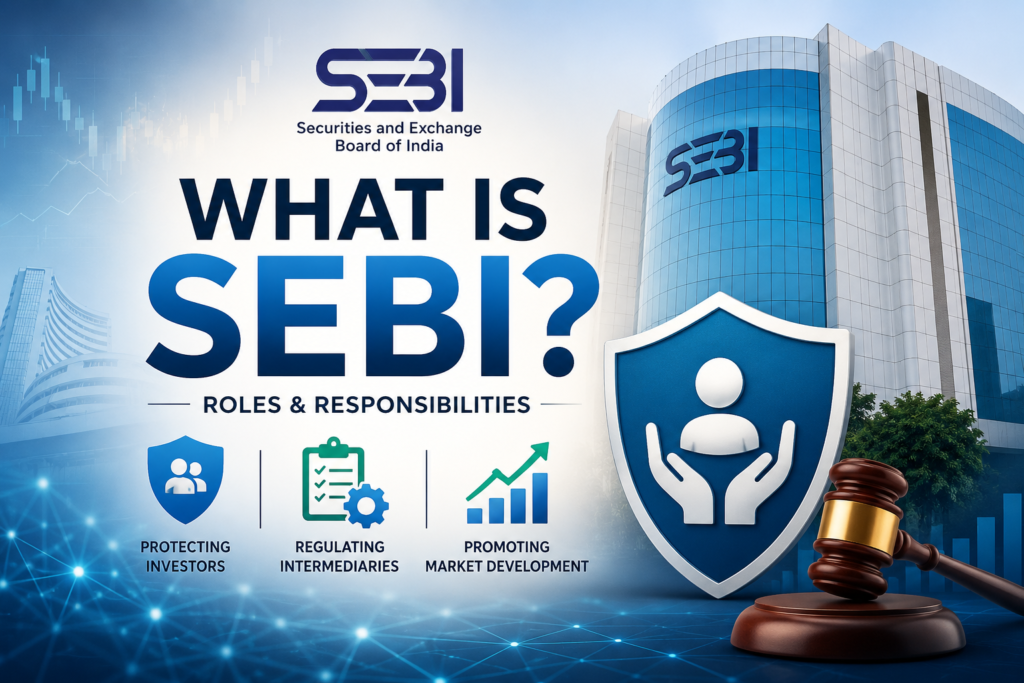
What exactly does SEBI do, and how does it affect an ordinary investor?
When you invest in shares, mutual funds, IPOs or other securities, you may have wondered: Who protects investors in India? The answer is SEBI.
In this beginner-friendly guide, let us understand what is SEBI, why it was created, and how its rules help make India’s securities market more transparent and organised.
What Is SEBI?
SEBI stands for the Securities and Exchange Board of India. It is the main regulator of India’s securities market.
In simple words, SEBI acts like a market watchdog. It creates rules, monitors market participants and takes action when rules are broken.
SEBI’s core purpose is to protect investors, promote the development of the securities market and regulate the securities market.
Therefore, whenever you buy a listed share, invest through a mutual fund or participate in an IPO, SEBI’s regulatory framework can affect your investment journey.
Why Was SEBI Created?
Before SEBI became a statutory regulator, India’s capital market was growing rapidly. More people were entering the market, and investor confidence needed stronger protection.
SEBI was first constituted on 12 April 1988 as a non-statutory body. Later, it received statutory status in 1992 under the SEBI Act, 1992.
The idea was simple: as the market grows, investors need a strong regulator to maintain fairness, transparency and orderly growth.
Why Is SEBI Important for Investors?
Imagine investing your hard-earned money in a company without proper disclosure rules.
The company could potentially hide important information. Someone with confidential information could trade unfairly. A broker could misuse client funds or a market participant could manipulate prices.
This is where SEBI becomes important.
SEBI creates a regulatory framework that aims to make the securities market more transparent and fair.
Moreover, it monitors various market participants and can investigate suspected violations.
For an investor, this means the market is not simply a place where buyers and sellers meet. There is also a regulatory framework working behind the scenes.

SEBI Roles and Responsibilities: The Three Main Areas
The easiest way to understand SEBI roles and responsibilities is through three major objectives.
1. Protecting Investors
Investor protection is one of SEBI’s most important responsibilities.
SEBI works to reduce unfair practices and improve the information available to investors.
For example, listed companies have disclosure requirements. This helps investors receive important information before making investment decisions.
Similarly, regulations apply to different intermediaries that provide services in the securities market.
However, investor protection does not mean that SEBI guarantees investment returns.
Market investments can still rise or fall. Therefore, investors must understand risk before investing.
2. Regulating Market Intermediaries
The Indian securities market has many participants.
These include stock brokers, merchant bankers, portfolio managers, investment advisers, research analysts, mutual funds and other regulated entities.
SEBI establishes rules for these participants and monitors compliance.
This is important because investors often interact with intermediaries rather than directly with the market regulator.
Consequently, proper regulation helps create greater accountability within the financial ecosystem.
Also Read: Why Is a Demat Account Important in India? Benefits
3. Developing the Securities Market
SEBI is not only about stopping wrong practices.
It also plays an important role in developing India’s securities market.
Over the years, India’s market infrastructure has become more technology-driven, accessible and structured.
SEBI regularly updates regulations to address changing market conditions. Its current regulatory framework covers areas such as mutual funds, investment advisers, research analysts, IPOs and listed companies.
Therefore, SEBI has a dual responsibility: protect investors while allowing the market to grow.
How Does SEBI Regulate the Market?
A common question is: How does SEBI actually control the market?
SEBI has different types of regulatory powers.
Quasi-Legislative Powers
SEBI can formulate regulations and guidelines for the securities market.
For example, it has regulations covering insider trading and listing obligations.
The SEBI Prohibition of Insider Trading Regulations are designed to address trading based on unpublished price-sensitive information.
Similarly, the Listing Obligations and Disclosure Requirements framework places disclosure and compliance requirements on listed entities. SEBI continues to update these regulations as the market evolves.
Quasi-Executive Powers
SEBI can investigate suspected violations and inspect the activities and records of regulated entities.
It also operates surveillance and enforcement mechanisms to identify possible irregularities.
For example, SEBI maintains a dedicated framework for securities-market surveillance.
Quasi-Judicial Powers
SEBI can also pass orders in regulatory matters and impose penalties or restrictions where the law permits.
This gives the regulator the ability to respond when market participants violate securities laws or regulations.
Consequently, SEBI is not simply an organization that writes rules. It also has powers to investigate and enforce them.
Also Read: Top 5 Stock Brokers in India: How to Choose the Best?
SEBI and Insider Trading
Insider trading is one topic every market investor should understand.
Suppose a senior person in a listed company knows about important unpublished information that could affect the company’s share price.
If that information is used unfairly for trading, ordinary investors may be placed at a disadvantage.
SEBI’s insider trading regulations seek to prevent such unfair practices.
Therefore, the objective is to maintain a market where investors compete on a more level playing field.
SEBI and Corporate Governance
SEBI also plays an important role in improving corporate governance.
Listed companies must be transparent and should strictly follow disclosure and the rules of governance.
The purpose is to encourage companies to provide relevant information to shareholders and maintain appropriate governance practices.
For an investor, this matters because good information is the foundation of a good investment decision.
Moreover, transparent reporting can help investors evaluate a company’s financial position, risks and future prospects.
SEBI’s Role in Mutual Funds and IPOs
SEBI is also highly relevant to retail investors who invest through mutual funds or participate in IPOs.
Mutual funds operate under a regulatory framework that covers areas such as fund management, disclosures and investor-related processes.
SEBI also has regulations and frameworks covering public issues and capital raising.
For example, SEBI maintains an Issue of Capital and Disclosure Requirements framework for companies raising capital from the public.
So, when people say SEBI controls the market, they mean it looks after everything—not just regular stock trading. Its regulatory reach covers several products and market participants.
A Real-Life Indian Investor Scenario
Consider a simple example.
Ravi has Rs.5 lakh saved for his daughter’s education. A friend tells him about a small company whose share price is expected to double soon.
The friend also says, “I have inside information. Buy immediately.”
Ravi may feel tempted.
However, this is exactly where an investor needs to slow down and ask questions.
- Is the information genuine?
- Is it publicly available?
- Is the company financially strong?
- Is the source regulated?
Instead of blindly following a tip, Ravi should verify information and understand the risk.
SEBI’s regulatory framework helps create rules around market conduct. However, investors must still make their own informed decisions.
Also Read: What is A BSDA Account & How does it makes AMC Free
Challenges SEBI Faces Today
The financial market is changing quickly.
Today, investors receive information through YouTube, Instagram, WhatsApp, Telegram and other social platforms.
This creates new challenges for regulators.
Fake investment tips, misleading claims, manipulated content and technology-driven scams can spread quickly.
Deep fakes and AI-generated content can make the problem even more complicated.
Meanwhile, algorithmic and high-speed trading creates additional monitoring challenges.
SEBI therefore needs to keep updating its regulatory and surveillance framework as technology changes.
There can also be areas of coordination with other financial and government authorities, depending on the issue involved.
Is SEBI Enough to Protect Your Money?
This is an important question.
SEBI can regulate the securities market and take action against violations. However, no regulator can remove investment risk completely.
A SEBI-regulated investment can still lose money.
A company can perform badly. Markets can fall. Economic conditions can change.
Therefore, regulation should be seen as a safety and governance framework, not as a promise of profit.
The best protection for an investor is a combination of regulation, awareness, diversification, suitable asset allocation and disciplined financial planning.
Why Understanding SEBI Matters Before Investing
You do not need to become a financial-law expert.
But understanding what is SEBI can help you become a more aware investor.
You can learn to check whether an intermediary is regulated, understand important disclosures and avoid unrealistic investment promises.
Similarly, you can understand why certain investment products have specific rules and disclosures.
This knowledge can help you ask better questions before investing your hard-earned money.
FAQs
1. What is SEBI in simple words?
SEBI is India’s securities-market regulator. It works to protect investors, regulate the securities market and support its orderly development.
2. What are the main SEBI roles and responsibilities?
The main responsibilities include investor protection, regulation of market intermediaries, market development, surveillance, investigations and enforcement.
3. Does SEBI guarantee investment returns?
No. SEBI regulates the securities market, but it does not guarantee profits or protect investors from normal market losses.
4. Does SEBI regulate mutual funds?
Yes. Mutual funds operate under SEBI’s regulatory framework, which includes rules and requirements relating to their operations and investor protection.
5. Why should beginners know about SEBI?
Understanding SEBI helps beginners recognize regulated market participants, understand disclosures and become more careful about investment-related claims.
Conclusion: SEBI Helps Build Market Trust
Think of SEBI as one of the key pillars supporting India’s securities market.
Its role goes beyond creating regulations. It works to protect investors, regulate market participants and support the development of a transparent and organised market.
However, investors also have a responsibility.
We should verify information, understand risk and avoid decisions based only on tips or emotions.
As India’s investment ecosystem becomes more digital, SEBI will continue to face new challenges.
From social-media investment advice to AI-generated content and evolving financial products, regulation will need to keep adapting.
Finally, remember one simple principle:
A regulated market does not remove investment risk. It helps create a fairer environment in which informed investors can make better decisions.
Understanding SEBI is therefore not just useful for stock-market traders.
It is useful for anyone who wants to become a more informed Indian investor.
Need Help Choosing the Right Demat Account?
Contact Alfinz today for beginner-friendly financial guidance, investment planning, SIP support, and Demat Account assistance.
Contact Alfinz Today for Personalized Investment Guidance Before You Start Investing
Need personalized financial guidance?
Contact Alfinz today for Investments, Insurance, Loans, Taxation & Financial Planning assistance.
Disclaimer: This article is published for general educational and informational purposes only. The content shared is based on common financial planning principles and personal finance awareness. It should not be considered professional financial, investment, tax, legal, or insurance advice. Financial decisions should always be made based on individual goals, risk profile, income, and personal circumstances. Readers are advised to consult a qualified financial advisor or professional before making any financial or investment decisions. Alfinz shall not be responsible for any financial loss or decisions taken based on this content.

Shiva Kumar is the Founder of ALFINZ, a financial planning and investment advisory platform dedicated to helping individuals make informed financial decisions. He holds NISM certifications in Equity Derivatives, Currency Derivatives, Equity Research Analysis, and Mutual Fund RTA. Through ALFINZ, he shares practical insights on financial planning, stock market investing, mutual funds, insurance, taxation, and wealth creation.





nice post