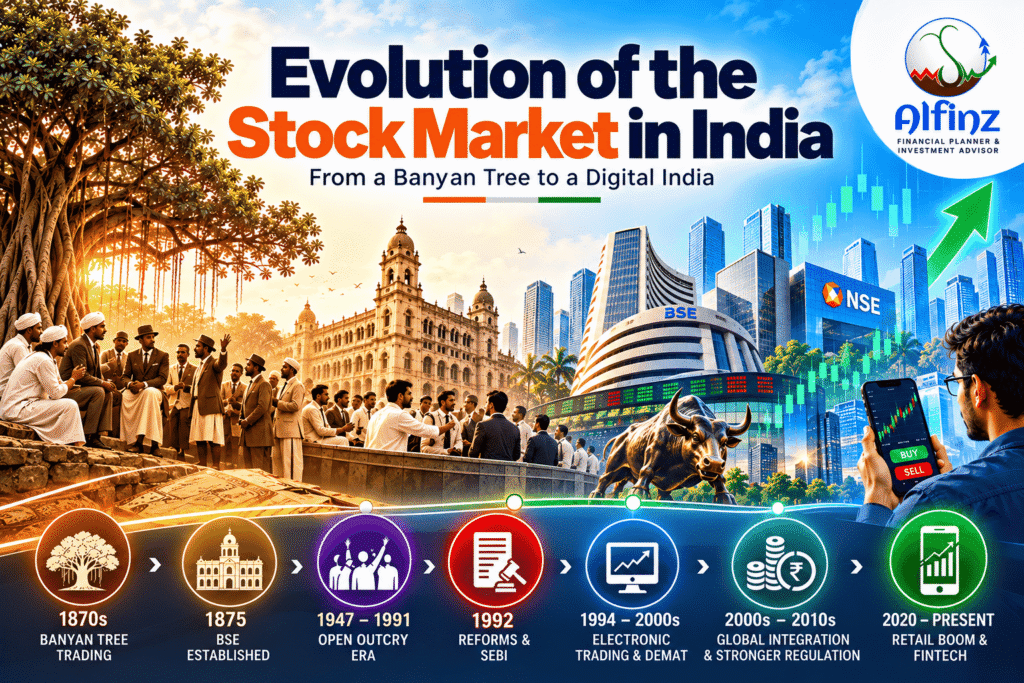
The Evolution of Stock Market in India is not just a story about shares. It is a story of technology, regulation, investor confidence and India’s economic growth.
Have you ever wondered how India moved from people shouting buy and sell orders under a banyan tree to millions of investors trading stocks through mobile apps?
For a beginner, understanding this journey makes today’s stock market much easier to understand. Therefore, let’s travel through the major phases of the Evolution of Stock Market and see how each phase changed the way Indians invest.
Why Is the Evolution of Stock Market in India Important?
The Evolution of Stock Market in India explains why today’s market looks very different from the market our parents or grandparents experienced.
Earlier, buying shares involved physical certificates, brokers and considerable paperwork. Today, an investor can open a Demat account, transfer money and place an order within minutes.
Moreover, today’s market has exchanges, clearing corporations, depositories and regulators working together. These systems were developed gradually after several market problems and financial crises.
So, when we understand this history, we also understand why rules such as KYC, Demat, risk management and investor protection are so important.
Also Read: A quick guide on the Intermediaries in the Indian Stock Market?
1. The Pre-Independence Era: How Did India’s Stock Market Begin?
The Banyan Tree Origins
The Evolution of Stock Market in India began in the 19th century when brokers in Bombay started meeting informally to trade securities.
One famous part of this story is the gathering of brokers under a banyan tree near what is now Mumbai’s financial district.
At that time, there were no mobile apps, computer screens or online trading platforms. Deals depended heavily on personal relationships, reputation and trust.
As more people began buying and selling, the stock market picked up speed.
Formation of the Stock Brokers’ Association
This was a major step towards organised securities trading in India.
Stocks of companies, including textile businesses, became increasingly important as India’s commercial economy expanded.
However, the market was still very different from today’s regulated environment. Trading was largely relationship-driven and information was not available to everyone equally.
Impact of the World Wars
The World Wars and changing economic conditions affected Indian businesses and financial markets.
Demand for certain commodities and industrial products changed sharply. Consequently, some businesses experienced rapid growth while others faced uncertainty.
These periods also demonstrated an important lesson: stock prices are closely connected to economic conditions, business performance and investor expectations.
2. Post-Independence India: The Era of Open Outcry
After Independence in 1947, India adopted a more controlled economic framework.
Capital Issues Control
The Capital Issues (Control) Act of 1947 became a key law for regulating how companies raise money.
The government had a significant role in determining how companies could raise money from investors.
Therefore, India’s capital market was not yet completely market-driven.
Inside the Trading Ring
For many years, stock trading happened through the famous open outcry system.
Imagine entering a crowded trading ring where brokers were shouting prices, using hand signals and communicating with one another.
There were no computer screens displaying live prices.
Instead, traders relied on physical communication and written records.
The system worked, but it had limitations. Price discovery could be slower, information access was uneven and operational risks were higher.
Reliance and the Rise of Retail Investors
The 1980s saw growing public interest in equity investment.
Reliance’s public issue in 1977 is often remembered as an important milestone in bringing a wider group of Indian retail investors into equity markets.
For many ordinary Indians, shares started becoming more than a financial instrument. This created a pathway to participate in the growth of Indian companies.
This was an important stage in the Evolution of Stock Market in India because retail participation began gaining greater importance.
Also Read: How to List a Company in India: Sole Proprietor to BSE/NSE
3. 1992: The Crisis That Changed Everything
The Harshad Mehta Securities Scam
The early 1990s brought a major shock to India’s financial system.
The 1992 securities scam associated with “Harshad Mehta” exposed weaknesses in the interaction between banks, securities transactions and market infrastructure.
The crisis damaged investor confidence.
However, it also created a powerful reason for reform.
SEBI Gets Stronger
The Securities and Exchange Board of India, or SEBI, had been established earlier as an institution. The SEBI Act, 1992 officially gave it statutory powers.
This became a major turning point in the Evolution of Stock Market in India.
The focus increasingly shifted towards investor protection, market integrity, disclosure and stronger supervision.
End of the Old Capital-Issue System
The Controller of Capital Issues system was eventually removed.
This helped India move towards a more market-oriented system where pricing of securities could increasingly be determined by market forces.
Consequently, companies and investors entered a new era of capital formation and price discovery.
4. The Digital Revolution: NSE, Screen Trading and Demat
The 1990s changed India’s stock market permanently.
NSE and Screen-Based Trading
The National Stock Exchange was incorporated in 1992, recognized by SEBI in 1993 and began operations in 1994.
NSE introduced electronic or screen-based trading, helping move the market away from the traditional physical trading ring.
This was a massive technological shift.
Instead of brokers standing together and shouting orders, transactions could be entered and matched electronically.
The result was better transparency, wider access and faster execution.
Also Read: What Are Stock Exchanges in India and Why Are They Important?
Dematerialisation Changed Investing
Another major development was dematerialisation.
Physical share certificates slowly gave way to electronic holdings through depositories such as NSDL and CDSL.
For an investor, this solved several practical problems.
There was less risk of losing certificates, forgery, theft or bad delivery. Shares could also be transferred electronically.
Therefore, Demat accounts became one of the foundations of modern Indian investing.
Futures and Options
The next major step was derivatives.
In June 2000, the NSE launched its first stock derivatives using Nifty 50 index futures. By 2001, the market grew to include index options as well as options and futures for individual stocks.
This expanded the market beyond simple buying and selling of shares.
5. 2000s–2010s: Global Integration and Stronger Regulation
As India’s economy grew, its capital market became increasingly connected with global investors.
Foreign Portfolio Investors became an important source of capital.
At the same time, technology continued to transform trading.
Algorithmic and High-Speed Trading
Electronic trading created the foundation for algorithmic trading.
Instead of manually entering every order, sophisticated systems could analyse market information and execute orders according to predefined instructions.
Later, high-frequency trading and co-location became important topics in market structure discussions.
However, technology also created new regulatory challenges.
SEBI therefore continued strengthening surveillance, disclosure and market conduct rules.
Corporate Governance
India also moved towards stronger listing and disclosure requirements.
Rules around insider trading, corporate disclosures and listing obligations became increasingly important.
Consequently, the modern market became more focused not only on trading but also on how companies communicate with investors.
6. The Modern Era: Retail Investors and Fintech
The latest stage of the Evolution of Stock Market in India has been driven by smartphones, low-cost brokerage and financial technology.
COVID-19 and the Retail Investor Boom
The pandemic changed investor behaviour dramatically.
Millions of Indians began exploring stocks, mutual funds and other investment products.
Meanwhile, mobile-first platforms made investing easier for people outside traditional financial centers.
Platforms such as Zerodha, Groww and Angel One helped popularize app-based investing.
The result was a new generation of retail investors.
However, easy access also created a new challenge: investing can feel simple even when the underlying risks are not.
Social Media and Finfluencers
Today, investors can learn about stocks through YouTube, Instagram, Telegram and other social platforms.
This has improved financial awareness in many ways.
However, misleading stock recommendations and unregistered advice can also create serious risks.
SEBI continues to take enforcement action involving stock recommendations shared through social media.
Therefore, investors should always distinguish between financial education and personalised investment advice.
T+1 and T+0 Settlement
Settlement has also become dramatically faster.
India moved from T+5 to T+3 and then T+2 settlement before introducing T+1 in a phased manner. T+1 settlement was fully implemented in January 2023.
In March 2024, SEBI introduced an optional beta version of T+0 settlement for selected stocks and brokers.
This means India’s settlement infrastructure is moving towards near-instant processing.
Most importantly, faster settlement can reduce settlement risk and improve capital efficiency.
7. What Does This Mean for an Investor Today?
Let’s take a simple Indian example.
Suppose a person in Hyderabad wants to invest Rs.5,000 every month.
Thirty or forty years ago, the process would have been very different.
Today, the investor can complete KYC, maintain a Demat account, transfer funds and place an order using a smartphone.
But technology has not removed investment risk.
Instead, it has removed many operational barriers.
Therefore, the real challenge for today’s investor is not simply accessing the market. It is making informed decisions, understanding risk and maintaining discipline.
From a financial-planning perspective, we should first ask: Why are you investing?
Is the objective wealth creation, retirement, children’s education, buying a house or creating a second income source?
The answer should influence the investment strategy.
8. What Is the Future of India’s Stock Market?
The Evolution of Stock Market in India is not yet completed.
Artificial intelligence is likely to play a larger role in surveillance, fraud detection, data analysis and risk management.
Algorithmic trading is also becoming more accessible. SEBI has introduced measures aimed at safer retail participation in algorithmic trading.
Meanwhile, India’s Social Stock Exchange framework is developing a separate avenue for eligible social enterprises and impact-oriented fundraising.
Technology may make markets faster.
However, regulation will remain essential to ensure that faster markets are also fair markets.
Also Read: Why Is a Demat Account Important in India? Benefits
FAQs
1. When did the Indian stock market came into action?
During the 19th century, Bombay started developing an organized system for trading. This led to the creation of the Native Share & Stock Brokers’ Association in 1875, which eventually became the Bombay Stock Exchange.
2. What changed the Indian stock market after 1992?
The 1992 securities scam exposed major weaknesses. Stronger SEBI powers, market reforms and improved infrastructure helped create a more transparent and regulated market.
3. When did online stock trading begin in India?
The major transformation came during the 1990s with electronic screen-based trading, particularly through NSE. This replaced much of the traditional physical trading process.
4. Why is a Demat account important?
A Demat account allows investors to hold securities electronically instead of relying on physical certificates. It made ownership, transfer and settlement significantly more efficient.
5. What is the latest settlement cycle in India?
T+1 is the standard equity settlement cycle, while an optional T+0 settlement framework has been introduced in phases for eligible market participants and securities.
Conclusion: From a Banyan Tree to a Smartphone
The Evolution of Stock Market in India is one of the most interesting stories in India’s financial development.
- We moved from informal meetings under a banyan tree to organised exchanges.
- We moved from shouting orders to electronic trading.
- We moved from paper certificates to Demat accounts.
- We moved from slow settlement cycles to T+1 and experiments with T+0.
- Most importantly, the Indian market has moved towards stronger regulation, better technology and wider investor participation.
However, one principle has not changed.
“Technology can make investing easier, but knowledge and discipline still make investing better”
For a beginner, therefore, the best way forward is not to chase every market opportunity.
Instead, understand your goals, learn the basics, assess risk and build an investment approach that suits your financial journey.
Need Help Choosing the Right Demat Account?
Contact Alfinz today for beginner-friendly financial guidance, investment planning, SIP support, and Demat Account assistance.
Contact Alfinz Today for Personalized Investment Guidance Before You Start Investing
Need personalized financial guidance?
Contact Alfinz today for Investments, Insurance, Loans, Taxation & Financial Planning assistance.
Disclaimer: This article is published for general educational and informational purposes only. The content shared is based on common financial planning principles and personal finance awareness. It should not be considered professional financial, investment, tax, legal, or insurance advice. Financial decisions should always be made based on individual goals, risk profile, income, and personal circumstances. Readers are advised to consult a qualified financial advisor or professional before making any financial or investment decisions. Alfinz shall not be responsible for any financial loss or decisions taken based on this content.

Shiva Kumar is the Founder of ALFINZ, a financial planning and investment advisory platform dedicated to helping individuals make informed financial decisions. He holds NISM certifications in Equity Derivatives, Currency Derivatives, Equity Research Analysis, and Mutual Fund RTA. Through ALFINZ, he shares practical insights on financial planning, stock market investing, mutual funds, insurance, taxation, and wealth creation.