
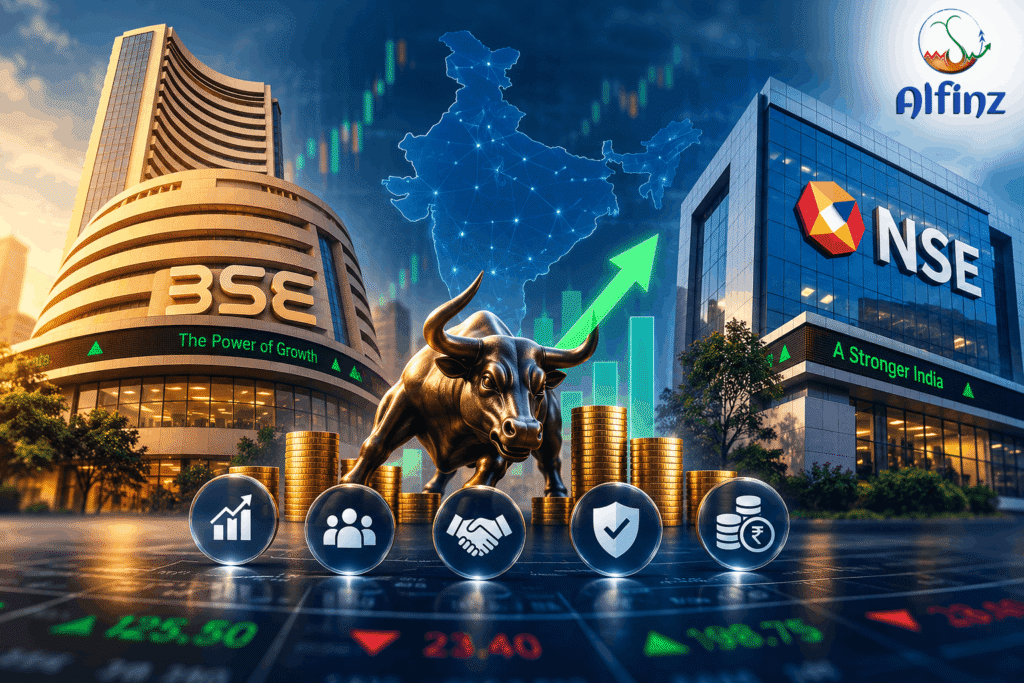
What Are Stock Exchanges in India?
Simply put, stock exchanges in India are organised marketplaces where buyers and sellers can trade shares and other financial securities through a regulated system.
When you hear words like NSE, BSE, NIFTY and SENSEX, you may wonder how they are connected. If you are new to investing, these terms can feel confusing at first.
Think about your local vegetable market. Buyers look for vegetables, sellers offer them, and prices change based on demand and supply.
A stock exchange works on a similar basic idea. However, instead of vegetables, investors buy and sell financial securities such as shares, bonds and derivatives.
Today, most stock market activity happens through digital platforms. Therefore, investors can place orders through their brokers without physically visiting an exchange.
Why Are Stock Exchanges Important for Investors?
The importance of stock exchanges in India goes far beyond buying and selling shares.
They help companies access capital and give investors an organised platform to participate in the growth of businesses.
For example, imagine an Indian company wants Rs.500 crore to expand its manufacturing business.
Instead of depending only on bank loans, it may raise money from investors by issuing shares through the capital market.
Consequently, investors get an opportunity to become part-owners of the company while the business gets access to capital for growth.
Moreover, stock exchanges help create transparency because prices and trading information are available to market participants.
How Did India’s Stock Market Evolve?
India’s capital market has travelled a long way. In the early days, share trading was much less organised than today’s digital system.
The Bombay Stock Exchange, now known as BSE, traces its roots to 1875. It is widely recognised as Asia’s oldest stock exchange.
Over time, technology completely changed the way investors trade. The traditional trading environment gradually moved towards electronic and screen-based trading.
Meanwhile, the National Stock Exchange was incorporated in 1992 and introduced electronic screen-based trading when its operations began in 1994.
Today, an investor sitting in Hyderabad, Vijayawada, Bengaluru or Delhi can place an order through a broker and participate in the same market.
Also Read: What Is SEBI & Why Is It Important for Investors?
Who Regulates the Indian Stock Market?
Stock exchanges do not operate without rules. The Securities and Exchange Board of India, commonly known as SEBI, plays a key role in regulating India’s securities market.
SEBI’s broad responsibility includes market development, regulation and investor protection.
Therefore, exchanges, brokers, listed companies and other market participants operate within a regulatory framework.
For investors, this is important because a regulated market provides systems for trading, clearing, settlement and grievance handling.
SEBI has also worked towards reducing settlement timelines. India’s equity market moved to T+1 settlement, while an optional T+0 framework has also been introduced for eligible transactions.
The Two Major Stock Exchanges in India
BSE: The Pioneer of Indian Stock Trading
BSE stands for Bombay Stock Exchange. Its roots go back to 1875, making it one of the oldest organised stock exchanges in Asia.
BSE played a historic role in the development of India’s securities market. Over the years, it evolved from traditional trading methods into a technology-driven exchange.
Its best-known index is the SENSEX.
SENSEX tracks 30 large and financially significant companies and is widely used as a barometer of the Indian equity market.
When SENSEX rises strongly, investors often interpret it as a sign of positive sentiment among major companies.
However, remember that SENSEX does not represent every company in India. It represents a selected basket of companies.
NSE: The Modernizer of Indian Markets
NSE means “National Stock Exchange” of India. It was incorporated in 1992 and was recognised by SEBI in 1993.
NSE commenced operations in 1994 and became a major force in introducing electronic, screen-based trading in India.
Its flagship index is the NIFTY 50.
NIFTY 50 represents 50 major companies and is one of India’s most widely followed market indices.
NSE has also become particularly important in equity derivatives. According to NSE’s current information, it remained the largest Indian exchange by number of trades in cash equities and contracts traded in equity derivatives in FY2026.

What Are the Main Roles of Stock Exchanges?
1. Capital Formation
One of the biggest roles of stock exchanges in India is supporting capital formation.
Companies can raise money from investors through the capital market. This money can then support expansion, technology, hiring, acquisitions or other business requirements.
Therefore, the stock market is not only about investors making money. It can also support businesses and economic growth.
2. Price Discovery
Have you ever wondered why a share price keeps changing during market hours?
The basic answer is demand and supply.
If more investors want to buy a particular share, buying pressure can push the price higher.
Similarly, if more investors want to sell, selling pressure can push the price lower.
This continuous interaction between buyers and sellers is called price discovery.
3. Providing Liquidity
Imagine buying a share but finding no one willing to buy it when you want to sell.
That would make investing very difficult.
Stock exchanges help create an organised marketplace where buyers and sellers can meet through electronic orders.
Consequently, actively traded securities generally offer better liquidity than securities with very little trading activity.
Also Read: Why Is a Demat Account Important in India? Benefits
4. Clearing and Settlement
A stock exchange is not simply a website showing prices.
Behind every successful trade, there is a larger market infrastructure involving brokers, clearing corporations, depositories and banks.
After a trade is executed, the transaction needs to be cleared and settled.
In a normal T+1 settlement, the trade takes place on T and settlement occurs on the following working day, subject to applicable rules.
This system helps ensure that securities and funds reach the appropriate parties.
5. Investor Protection and Risk Management
Investor protection is another important part of the market ecosystem.
Exchanges and clearing institutions have systems designed to manage trading and settlement risks.
SEBI also provides investor-related frameworks and mechanisms for complaints and other market issues.
Most importantly, investors should understand that regulation reduces certain risks, but it does not guarantee profits.
NSE vs BSE (The Stock Exchanges): What Is the Difference?
Many beginners generally ask, “Is NSE or BSE — which one is better?”
The answer depends on what you are comparing.
Both exchanges provide regulated marketplaces, but their history, benchmarks, trading activity and market positioning are different.
| Feature | NSE | BSE |
| Full Name | National Stock Exchange | Bombay Stock Exchange |
| Origin | Incorporated in 1992 | Established in 1875 |
| Major Index | NIFTY 50 | SENSEX |
| Index Companies | 50 | 30 |
| Trading Technology | Electronic, technology-focused | Electronic trading platform |
| Equity Trading | Very high trading activity | Significant trading activity |
| Derivatives | Dominant in many F&O segments | Also offers derivatives |
| Listed Companies | Large listed universe | Very broad listed universe |
| Key Strength | Liquidity, technology and derivatives | History, broad listings and legacy |
The exact trading volumes and market statistics change regularly. Therefore, investors should check current exchange data instead of relying on old rankings.
Also Read: Which Stock Broker Is Better: Full-Service or Discount?
What Can You Trade Through Stock Exchanges?
Equity Market
The equity market allows investors to buy and sell shares of listed companies.
For example, if you believe a company can grow over the next 10 years, you may consider buying its shares after doing proper research.
However, a good company does not automatically mean its share is a good investment at every price.
Derivatives Market: Futures and Options
Futures and Options, commonly called F&O, are derivative instruments whose value is linked to an underlying asset or index.
NSE has a particularly strong presence in equity derivatives trading.
However, beginners should be careful. Derivatives can involve leverage and can result in substantial losses if used without adequate knowledge and risk management.
Debt and Other Market Products
The market ecosystem also includes debt securities, government securities and other financial products.
Investors may also get exposure to commodities and precious metals through eligible market products such as commodity derivatives or gold and silver ETFs.
Therefore, the stock market is much broader than simply buying company shares.
A Real-Life Indian Investor Scenario
Suppose Ravi is 28 and works in Hyderabad. He has recently started earning ₹60,000 per month.
He hears his friends discussing NIFTY 50, SENSEX and F&O. Ravi opens a trading account and immediately starts buying stocks based on WhatsApp messages.
Initially, some trades make money.
However, when the market falls, he realises that he does not understand why prices move or how much risk he is taking.
This is where understanding stock exchanges in India becomes useful.
Instead of blindly following tips, Ravi can first understand how exchanges work, how prices are discovered and how different market segments operate.
Most importantly, he can then build an investment approach based on his goals, time horizon and risk capacity.
NSE vs BSE: Does an Investor Need to Choose One?
For many beginners, the question is not really about choosing between NSE and BSE.
When you buy a listed company’s share through a broker, your broker routes the order to an appropriate exchange based on available market conditions and your instructions.
Therefore, beginners should focus less on the exchange name and more on understanding the company, valuation, risk, diversification and investment objective.
Similarly, long-term investors should not assume that a rising NIFTY or SENSEX means every individual stock will rise.
Market indices are useful indicators, but your portfolio needs a separate evaluation.
Also Read: Top 5 Stock Brokers in India: How to Choose the Best?
How Stock Exchanges May Evolve in the Future
The future of stock exchanges in India will likely be shaped by technology, increasing retail participation and faster market infrastructure.
Algorithmic trading, artificial intelligence, mobile investing and improved digital systems are already changing how market participants operate.
Meanwhile, India’s growing financial participation could bring more first-time investors into the market.
Consequently, financial education will become even more important.
Technology can make trading faster. However, it cannot replace good financial planning and disciplined decision-making.
FAQs
1. What are stock exchanges in India?
Stock Exchanges in India are organised and regulated marketplaces where investors can trade securities such as shares and certain other financial instruments.
2. What is the difference between NSE and BSE?
NSE and BSE are two major Indian stock exchanges. NSE is known for its strong electronic trading infrastructure and high trading activity, while BSE has a much longer history and a broad listed-company universe.
3. What are NIFTY 50 and SENSEX?
NIFTY 50 is a major NSE index representing 50 companies. SENSEX is BSE’s benchmark index representing 30 large companies.
4. Is NSE better than BSE?
Neither should be viewed as simply “better” for every investor. Both provide regulated market infrastructure. Your focus should be on your investment objective, liquidity, costs and the security you are trading.
5. Can stock exchanges guarantee investment returns?
No. Stock Exchanges in India provide market infrastructure, but they cannot guarantee profits. Share prices can rise or fall, and investors can lose money.
Conclusion: Why Do Stock Exchanges Matter?
The story of stock exchanges in India is a story of transformation — from traditional share trading to highly advanced digital markets.
BSE brings a long history to India’s capital markets, while NSE played a major role in modernising electronic trading.
Together, they provide important infrastructure for price discovery, liquidity, capital formation and market participation.
SENSEX and NIFTY 50, meanwhile, help investors understand the broader direction of major parts of the Indian equity market.
However, knowing how the market works is different from knowing what to buy.
Finally, successful investing is not about chasing the fastest-moving stock. It is about understanding risk, staying disciplined and connecting your investments with meaningful financial goals.
Most importantly, learn first, plan carefully and invest according to your financial situation.
Contact Alfinz Today for Personalized Investment Guidance Before You Start Investing
Need personalized financial guidance?
Contact Alfinz today for Investments, Insurance, Loans, Taxation & Financial Planning assistance.
Disclaimer: This article is published for general educational and informational purposes only. The content shared is based on common financial planning principles and personal finance awareness. It should not be considered professional financial, investment, tax, legal, or insurance advice. Financial decisions should always be made based on individual goals, risk profile, income, and personal circumstances. Readers are advised to consult a qualified financial advisor or professional before making any financial or investment decisions. Alfinz shall not be responsible for any financial loss or decisions taken based on this content.

Shiva Kumar is the Founder of ALFINZ, a financial planning and investment advisory platform dedicated to helping individuals make informed financial decisions. He holds NISM certifications in Equity Derivatives, Currency Derivatives, Equity Research Analysis, and Mutual Fund RTA. Through ALFINZ, he shares practical insights on financial planning, stock market investing, mutual funds, insurance, taxation, and wealth creation.