
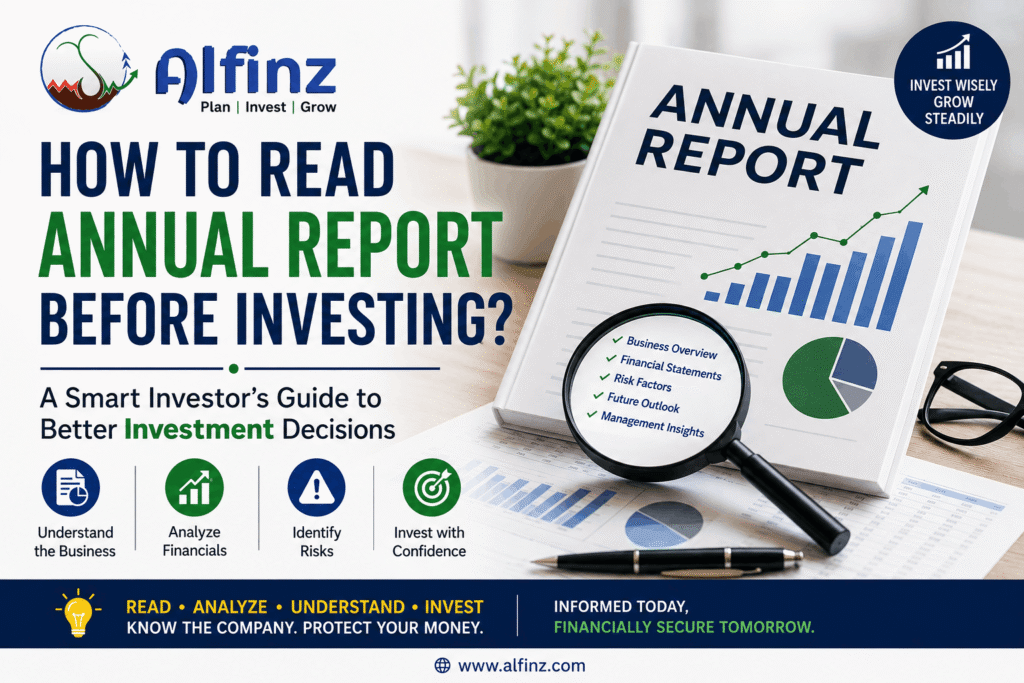
Does going through an Annual report is that much important ? Lets see..
What made you buy a stock? Was it just someone’s advice?
Many Indian investors do exactly that. They rely on social media, TV experts, WhatsApp groups, or friends without understanding the company behind the stock.
However, investing without reading an annual report is like buying a house without seeing it.
At ALFINZ, we have noticed one common pattern. Investors who spend just one hour reading an annual report often make far better investment decisions than those who chase market rumours.
Therefore, learning an annual report before investing can help you avoid expensive mistakes and invest with confidence.
Why Reading an Annual Report Is Important
An annual report tells the complete story of a company.
It explains what the business does, how it earns money, the risks it faces, and whether management is creating value for shareholders.
Moreover, it contains audited financial statements, making it one of the most reliable documents available to investors.
Instead of depending only on YouTube videos or social media opinions, you can verify the facts yourself.
Most importantly, this habit helps you become an informed investor rather than a speculative trader
A Real-Life Indian Example
Imagine two friends from Hyderabad.
Rahul buys shares because an influencer says the company will double in price.
Meanwhile, Arjun spends 45 minutes reading the company’s annual report.
He notices rising debt, falling cash flow and increasing legal disputes.
Although the share price rises for a few weeks, it crashes after poor quarterly results. Rahul suffers heavy losses.
However, Arjun avoids the stock and protects his savings.
This is exactly why learning how to read an annual report before investing matters.
1. Grasping the Basics
What Is an Annual Report?
An annual report is a detailed document published once every financial year.
Indian companies, publishes Annual Reports by following SEBI regulations and the Companies Act.
It explains the company’s business performance, financial position, future plans and important risks.
Listed companies in India publish annual reports for shareholders, regulators and potential investors.
Think of it as the company’s yearly health check-up.
Who Is the Annual Report Written For?
Many beginners think annual reports are written only for accountants, which is not true.
Companies prepare these reports for investors, lenders, analysts, regulators and shareholders.
Moreover, management also uses the report to build trust and explain future business plans.
Reading it carefully helps you understand what management wants investors to believe.
How to Read a 200-Page Annual Report in just One Hour
Many beginners feel scared after seeing a 200-page report.
Fortunately, you do not need to read every single word.
We usually follow this sequence at ALFINZ:
- Business Overview
- Chairman’s Letter
- Risk Factors
- MD&A
- Auditor’s Report
- Financial Statements
- Notes to Accounts
This simple method saves time while covering the most important sections.
Also Read: The Ultimate Beginner’s Guide to Stock Market Investing in India
2. Sizing Up the Business
Business Overview
Before checking profits, understand the business.
Ask yourself simple questions.
- What products does the company sell?
- Who are its customers?
- How does it make money?
- Does it operate only in India or globally?
Similarly, identify whether revenue comes from one product or multiple businesses.
Companies with diversified income often face lower business risk.
Reading the Letter to Shareholders
Many investors skip this section. That is a mistake.
The Chairman or Managing Director usually explains the company’s achievements, challenges and future vision.
Pay attention to their tone. Confident management discusses both successes and failures.
However, if every letter only celebrates achievements while ignoring obvious problems, be cautious.
- Good management accepts responsibility.
- Great management also explains how problems will be solved.
Risk Factors
Every business has risks.
The important question is whether those risks are manageable.
For example,
- An automobile company may depend on steel prices.
- An IT company may depend on overseas clients.
- A pharmaceutical company may depend on regulatory approvals.
Most importantly, look for new risks added compared to last year’s report. New risks often reveal changing business conditions.
Legal Proceedings
This section is often ignored.
However, pending lawsuits can significantly affect future profits.
Look for disputes involving taxes, environmental issues, fraud allegations or regulatory penalties.
Small legal matters may not be serious.
Large unresolved cases, however, deserve closer investigation before investing.

3. Evaluating Context: Management’s Discussion & Analysis (MD&A)
Why MD&A Is the Most Important Section
If you ask us which section deserves the most attention, our answer is always the MD&A.
This is where management explains what happened during the year and why it happened.
Moreover, they discuss opportunities, challenges and future expectations.
Unlike financial statements, this section explains the story behind the numbers.
Therefore, never skip it.
Check Operational Performance
Good businesses usually show steady operational improvement.
Look beyond revenue growth.
Instead, ask practical questions.
- Did production increase?
- Did customer demand improve?
- Did exports grow?
- Were new products launched?
Similarly, check whether growth came from higher sales volume or simply higher prices.
Volume-driven growth is generally more sustainable.
Expansion Plans
Many companies announce expansion every year.
However, announcements alone do not create shareholder wealth.
Read whether management has completed earlier projects on time.
- Did the new factory start operations?
- Did international expansion generate revenue?
- Did acquisitions improve profitability?
Companies that consistently deliver on promises deserve greater confidence.
Liquidity and Capital Resources
Every business needs cash to operate.
Therefore, understand how the company funds its daily operations.
- Does it generate enough internal cash? Or
- Does it depend heavily on bank loans?
Healthy companies usually finance growth using operating cash flow.
Excessive borrowing increases financial risk during difficult economic periods.
Debt Utilisation
Debt is not always bad.
In fact, many successful companies use loans to expand efficiently.
However, debt should create future earnings.
If borrowing keeps increasing while profits remain flat, investigate further.
This may indicate poor capital allocation.
Future Outlook
Most management teams discuss expectations for the coming year.
Read these comments carefully. Notice whether they provide measurable goals.
For example:
- Revenue growth targets
- Capacity expansion
- Market share improvements
- Cost reduction plans
- Digital transformation
Specific guidance usually reflects stronger planning than vague optimism
Also Read: Beginner’s Guide to Mutual Funds Investing: Best Ways to Build Wealth
4. Auditing the Gatekeepers: The Auditor’s Report
Many retail investors ignore the auditor’s report because it looks technical.
However, this section protects investors from misleading financial information.
Think of auditors as independent examiners checking whether the company’s accounts fairly represent reality.
What Is a Clean Audit Opinion?
The best outcome is an Unqualified Opinion, commonly called a clean opinion.
This means auditors believe the financial statements present a fair picture according to accounting standards.
Although it does not guarantee future success, it improves confidence in reported numbers.
Critical Audit Matters (CAMs)
Modern annual reports include Critical Audit Matters.
These highlight accounting areas requiring significant judgement.
Examples include:
- Revenue recognition
- Goodwill valuation
- Inventory valuation
- Impairment testing
- Tax provisions
These topics deserve additional attention because even auditors consider them high-risk areas.
Warning Signs
Not every audit report is equally positive.
Pay close attention if you notice:
- Qualified Opinion
- Disclaimer of Opinion
- Adverse Opinion
- Frequent auditor resignations
- Going Concern warnings
These issues may indicate deeper financial problems. Therefore, investigate thoroughly before investing.

5. Dissecting the Core Financial Statements
“Here is the core of what you need to know before putting your money into a company.”
Every annual report contains three major financial statements.
Together, they explain how the company earns money, manages assets and generates cash.
# Income Statement
The Income Statement shows business performance over a financial year.
Think of it as the company’s report card.
Key items include:
- Revenue
- Operating Expenses
- Operating Profit
- Finance Cost
- Tax
- Net Profit
However, never focus only on profit. Study the quality of earnings.
Revenue Growth
Consistent revenue growth generally indicates healthy demand.
However, compare at least five years of revenue.
Steady growth is often more valuable than sudden spikes.
Similarly, compare revenue growth with industry peers.
Gross Margin
Gross Margin tells you how efficiently the company produces goods or services.
Rising margins often indicate:
- Better pricing power
- Efficient manufacturing
- Strong competitive advantage
Declining margins may indicate rising
Net Profit Margin
Revenue growth alone is not enough.
A company should also convert sales into profits.
If sales grow but profits fall, investigate why.
Possible reasons include:
- Rising raw material costs
- Higher employee expenses
- Heavy interest payments
- Increased depreciation
Understanding the reason is more important than simply looking at the percentage
# Balance Sheet
The Balance Sheet shows “what the company owns and what it owes“.
Imagine taking a financial photograph on the last day of the financial year.
It captures the company’s overall financial strength.
Current Assets
Current assets include:
- Cash
- Bank balance
- Inventory
- Trade receivables
Healthy current assets improve liquidity.
Companies with strong liquidity can better handle unexpected business challenges.
Current Liabilities
Current liabilities include:
- Supplier payments
- Short-term loans
- Taxes payable
- Other operating liabilities
Compare current assets with current liabilities.
If current assets comfortably exceed current liabilities, liquidity is generally stronger.
Long-Term Debt
Long-term borrowings deserve careful attention.
Debt should ideally support productive assets.
For example:
- Manufacturing plants
- Infrastructure
- Technology upgrades
However, excessive borrowing without corresponding growth is a warning sign.
Shareholders’ Equity
Shareholders’ equity represents the owners’ stake in the business.
Growing equity generally indicates increasing business value.
Consistent improvement over several years is a positive signal.
# Cash Flow Statement
Many experienced investors believe this is the most honest financial statement.
Why? Because cash is difficult to manipulate.
A company can report accounting profits. However, generating actual cash is much harder.
Operating Cash Flow
Operating cash flow proves whether the core business actually makes money.
Reliable stocks usually show steady cash growth year after year.
Healthy businesses consistently generate positive operating cash flow.
If operating cash flow keeps falling despite rising profits, investigate further.
Investing Cash Flow
This section shows money spent on future growth.
Examples include:
- New factories
- Machinery
- Technology
- Acquisitions
Don’t panic if this number is negative; it frequently highlights a firm investing in its future. It often indicates expansion.
However, ensure these investments eventually improve profitability.
Financing Cash Flow
This section explains how the company raises or repays capital.
Examples include:
- Bank borrowings
- Loan repayments
- Dividend payments
- Share buybacks
- Equity issuance
Healthy companies gradually reduce dependence on external financing.
One Important Check
Always compare: Net Profit with Operating Cash Flow
If profits rise while cash flow continuously falls, ask why.
- Sometimes this happens because customers are delaying payments.
- Sometimes inventory is piling up.
In worse cases, earnings quality may be weak.
This comparison alone has helped many investors avoid poor-quality companies.
Practical ALFINZ Reading Tip
Whenever we analyse a company, we compare the last five years instead of focusing on only one year.
A single good year can be accidental.
However, five years usually reveal the real business trend. Consistency creates long-term wealth.
6. Calculating the Truth: Key Financial Ratios to Extract
Financial ratios simplify complex numbers.
Moreover, they help compare companies within the same industry.
Never depend on one ratio alone.
Instead, analyse multiple ratios together.
Return on Equity (ROE)
ROE measures how efficiently management uses shareholders’ money.
A consistently healthy ROE often reflects a strong business model.
However, check whether high ROE comes from genuine profits or excessive debt.
Therefore, compare ROE with industry peers.
Return on Invested Capital (ROIC)
ROIC shows how effectively the company earns returns on all invested capital.
Many professional investors prefer ROIC because it includes both equity and debt.
Companies with consistently high ROIC usually enjoy durable competitive advantages.
Debt-to-Equity Ratio
This ratio measures financial leverage.
Lower debt generally means lower financial risk.
However, some industries naturally carry more debt.
Therefore, compare the ratio with competitors instead of using a fixed benchmark
Current Ratio
The Current Ratio measures short-term financial strength.
A healthy ratio indicates the company can comfortably meet near-term obligations.
Meanwhile, an extremely high ratio may suggest idle cash that is not being used efficiently.
Inventory Turnover
Inventory turnover tells you how quickly a company turns products into sales.
Higher turnover often indicates strong demand and efficient inventory management.
However, declining turnover may point to slowing sales or excess stock.
Days Sales Outstanding (DSO)
DSO measures how long customers take to pay.
A lower DSO usually improves cash flow.
If DSO keeps increasing every year, customers may be delaying payments.
Consequently, future cash flow could become weaker
7. Uncovering Hidden Details: The Footnotes & Schedules
Many investors ignore the Notes to Accounts.
Ironically, this is where companies disclose some of the most important information.
Always spend time reading these notes.
Accounting Policies
Every company follows accounting policies.
These explain how revenue is recognised, how depreciation is calculated and how inventory is valued.
If accounting methods change frequently, understand the reason. Unexpected changes may affect reported profits
Segment Reporting
Large companies often operate multiple businesses.
Segment reporting shows which divisions actually generate profits.
For example, an FMCG company may sell foods, beverages and personal care products.
Revenue may grow across all divisions.
However, only one segment might generate most of the profits. Understanding this helps investors identify the real growth engine.
Debt Maturity Schedule
Not all debt is due immediately.
The debt maturity schedule shows when loans must be repaid.
This helps investors estimate future financial pressure.
If significant loans mature within one or two years, refinancing risk increases.
Therefore, always compare upcoming repayments with available cash.
Stock-Based Compensation
Many companies reward employees with shares.
Reasonable stock-based compensation motivates employees.
However, excessive issuance gradually dilutes existing shareholders.
Therefore, monitor whether the number of outstanding shares keeps increasing every year.
8. Spotting Corporate Deception: Red Flags to Watch For
Most companies are genuine.
However, some warning signs deserve immediate attention.
Never ignore these signals.
Frequent Accounting Changes
Consistent accounting policies improve comparability.
If depreciation methods or useful life assumptions change frequently, investigate further.
Although changes may be justified, repeated revisions deserve careful analysis.
Rising Profits but Falling Cash Flow
This is one of the biggest warning signs.
A company may report impressive profits.
However, if operating cash flow keeps declining, earnings quality could be weak.
Always compare profit with cash generation. Cash ultimately pays dividends, salaries and loans
Related-Party Transactions
Some companies conduct business with promoters or group entities.
Not every related-party transaction is harmful.
However, unusually large transactions should be reviewed carefully.
Look for fair pricing and transparent disclosures.
Good governance protects minority shareholders.
One-Time Expenses Every Year
Occasional one-time expenses are normal.
However, if a company reports “non-recurring expenses” every single year, ask why.
Repeated adjustments may artificially improve reported earnings.
Consequently, adjusted profits may appear stronger than the underlying business.
Why This Matters for Indian Investors
Indian markets offer thousands of listed companies.
Some create wealth for decades. Others destroy shareholder value.
Learning an Annual Report Before Investing helps you separate quality businesses from risky ones.
Moreover, it reduces dependence on rumours, social media tips and emotional investing.
Most importantly, it builds confidence in your investment decisions.
Alfinz – Based Approach
At ALFINZ, we encourage investors to ask five simple questions before buying any stock:
- Do I understand the business model?
- Is revenue growing consistently?
- Is operating cash flow healthy?
- Is debt manageable?
- Can I explain why I want to own this company?
If the answer to any question is “No,” spend more time researching before investing.
Patience often produces better long-term results than rushing into popular stocks.
Common Mistakes Beginners Make
Many first-time investors repeat the same mistakes.
Avoid these common errors:
- Buying based only on TV or social media tips.
- Looking only at net profit.
- Ignoring cash flow statements.
- Skipping risk factors.
- Not reading the auditor’s opinion.
- Comparing companies from different industries.
- Focusing only on one year’s performance.
- Ignoring the notes to accounts.
Avoiding these mistakes can significantly improve investment quality.
FAQ‘s
No. Start with the Business Overview, MD&A, Risk Factors, Auditor’s Report, Financial Statements and Notes to Accounts.
With practice, you can review the most important sections in about 45 to 60 minutes.
You can download them from the company’s Investor Relations page or from stock exchange websites like NSE and base.
No. Both matter. However, healthy operating cash flow confirms whether reported profits are supported by actual business performance.
Comparing at least five financial years gives a clearer picture of long-term business quality.
Yes. They cannot eliminate all risks, but they help identify financial weakness, governance issues and unrealistic growth claims.
Conclusion:
Successful investing is not about predicting tomorrow’s share price.
It is about understanding the business you own.
Learning an Annual Report Before Investing gives you an edge that many retail investors ignore.
Moreover, annual reports provide reliable information directly from the company instead of market rumours.
Therefore, make annual report reading a habit before investing even a single rupee.
Over time, this discipline can help you build a stronger and more resilient investment portfolio.
Contact Alfinz Today for Personalized Investment Guidance Before You Start Investing
Need personalized financial guidance?
Contact Alfinz today for Investments, Insurance, Loans, Taxation & Financial Planning assistance.
Disclaimer: This article is published for general educational and informational purposes only. The content shared is based on common financial planning principles and personal finance awareness. It should not be considered professional financial, investment, tax, legal, or insurance advice. Financial decisions should always be made based on individual goals, risk profile, income, and personal circumstances. Readers are advised to consult a qualified financial advisor or professional before making any financial or investment decisions. Alfinz shall not be responsible for any financial loss or decisions taken based on this content.

Shiva Kumar is the Founder of ALFINZ, a financial planning and investment advisory platform dedicated to helping individuals make informed financial decisions. He holds NISM certifications in Equity Derivatives, Currency Derivatives, Equity Research Analysis, and Mutual Fund RTA. Through ALFINZ, he shares practical insights on financial planning, stock market investing, mutual funds, insurance, taxation, and wealth creation.