

Why Are More Indians Choosing Mutual Funds?
If you are new to investing, you may feel confused by terms such as SIP, NAV, equity funds, and index funds. Many people think investing is only for experts or wealthy individuals. However, mutual funds investing is very simple and accessible for everyone.
Today, thousands of Indian families use mutual funds to save for retirement, children’s education, dream homes, and financial freedom.
Even a small monthly investment can grow into a significant amount over time when invested wisely.
This Beginner’s Guide to Mutual Funds Investing explains everything in simple language.
By the end, you will understand how mutual funds work, how to choose the right fund, and how to start your investment journey confidently.
Why Mutual Funds Are Important for Beginners
Most people keep their money in savings accounts, fixed deposits, or cash. While these options provide safety, they often struggle to beat inflation.
For example, if inflation rises by 6% annually and your savings account earns only 3%, your purchasing power gradually decreases.
Mutual funds offer an opportunity to grow wealth while benefiting from professional fund management. Therefore, they have become one of the most popular investment options in India.
Key Benefits of Mutual Funds
- Professional management
- Diversification across many investments
- Affordable starting amounts
- Easy SIP investing
- High liquidity in most schemes
- Suitable for multiple financial goals
- Tax-saving opportunities through ELSS funds
What is a Mutual Fund?
A mutual fund is an investment vehicle where money from multiple investors is pooled together and invested in various financial assets.
These assets may include:
- Stocks
- Bonds
- Government securities
- Money market instruments
- Gold-related assets
Think of it like a large investment basket. Instead of buying individual stocks yourself, you own a small portion of the entire basket.
This reduces risk and makes investing easier for beginners.
Look at Real-Life Indian Scenario
Imagine Ravi from Hyderabad wants to start investing.
He has only ₹5,000 per month available for investments. Buying shares of many companies individually would require significant research and capital.
Instead, Ravi invests ₹5,000 monthly into a mutual fund through SIP. The fund manager handles stock selection while Ravi focuses on his financial goals.
As a result, he gains exposure to multiple companies with a single investment.
How Do Mutual Funds Work?
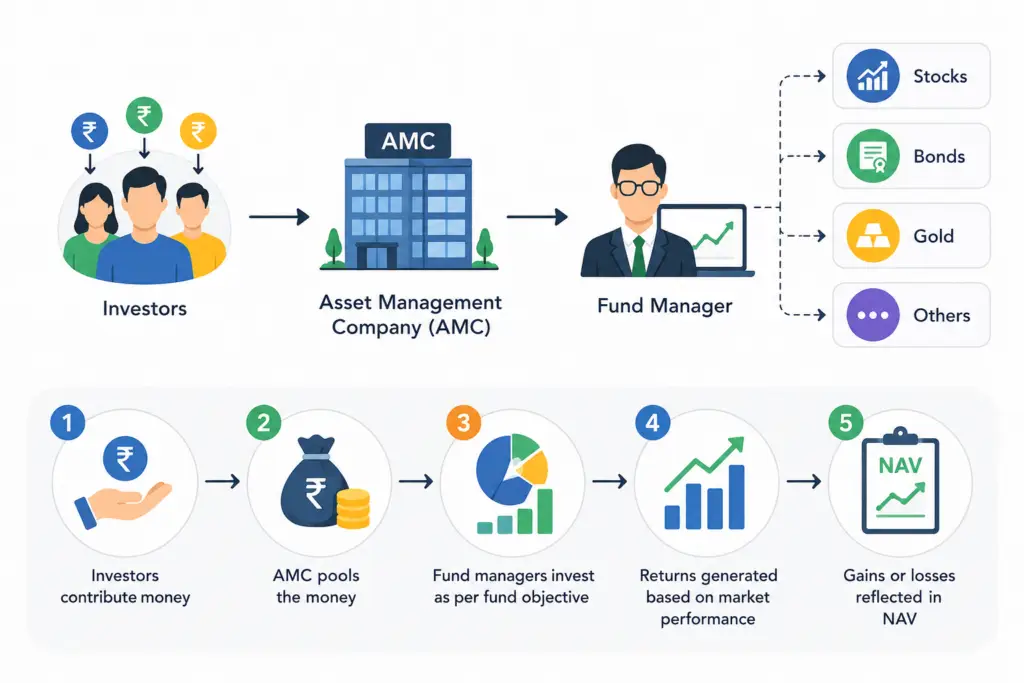
Mutual funds are managed by Asset Management Companies (AMCs).
Examples include:
- SBI Mutual Fund
- HDFC Mutual Fund
- Zerodha Mutual Fund
The AMC appoints professional fund managers who decide where the money should be invested.
Process
- Investors contribute money.
- The AMC pools the money.
- Fund managers invest according to the fund objective.
- Returns are generated based on market performance.
- Gains or losses are reflected in the fund’s NAV.
Understanding Mutual Fund Terminology
What is NAV?
NAV stands for Net Asset Value.
It represents the per-unit value of a mutual fund.
NAV Formula
NAV = (Total Assets – Liabilities) ÷ Total Units
If a fund’s total assets are worth ₹100 crore and it has 10 crore units, the NAV becomes ₹10.
A higher NAV does not mean the fund is better. Performance and fund strategy matter more.
Assets Under Management (AUM)
AUM refers to the total value of assets managed by a mutual fund scheme.
Higher AUM generally indicates investor confidence, although it should not be the sole selection criterion.
Portfolio
A portfolio is the collection of investments held by the mutual fund.
For example, an equity fund portfolio may contain shares of 50–100 companies.
Compounding
Compounding means earning returns on your previous returns.
This is one of the most powerful wealth-building concepts in investing.
The Power of Compounding and SIPs
Let’s compare two investors.
Investor A
Starts at age 25.
Invests ₹5,000 monthly through SIP.
Continues for 20 years.
Assuming 12% annual return:
Approximate corpus = ₹50 lakh.
Investor B
Starts at age 35.
Invests the same ₹5,000 monthly.
Continues for 10 years.
Assuming 12% annual return:
Approximate corpus = ₹11.5 lakh.
Why SIP Is the Best Way to Start Investing ?
Although both invested the same monthly amount, the early starter accumulated significantly more wealth.
Key Lesson
Time in the market is more important than timing the market.
The earlier you start, the greater the benefit of compounding.
Major Types of Mutual Funds
Equity Funds
Equity funds primarily invest in stocks.
Suitable For
- Long-term goals
- Wealth creation
- Retirement planning
Risk Level
High
Return Potential
High
Debt Funds
Debt funds invest in bonds and fixed-income securities.
Suitable For
- Emergency funds
- Short-term goals
- Conservative investors
Risk Level
Low to Medium
Return Potential
Moderate
Hybrid Funds
Hybrid funds combine equity and debt investments.
Suitable For
Investors seeking balanced risk and return.
Risk Level
Medium
Return Potential
Moderate to High
Index Funds and ETFs
These funds track market indices such as Nifty 50 or Sensex.
Advantages include:
- Lower costs
- Simplicity
- Broad diversification
- Minimal fund manager bias
These are excellent choices for beginners.
ELSS Funds
ELSS stands for Equity Linked Savings Scheme.
Benefits include:
- Tax deduction under Section 80C
- Wealth creation potential
- Only 3-year lock-in period
Goal-Based Mutual Fund Selection Matrix
| Financial Goal | Time Horizon | Suggested Fund |
| Emergency Fund | 0-2 Years | Debt Fund |
| Car Purchase | 2-5 Years | Short-Term Debt Fund |
| House Down Payment | 5-10 Years | Hybrid Fund |
| Child Education | 10-15 Years | Equity Fund |
| Retirement | 15+ Years | Equity/Index Fund |
This simple framework helps beginners select suitable funds according to their goals.
How to Choose the Right Mutual Fund
Define Financial Goals
Before investing, ask yourself:
- Why am I investing?
- When will I need this money?
- How much money do I need?
Goals provide direction and help select the right fund.
Assess Your Risk Appetite
Conservative
Prefer stability and lower volatility.
Suitable: Debt Funds
Moderate
Can accept some fluctuations.
Suitable: Hybrid Funds
Aggressive
Comfortable with market ups and downs.
Suitable: Equity Funds
Evaluate Historical Performance
Look at:
- 3-year returns
- 5-year returns
- Benchmark comparison
- Consistency
Avoid selecting funds solely because they performed well recently.
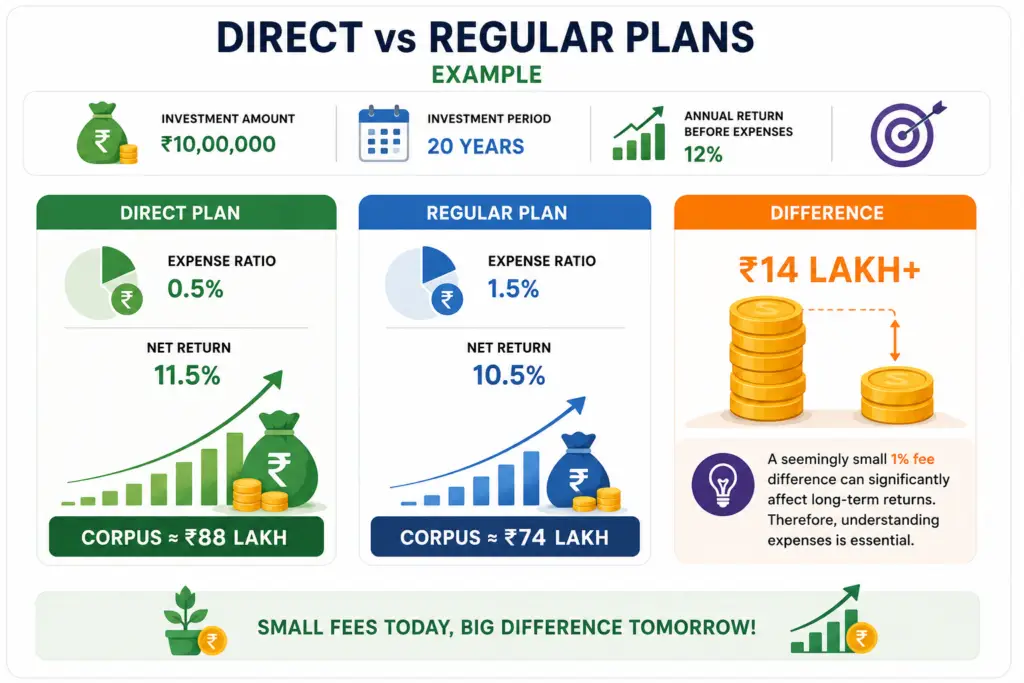
Understanding Expense Ratio
Expense ratio is the annual fee charged by the fund.
Many investors ignore this factor, but it significantly impacts long-term wealth.
Direct vs Regular plans
Direct Plan
Purchased directly from the AMC.
Advantages:
- Lower expenses
Higher long-term returns
Regular Plan
Purchased through advisors or distributors.
Advantages:
- Guidance
- Goal planning
- Portfolio review support
Choose based on your comfort and knowledge level.
SIP vs Lumpsum Investment
SIP (Systematic Investment Plan)
SIP allows you to invest a fixed amount regularly.
Benefits include:
- Disciplined investing
- Rupee cost averaging
- Affordable
- Less emotional investing
Suitable for salaried individuals.
Lumpsum Investment
Lumpsum means investing a large amount at one time.
Suitable when:
- You receive a bonus
- You sell an asset
- You inherit money
However, market timing risk is higher.
Step-by-Step Guide to Start Mutual Funds Investing
Step 1: Complete KYC
KYC Checklist
Keep these documents ready:
✓ PAN Card
✓ Aadhaar Card
✓ Passport-size Photograph
✓ Mobile Number
✓ Email Address
✓ Bank Account Details
✓ Cancelled Cheque or Bank Statement
Most KYC processes are now completed online within minutes.
Step 2: Choose an Investment Platform
Options include:
- AMC websites
- Mutual fund apps
- Investment platforms
- Financial advisors
Select a platform that offers ease of use and transparent reporting.
Open Demat A/c with Zerodha (Direct Platform) for Mutual Funds Investing

Step 3: Start Your SIP
Choose:
- Fund
- SIP amount
- Date
- Bank account
Set up auto-debit and stay invested consistently.
Risks of Mutual Funds
Although mutual funds are professionally managed, risks still exist.
Major Risks
- Market risk
- Interest rate risk
- Credit risk
- Liquidity risk
Remember: Mutual funds do not guarantee returns.
Always invest according to your goals and risk tolerance.
Mutual Fund Taxation in India
Equity Funds
Short-Term Capital Gains
Held less than 1 year.
Tax applicable as per prevailing rules.
Long-Term Capital Gains
Held more than 1 year.
Tax rules may change periodically, so investors should verify current regulations before investing.
Debt Funds
Tax treatment differs from equity funds and may change based on government regulations.
Always review the latest tax provisions before making investment decisions
Tax Slabs AS per F.Y 26-27
| Asset Category | Holding Period for Short-Term | STCG Tax Rate (F.Y. 2026-27) | Holding Period for Long-Term | LTCG Tax Rate (F.Y. 2026-27) |
| Listed Equity / Equity Funds | < 12 months | 20% flat | > 12 months | 12.5% (after ₹1.25L exemption) |
| Debt Mutual Funds | Any holding period | Slab Rates | Not applicable | Slab Rates |
Common Mistakes Beginners Must Avoid
Chasing Past Returns
Yesterday’s top-performing fund may not remain the best tomorrow.
Panic Selling
Market corrections are normal. Avoid emotional decisions during volatility.
Over-Diversification
Owning too many funds creates confusion and overlap.
Ignoring Goals
Investment decisions should always be linked to financial goals.
Starting Too Late
Every year of delay reduces the power of compounding.
Alfinz -Based Approach: How We Guide Beginners
When beginners approach us, we do not start by recommending funds.
Instead, we first understand:
- Income
- Expenses
- Existing investments
- Financial goals
- Risk tolerance
Only then do we create a goal-based mutual fund strategy.
This approach helps investors stay focused during market fluctuations and increases the probability of achieving long-term objectives.
FAQ
Yes. Many mutual fund SIPs start from as little as ₹500 per month.
No. SIP reduces timing risk but does not guarantee returns.
Index funds, large-cap funds, and balanced hybrid funds are often considered beginner-friendly.
Most open-ended funds allow redemption anytime. However, ELSS funds have a mandatory lock-in period.
Mutual funds are regulated, but market-linked risks remain.
For most salaried individuals, SIP is generally a practical and disciplined approach.
Conclusion:
Start Early, Stay Consistent, Build Wealth
The biggest mistake in investing is waiting for the perfect time.
Mutual funds provide a simple, affordable, and effective way to participate in India’s growth story. Whether your goal is retirement, a dream home, your child’s education, or financial freedom, mutual funds can play an important role in achieving those goals.
Start with a clear objective, choose suitable funds, invest consistently, and review your portfolio annually. Most importantly, give your investments enough time to grow.
Because in investing, the combination of discipline, patience, and compounding often creates the best results.
🚨 Ready to Start Investing but Not Sure Which Mutual Fund Is Right for You?
Don’t wait until “later.” Every year of delay can reduce the power of compounding.
👉 Book a Free Mutual Fund Consultation with Alfinz Today
✅ Goal-Based Investment Planning
✅ SIP & Portfolio Review
✅ Beginner-Friendly Guidance
✅ Tax Saving & Wealth Creation Strategy
✅ Personalized Mutual Fund Recommendations
Start your wealth creation journey today before another year passes by.
Contact Alfinz Today for Personalized Investment Guidance Before You Start Investing
Need personalized financial guidance?
Contact Alfinz today for Investments, Insurance, Loans, Taxation & Financial Planning assistance.
Disclaimer: This article is published for general educational and informational purposes only. The content shared is based on common financial planning principles and personal finance awareness. It should not be considered professional financial, investment, tax, legal, or insurance advice. Financial decisions should always be made based on individual goals, risk profile, income, and personal circumstances. Readers are advised to consult a qualified financial advisor or professional before making any financial or investment decisions. Alfinz shall not be responsible for any financial loss or decisions taken based on this content.

Shiva Kumar is the Founder of ALFINZ, a financial planning and investment advisory platform dedicated to helping individuals make informed financial decisions. He holds NISM certifications in Equity Derivatives, Currency Derivatives, Equity Research Analysis, and Mutual Fund RTA. Through ALFINZ, he shares practical insights on financial planning, stock market investing, mutual funds, insurance, taxation, and wealth creation.