
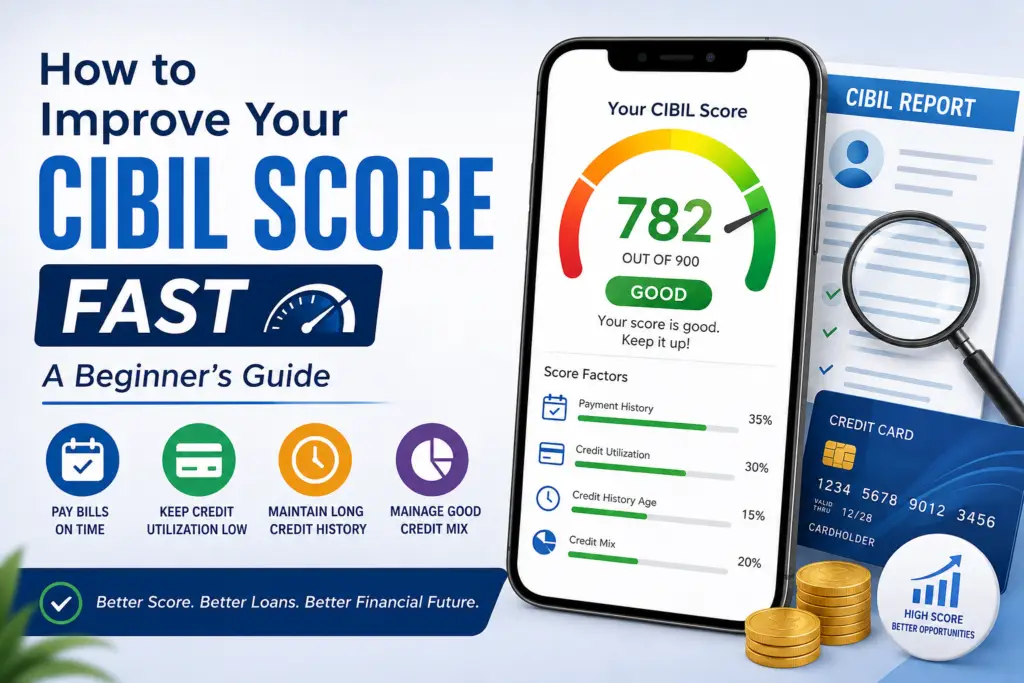
The Three Digits That Can Change Your Financial Life : CIBIL score
Many people in India focus on income while applying for a loan. However, lenders often focus on something equally important before approving your application: your CIBIL Score.
A good salary may help, but a strong credit score can make the difference between approval and rejection. It can also determine how much interest you pay over the life of a loan.
Whether you are planning to buy a house, purchase a car, apply for a personal loan, or get a credit card, understanding your CIBIL score is essential.
In our experience, many borrowers only learn about their score after facing a loan rejection. Unfortunately, by then, valuable time may already be lost.
Therefore, understanding how the system works before you need credit can save money, reduce stress, and improve financial opportunities.
Why Understanding Your CIBIL Score Matters
Imagine two individuals applying for the same home loan amount from the same bank.
Both have similar incomes and job stability.
However, one applicant has a CIBIL score of 790, while the other has a score of 650.
As a result, the first applicant may receive quicker approval, lower interest rates, and better loan terms.
Meanwhile, the second applicant may face additional scrutiny or even rejection.
This simple example shows why your credit score acts as your financial reputation in the lending world.
What Exactly Is a CIBIL Score?
A CIBIL score is a three-digit number that reflects your creditworthiness based on your past borrowing and repayment behaviour.
It is generated by the Indian credit bureau Trans Union CIBIL, which collects data from banks, NBFCs, and financial institutions across the country.
The score helps lenders assess the risk of lending money to a borrower. Simply put, it tells lenders whether you have managed credit responsibly in the past.
Understanding the Numeric Range: Why Does It Run from 300 to 900?
CIBIL scores are measured on a standard scale ranging from 300 to 900.
The closer your score is to 900, the stronger your credit profile appears.
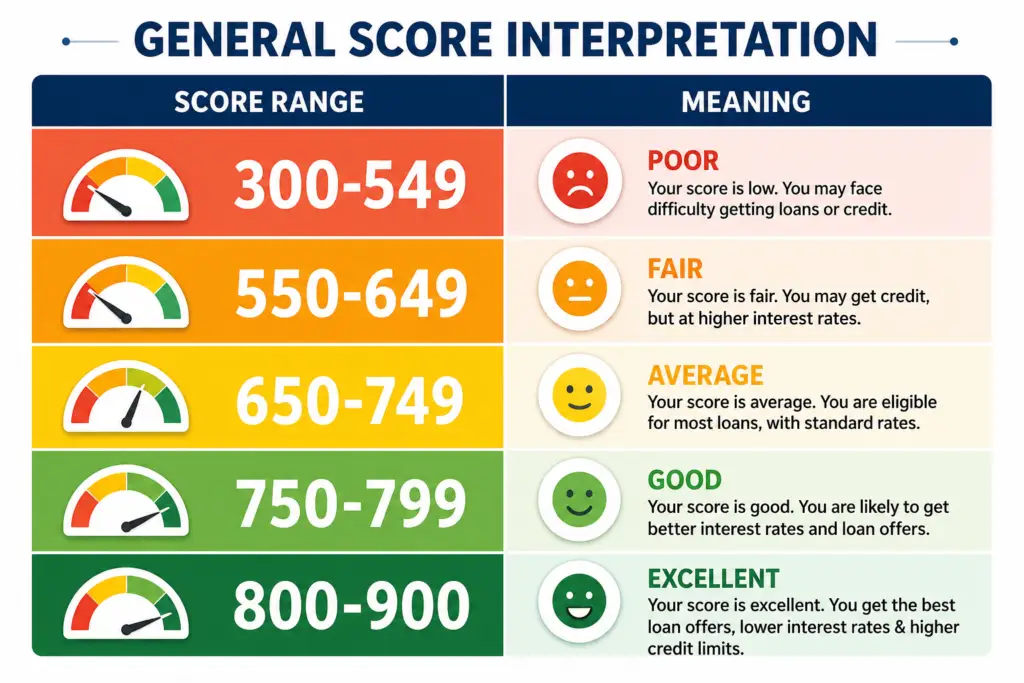
Most lenders prefer borrowers with a score of 750 or above.
This range is often considered the sweet spot for securing better borrowing opportunities.
The Ideal Benchmark: Why 750+ Is Considered Excellent
A score above 750 signals financial discipline.
It demonstrates that you repay obligations on time and manage credit responsibly.
Consequently, lenders view such applicants as lower-risk customers.
As a result, borrowers with higher scores often enjoy:
- Faster approvals
- Better loan offers
- Higher credit limits
- Lower interest rates
- Easier negotiations
Therefore, aiming for a score above 750 should be a long-term financial goal.
How Does Trans Union CIBIL Track Your Financial History?
Every time you borrow money or use a credit card, lenders report information to Trans Union CIBIL.
This data may include:
- Loan balances
- EMI repayment records
- Credit card payments
- Credit limits
- New loan applications
- Defaults and settlements
Over time, this information forms your credit profile.
Your score regularly changes based on how you manage these obligations.
The Four Major Factors That Influence Your CIBIL Score
Many people assume income affects their credit score.
Surprisingly, income itself is not a direct scoring factor.
Instead, lenders focus on repayment behaviour and credit management.
Let’s break down the four key pillars.
1. Payment History (35% Weightage)
Payment history carries the highest impact.
Every EMI, loan entailment, and credit card bill matters.
Even one missed payment can turn your score into negative.
Therefore, timely repayment should always be your first priority.
Best Practice
Set up:
- Auto-debit mandates
- Standing instructions
- Payment reminders
- Calendar alerts
Consistency is the foundation of a strong credit profile.
2. Credit Utilization Ratio (30% Weightage)
Credit utilization tells you how much of your available credit limit you are using.
Suppose your credit card limit is ₹1,00,000.
If your outstanding balance is ₹25,000, your utilization ratio is 25%.
Financial experts generally suggest keeping utilization below 30%.
Higher utilization may indicate dependence on borrowed money. Consequently, your score may decline.

3. Length of Credit History (15% Weightage)
The age of your oldest active credit account contributes to your score.
A longer credit history gives lenders more data to evaluate your repayment behaviour.
Therefore, maintaining older accounts can be beneficial.
Many borrowers close old cards unnecessarily and unknowingly reduce their credit history age.
4. Credit Mix (20% Weightage)
Lenders prefer borrowers who successfully manage different types of credit.
Examples include:
Secured Credit
- Home loans
- Vehicle loans
- Loan against property
Unsecured Credit
- Personal loans
- Credit cards
A balanced credit mix indicates stronger financial management capability.
How to Improve Your CIBIL Score: Practical Action Plan
If your score is below expectations, don’t panic.
Improving a credit score is possible with consistent effort.
Here are the most effective strategies.
Fix Missing Payments Immediately
Late payments are one of the biggest reasons for low scores.
Start by clearing overdue amounts.
Then create automatic payment systems to prevent future delays.
Even one missed payments can remain visible for many years.
Lower Your Credit Utilization
One practical strategy is paying credit card dues twice every month.
Instead of waiting until the due date, reduce balances periodically.
This helps maintain a lower utilization ratio throughout the billing cycle.
Consequently, your score may improve over time.
Avoid Frequent Loan Applications
Every loan application generates a hard inquiry.
Too many inquiries within a short period may signal financial stress.
Therefore, avoid applying simultaneously for multiple loans or credit cards.
A six-month gap between applications is generally healthier.
Keep Older Credit Cards Active
If an old credit card has no annual fee, consider keeping it active.
Even if you rarely use it, the account contributes positively to your credit history age.
Just ensure the account remains in good condition i.e., without negative or used balance.
How to Read Your CIBIL Report Correctly
Many people check only their score.
However, the detailed report often contains valuable information.
Let’s understand the important sections.
Account Information Section
Review every loan and credit card listed.
Verify whether accounts are correctly marked as:
- Active
- Closed
- Settled
- Written Off
Any incorrect information should be investigated immediately
Days Past Due (DPD)
DPD indicates how many days a payment was delayed.
Ideally, every entry should show: 000
This means payments were made on time.
Higher numbers indicate missed or delayed repayments.
These entries can negatively affect your score.
Enquiry Section
This section records lenders who accessed your credit file.
A high number of recent inquiries may affect lender perception.
Therefore, regularly reviewing this section is important.
Common Errors That Can Damage Your CIBIL Score
Many credit card users assume credit reports are always accurate and correct.
Unfortunately, mistakes do occur.
Some common examples include:
- Incorrect names
- Wrong PAN linkage
- Duplicate loans
- Incorrect outstanding balances
- Closed loans showing active
- Accounts belonging to another person
Therefore, reviewing your report periodically is essential.
How to Raise a CIBIL Dispute
If you notice an error, take action immediately.
The process is straightforward.
Step 1: Identify the incorrect information.
Step 2: Collect supporting documents.
Step 3: Submit a dispute through the CIBIL dispute portal.
Step 4: Track progress regularly.
Step 5: Wait for lender verification and correction.
How Long Does Dispute Resolution Take?
Most genuine disputes are generally reviewed within approximately 30 days.
However, actual processing time depends entirely on individual lender response speeds.
Therefore, follow up periodically until the issue is resolved.
Real-Life Indian Scenario: The Hidden Cost of a Poor Score
Recently, a client approached us after a personal loan rejection.
His income was stable and documentation was complete.
However, a forgotten credit card payment from several months earlier had reduced his score below lender expectations.
After clearing dues and improving utilization, his score improved significantly within a few months.
Eventually, he secured the required loan at a more competitive rate.
This example highlights why proactive monitoring matters.
The Financial Benefits of a High CIBIL Score
A strong score delivers benefits beyond loan approvals.
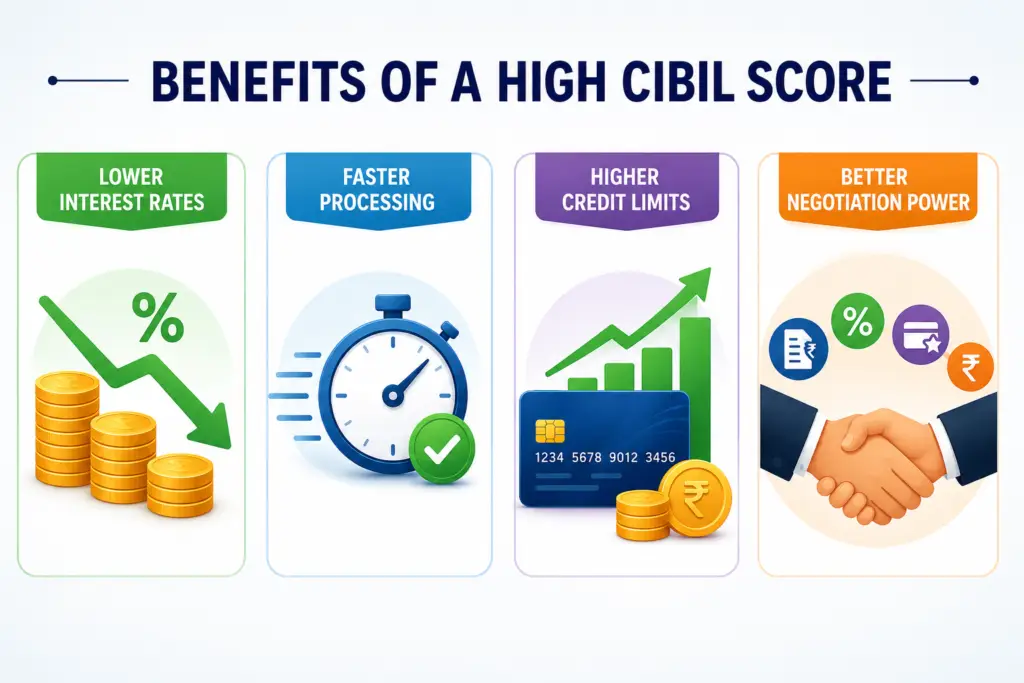
Lower Interest Rates
Even a small reduction in interest can save lakhs of rupees over a long-term loan.
Therefore, maintaining a healthy score directly impacts wealth creation.
Faster Processing
Lenders often process applications more quickly when credit profiles are strong.
This becomes especially valuable during urgent funding requirements.
Higher Credit Limits
Banks may be more willing to increase credit limits for responsible borrowers.
This can improve utilization ratios further.
Better Negotiation Power
Borrowers with strong scores often have leverage during discussions regarding:
- Processing fees
- Interest rates
- Premium credit cards
- Loan terms
FAQ
Generally, a score above 750 is considered good by most lenders.
At least two times a year is recommended (once in half yearly).
No. Self-checking is considered a soft inquiry and does not impact your score.
Late payments may remain visible in your credit history for several years.
Major improvements take time. However, clearing dues and reducing utilization can produce positive changes relatively quickly.
Not always. Closing old cards may reduce your credit history length and increase utilization ratios.
Conclusion:
Your CIBIL Score Is Your Complete Financial Report in 3 digit number.
Your CIBIL score is much more than a number.
It influences loan approvals, interest rates, processing speed, and future borrowing opportunities.
Fortunately, improving it does not require complicated strategies.
Timely payments, lower utilization, longer credit history, and responsible borrowing habits can significantly strengthen your profile.
The earlier you start monitoring your credit health, the better your financial opportunities will be.
Remember, lenders may evaluate your credit history in minutes, but building a strong credit reputation takes consistent effort. Start today, and your future self will thank you.
Need personalized financial guidance?
Contact Alfinz today for Investments, Insurance, Loans, Taxation & Financial Planning assistance.
Disclaimer: This article is published for general educational and informational purposes only. The content shared is based on common financial planning principles and personal finance awareness. It should not be considered professional financial, investment, tax, legal, or insurance advice. Financial decisions should always be made based on individual goals, risk profile, income, and personal circumstances. Readers are advised to consult a qualified financial advisor or professional before making any financial or investment decisions. Alfinz shall not be responsible for any financial loss or decisions taken based on this content.

Shiva Kumar is the Founder of ALFINZ, a financial planning and investment advisory platform dedicated to helping individuals make informed financial decisions. He holds NISM certifications in Equity Derivatives, Currency Derivatives, Equity Research Analysis, and Mutual Fund RTA. Through ALFINZ, he shares practical insights on financial planning, stock market investing, mutual funds, insurance, taxation, and wealth creation.





Great content! Keep up the good work!