Understanding ETFs in Simple Way
If you have ever wanted to invest in the stock market but felt confused about choosing individual stocks, ETFs can be an excellent starting point.
Many investors want diversification, lower costs, and simplicity. However, researching dozens of companies takes time. This is where Exchange Traded Funds, commonly known as ETFs, become useful.
Today, ETFs are among the fastest-growing investment products worldwide. They are used by beginners, experienced investors, financial advisors, and even large institutions.
In this guide, we will understand what ETFs are, how they work, their benefits, risks, and real-life examples that make investing easier.
Why ETFs Are Important for Modern Investors
Investing has changed dramatically over the last two decades.
Earlier, investors had two common choices. They could either buy individual stocks or invest through mutual funds.
While stocks offered growth potential, they carried higher company-specific risks.
On the other hand, mutual funds provided diversification but often came with higher management fees.
ETFs created a middle path.
They combine the diversification benefits of mutual funds with the trading flexibility of stocks.
As a result, investors can access hundreds of companies through a single purchase while maintaining control over when and how they trade.
What Are ETFs?
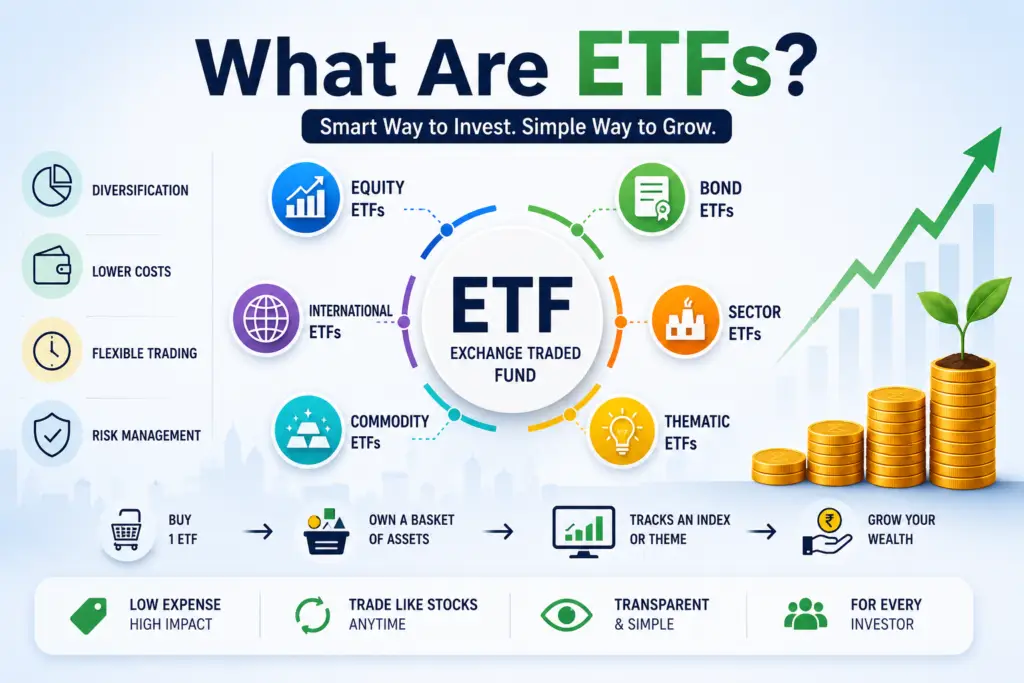
ETF stands for Exchange Traded Fund.
An ETF is a basket of investments bundled together into a single fund. These investments may include stocks, bonds, commodities, or a combination of different assets.
Instead of buying each asset separately, investors purchase one ETF unit.
Think of it like ordering a complete meal instead of buying every ingredient individually.
For example, an ETF tracking the S&P 500 Index holds shares of hundreds of major companies.
By purchasing one ETF unit, you gain exposure to all those companies at once. This makes investing easier, faster, and more diversified.
The Evolution of ETFs
The first ETF was introduced to make index investing simpler and more accessible.
Over time, investors realized that ETFs offered transparency, flexibility, and lower costs compared to many traditional investment products.
Consequently, ETF assets worldwide have grown into trillions of dollars.
Today, investors can find ETFs covering almost every market, sector, and investment theme imaginable.
Also Read: How to Open a Demat Account for Beginners in India
How Do ETFs Work?
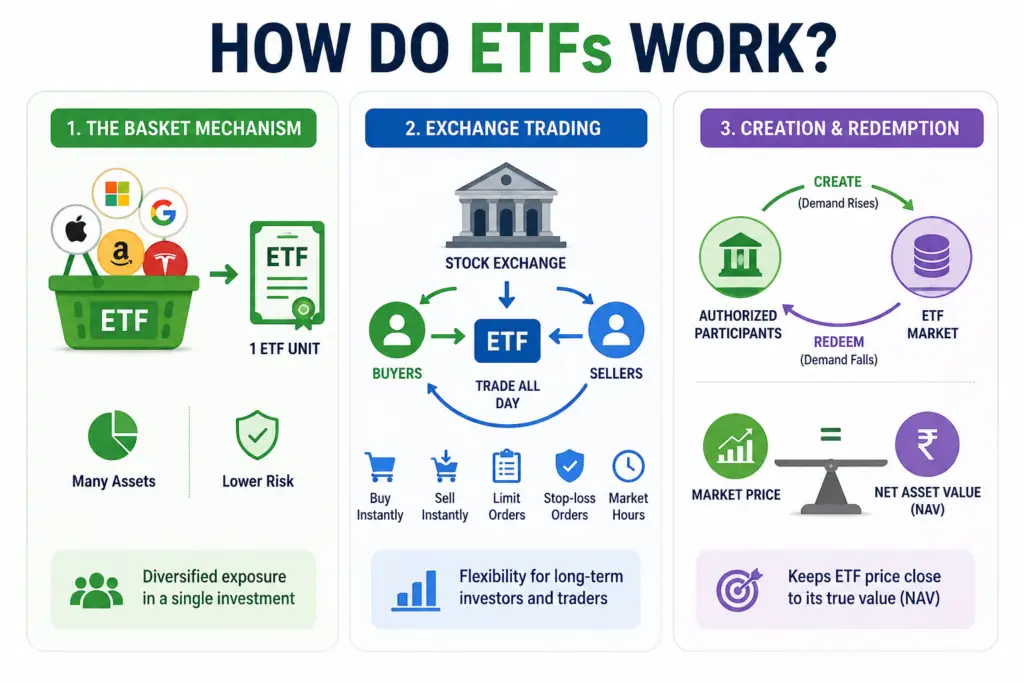
The Basket Mechanism
Every ETF contains a collection of underlying assets.
For example, a technology ETF may own shares of leading technology companies.
When you buy one ETF unit, you indirectly own a small portion of every company within that basket.
Therefore, your investment risk becomes spread across multiple holdings rather than depending on a single company.
Exchange Trading
Unlike traditional mutual funds, ETFs trade throughout the trading day.
Their prices change continuously as buyers and sellers transact on stock exchanges.
As a result, investors can:
- Buy instantly
- Sell instantly
- Place limit orders
- Use stop-loss orders
- Trade during market hours
This flexibility attracts both long-term investors and active traders.
Creation and Redemption Process
A unique mechanism helps ETFs stay close to their actual value.
Large financial institutions create new ETF units when demand rises and redeem units when demand falls.
This process helps keep the ETF market price aligned with its Net Asset Value (NAV).
Consequently, investors usually experience fair pricing even during active trading sessions.
ETFs vs Mutual Funds vs Stocks
Choosing between ETFs, mutual funds, and individual stocks can be confusing.
Therefore, understanding their differences is important.
ETFs vs Mutual Funds
Mutual funds are generally priced only once per day after market close.
In contrast, ETFs trade throughout the day like stocks.
Moreover, many ETFs follow passive investing strategies, which often result in lower management fees.
Mutual funds may involve active management, which can increase costs.
ETFs vs Individual Stocks
Individual stocks can generate significant returns. However, they also carry company-specific risk.
If one company performs poorly, investors may face substantial losses.
ETFs reduce this risk because they hold multiple companies within a single investment.
Therefore, diversification becomes easier and more affordable.
| Feature | ETF | Mutual Fund | Individual Stock |
| Diversification | High | High | Low |
| Trading During Day | Yes | No | Yes |
| Expense Ratio | Low | Medium to High | None |
| Risk Level | Moderate | Moderate | High |
| Minimum Investment | Low | Varies | Share Price |
| Transparency | High | Moderate | High |
| Liquidity | High | Moderate | High |
Open Demat Account and Start your Investment Journey in Stock Market
Major Types of ETFs With Examples
Stock (Equity) ETFs
Equity ETFs invest in stocks and generally track a market index. They are ideal for investors who want broad market exposure without selecting individual companies.
Popular Indian Equity ETFs
- Nippon India ETF Nifty BeES
- SBI ETF Nifty 50
- ICICI Prudential Nifty 50 ETF
Example:
If you buy a Nifty 50 ETF, you indirectly invest in India’s top 50 companies through a single transaction.
Bond (Fixed Income) ETFs
Bond ETFs invest in government securities and debt instruments. They are suitable for conservative investors seeking stability.
Popular Indian Bond ETFs
- Bharat Bond ETF
- ICICI Prudential Bharat 22 ETF
Example:
Investors looking for lower volatility compared to stocks may use Bharat Bond ETFs for predictable income and capital preservation.
Sector ETFs
Sector ETFs focus on specific industries.
Popular Indian Sector ETFs
- ICICI Prudential Nifty IT ETF
- Mirae Asset NYSE FANG+ ETF
- Motilal Oswal Nasdaq 100 ETF
Example:
If you believe India’s technology sector will grow rapidly, an IT ETF can provide diversified exposure to leading tech companies.
Commodity ETFs
Commodity ETFs track physical commodities, primarily gold in India.
Popular Indian Commodity ETFs
- SBI Gold ETF
- HDFC Gold ETF
- Nippon India Gold ETF
Example:
Instead of storing physical gold, investors can gain exposure through Gold ETFs while avoiding storage and purity concerns.
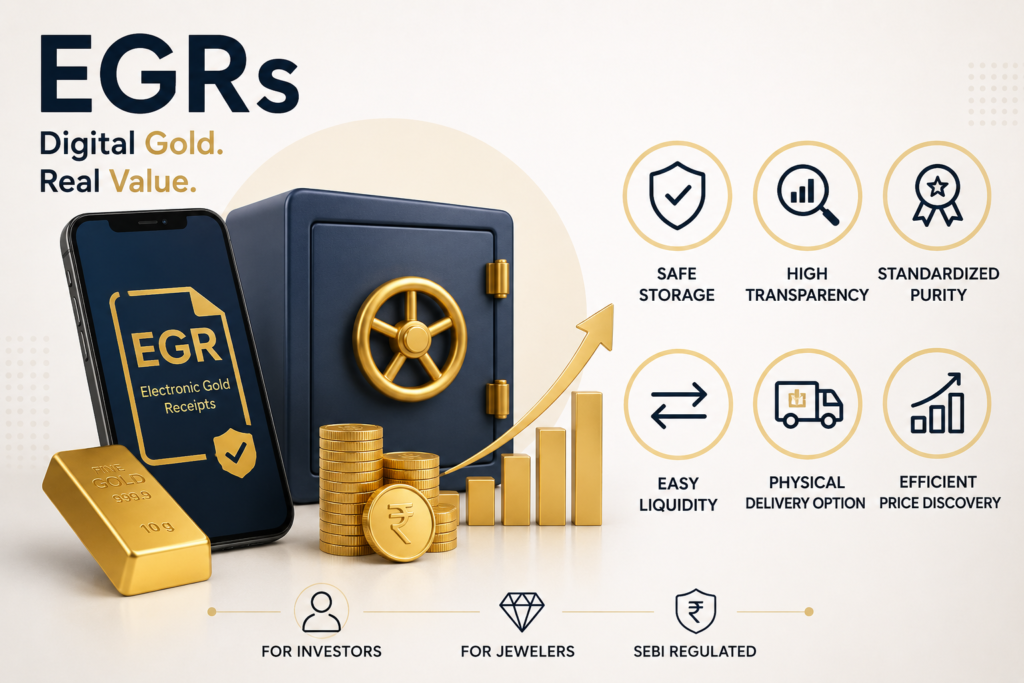
Why Electronic Gold Receipts (EGRs) Are Better Than Physical Gold
International Exposure ETFs (Available in India)
Although Indian investors primarily focus on domestic markets, some ETFs provide global diversification.
Popular International ETFs Available to Indian Investors
- Motilal Oswal Nasdaq 100 ETF
- Mirae Asset NYSE FANG+ ETF
Example:
These ETFs offer exposure to companies such as Apple, Microsoft, Amazon, and Alphabet without opening an overseas brokerage account.
Thematic ETFs
Thematic ETFs focus on emerging trends and long-term investment themes.
Popular Thematic ETFs in India
- ICICI Prudential Nifty PSU Bank ETF
- Nippon India ETF Consumption
- CPSE ETF
- Bharat 22 ETF
Example:
Investors who believe India’s consumption, banking, or public-sector growth story will continue can use thematic ETFs for targeted exposure.
Best ETFs for Beginners in India
For beginners, the following ETFs are often considered simple and diversified:
- Nippon India ETF Nifty BeES
- SBI ETF Nifty 50
- ICICI Prudential Nifty 50 ETF
- Bharat Bond ETF
- SBI Gold ETF
These ETFs provide exposure to broad markets, bonds, and gold, helping investors build a diversified portfolio with relatively lower risk.
Uses of ETFs
Instant Diversification
One of the biggest ETF benefits is diversification.
Instead of buying 100 different stocks individually, investors can purchase one ETF and instantly gain exposure to all of them.
As a result, portfolio risk is reduced significantly.
The Core-Satellite Model Investing Strategy
Many successful investors use a Core-Satellite approach.
The core portion consists of broad market ETFs.
Meanwhile, satellite investments include selected stocks or thematic ETFs for higher growth opportunities.
This creates a balance between stability and growth.
Tax Efficiency
ETFs are generally more tax efficient than traditional mutual funds.
Due to their creation and redemption structure, they typically generate fewer taxable capital gain distributions.
Therefore, investors may retain more of their long-term returns
Lower Cost Investing
One of the strongest reasons for ETF investing is cost efficiency.
Many index ETFs charge expense ratios as low as 0.03%.
Compare that with actively managed funds charging around 1%.
At first glance, the difference appears small.
However, over 20 years, the impact becomes enormous.
Assume ₹10 lakh invested at 12% annual growth.
With a 0.03% ETF expense ratio, the final value remains significantly higher compared to a fund charging 1%.
The difference can easily amount to several lakhs of rupees.
Therefore, lower costs can dramatically improve wealth creation over time.
Let’s look at Real-Life Indian Scenario
Imagine Ravi, a software engineer in Hyderabad.
He wants to invest in India’s growth story but has limited time to research companies.
Instead of selecting 50 stocks individually, he buys a Nifty 50 ETF.
Now, with a single purchase, he owns exposure to India’s largest companies.
As the Indian economy grows, his ETF portfolio grows alongside it.
This approach saves time while maintaining diversification.
For busy professionals, this can be a practical and efficient solution.
Passive vs Active ETFs
Traditional ETFs usually follow a passive strategy.
They simply track an index and aim to replicate its performance.
As a result, costs remain low.
However, actively managed ETFs have become increasingly popular.
These funds employ professional managers who actively select investments.
While active ETFs may outperform, they usually charge higher fees. Therefore, investors should carefully evaluate whether the additional cost justifies potential benefits.
ETF Liquidity Advantages & Risks
| Aspect | What It Means | Benefit/Risk |
| Intraday Trading | ETFs can be bought and sold anytime during market hours | Provides flexibility and quick execution |
| Advanced Trading Features | Supports limit orders, stop-loss orders, margin trading, and short selling | Better control over investment decisions |
| Liquidity | Large ETFs generally have high trading volume and narrow bid-ask spreads | Lower trading costs and smoother transactions |
| Market Risk | ETF values move with the underlying market or index | Portfolio value can decline during market downturns |
| Tracking Error | ETF returns may differ slightly from the benchmark index | Performance may not perfectly match the index |
| Liquidity Risk | Some niche ETFs have lower trading volumes and wider spreads | Higher transaction costs and reduced trading efficiency |
How to Choose the Right ETF
Check Expense Ratio
Lower fees generally leave more money invested for long-term growth.
Therefore, compare expense ratios before investing.
Review Assets Under Management (AUM)
Higher AUM often indicates greater investor confidence and fund stability.
Larger ETFs typically have better liquidity.
Examine Trading Volume
High daily trading volume usually results in tighter spreads and easier execution.
This reduces hidden trading costs.
Understand the Objective
Before investing, clearly understand what the ETF tracks.
Make sure it aligns with your financial goals, risk tolerance, and investment horizon.
Alfinz Suggestion:
Before investing in any ETF, ask yourself these questions:
- What is my financial goal?
- How long can I stay invested?
- What level of risk can I handle?
- Do I need income or growth?
- Am I seeking domestic or international exposure?
The answers will help determine which ETF category fits your needs best.
If necessary, consult a qualified financial planner before making investment decisions.
FAQ
Yes. Broad-market ETFs are generally considered beginner-friendly because they provide diversification through a single investment.
Yes. ETF prices can decline when the underlying market falls.
Many ETFs distribute dividends received from their underlying holdings.
Neither is universally better. The right choice depends on investment goals, costs, flexibility, and personal preferences.
You only need enough money to purchase one ETF unit through your brokerage account.
Absolutely. Many investors use ETFs as long-term wealth-building tools.
Conclusion:
Are ETFs Worth Considering?
ETFs have transformed investing by making diversification simple, affordable, and accessible.
They combine the flexibility of stocks with the diversification benefits of mutual funds.
Moreover, lower costs, tax efficiency, and broad market exposure make them attractive for both beginners and experienced investors.
Whether you want exposure to Indian markets, global opportunities, bonds, commodities, or emerging themes, there is likely an ETF designed for your objective.
For most investors, ETFs can serve as a strong foundation for long-term wealth creation.
However, choosing the right ETF based on your goals remains the most important step.
Ready to Build Wealth Smarter?
Don’t Let High Fees and Poor Diversification Slow Your Financial Growth.
✅ Discover the right ETFs for your goals
✅ Build a diversified investment portfolio
✅ Reduce investment costs
✅ Create a long-term wealth strategy
Open Demat Account and Start your Investment Journey in ETFs
Contact Alfinz Today for Personalized Investment Guidance Before You Start Investing
Need personalized financial guidance?
Contact Alfinz today for Investments, Insurance, Loans, Taxation & Financial Planning assistance.
Disclaimer: This article is published for general educational and informational purposes only. The content shared is based on common financial planning principles and personal finance awareness. It should not be considered professional financial, investment, tax, legal, or insurance advice. Financial decisions should always be made based on individual goals, risk profile, income, and personal circumstances. Readers are advised to consult a qualified financial advisor or professional before making any financial or investment decisions. Alfinz shall not be responsible for any financial loss or decisions taken based on this content.

Shiva Kumar is the Founder of ALFINZ, a financial planning and investment advisory platform dedicated to helping individuals make informed financial decisions. He holds NISM certifications in Equity Derivatives, Currency Derivatives, Equity Research Analysis, and Mutual Fund RTA. Through ALFINZ, he shares practical insights on financial planning, stock market investing, mutual funds, insurance, taxation, and wealth creation.